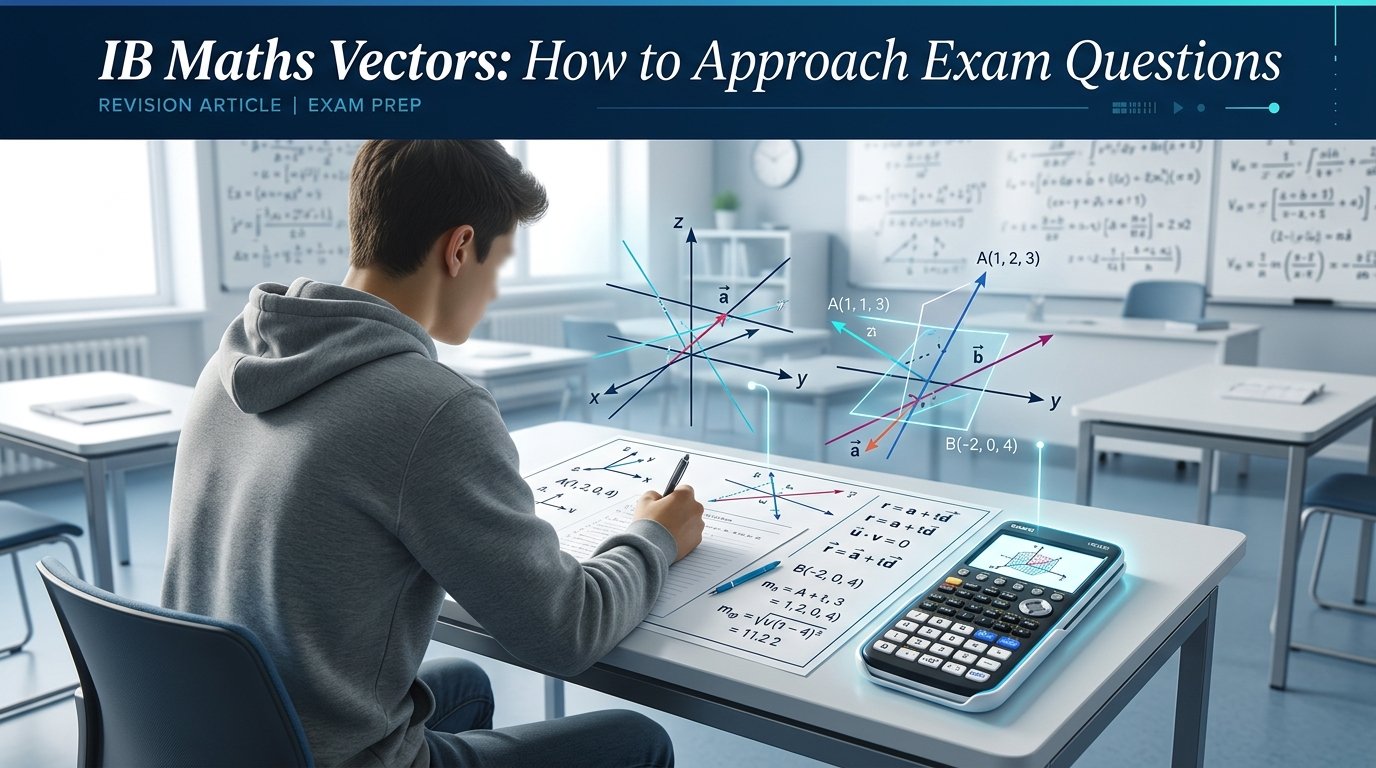
Vectors can be one of those IB Maths topics that seem straightforward when you first learn them but become much harder when several ideas appear in the same question.
You may know how to write a vector equation.
You may know how to calculate a magnitude.
You may even understand the geometry.
Yet an examination question can still feel difficult because you need to decide which vector method to use and what the result means.
The key is to stop treating vectors as a collection of formulas.
Instead, think about what the vectors are describing.
A good vector solution usually begins with identifying the objects involved, translating the information into vector form, and then using the appropriate relationship.
Table of Contents
Why IB Maths Vector Questions Can Be Difficult
The mathematics in a vector question is often not the only challenge.
You may be given points, lines, directions, parameters, angles, or geometric conditions.
The question may then ask you to determine an intersection, calculate a distance, find an angle, or show that two objects have a particular relationship.
This means you need to translate between geometry and algebra.
For example, a line in three dimensional space can be represented using a vector equation.
[
\mathbf r=\mathbf a+\lambda\mathbf b
]
Here, (\mathbf a) represents a position vector and (\mathbf b) represents a direction vector.
The parameter (\lambda) determines where you are on the line.
Once you understand what each part represents, many apparently complicated questions become much more manageable.
Start by Identifying What the Vector Represents
Before doing any calculation, ask:
What does this vector represent?
A position vector tells you where a point is relative to the origin.
A direction vector tells you the direction in which a line travels.
A displacement vector describes movement from one point to another.
For two points (A) and (B), the vector from (A) to (B) is:
[
\overrightarrow{AB}=\mathbf b-\mathbf a
]
where (\mathbf a) and (\mathbf b) are the position vectors of (A) and (B).
This simple interpretation is important because many vector questions depend on getting the direction correct.
Finding a Direction Vector
Suppose:
[
A=(2,1,4)
]
and
[
B=(7,3,10)
]
The direction from (A) to (B) is:
\begin{pmatrix}
2\
1\
4
\end{pmatrix}
]
Therefore:
\begin{pmatrix}
5\
2\
6
\end{pmatrix}
]
The order matters.
The vector from (B) to (A) would be:
[
\begin{pmatrix}
-5\
-2\
-6
\end{pmatrix}
]
Both vectors describe the same line direction in opposite senses, but you must use the direction that matches the question.
Understanding Vector Equations of Lines
A common form of a line equation is:
[
\mathbf r=\mathbf a+\lambda\mathbf b
]
You should be able to identify the three important components.
The vector (\mathbf a) gives a point on the line.
The vector (\mathbf b) gives the direction of the line.
The parameter (\lambda) allows you to move along the line.
For example:
[
\mathbf r=
\begin{pmatrix}
2\
1\
4
\end{pmatrix}
+
\lambda
\begin{pmatrix}
3\
2\
1
\end{pmatrix}
]
means that the line passes through the point ((2,1,4)) and has direction vector:
[
\begin{pmatrix}
3\
2\
1
\end{pmatrix}
]
Understanding this structure is more useful than simply memorising the equation.
How to Find the Intersection of Two Lines
Intersection questions are among the most important applications of vector equations.
Suppose two lines are:
[
\mathbf r=
\begin{pmatrix}
1\
2\
3
\end{pmatrix}
+
\lambda
\begin{pmatrix}
2\
1\
4
\end{pmatrix}
]
and
[
\mathbf r=
\begin{pmatrix}
7\
5\
15
\end{pmatrix}
+
\mu
\begin{pmatrix}
1\
0\
2
\end{pmatrix}
]
At the point of intersection, both equations describe exactly the same position.
Therefore, their corresponding coordinates must be equal.
Write the equations coordinate by coordinate.
For the first line:
[
x=1+2\lambda
]
[
y=2+\lambda
]
[
z=3+4\lambda
]
For the second line:
[
x=7+\mu
]
[
y=5
]
[
z=15+2\mu
]
You can now solve the resulting simultaneous equations.
The important idea is:
At an intersection, the two vector equations represent the same point.
That principle helps you reconstruct the method even if you forget the exact procedure.
Finding the Angle Between Two Vectors
Another important vector skill is calculating the angle between two vectors.
For vectors (\mathbf a) and (\mathbf b):
|\mathbf a||\mathbf b|\cos\theta
]
Therefore:
[
\cos\theta=
\frac{\mathbf a\cdot\mathbf b}
{|\mathbf a||\mathbf b|}
]
and:
[
\theta=
\cos^{-1}
\left(
\frac{\mathbf a\cdot\mathbf b}
{|\mathbf a||\mathbf b|}
\right)
]
The dot product is:
a_1b_1+a_2b_2+a_3b_3
]
Do not forget that the angle depends on the direction of the vectors.
If you reverse one vector, the direction changes and the resulting angle can change accordingly.
Recognising Perpendicular Vectors
If two non zero vectors are perpendicular, their dot product is zero.
Therefore:
[
\mathbf a\cdot\mathbf b=0
]
This can make some examination questions much easier.
If the question asks you to find an unknown parameter that makes two vectors perpendicular, form the dot product and set it equal to zero.
For example, if:
[
\mathbf a=
\begin{pmatrix}
2\
k\
3
\end{pmatrix}
]
and:
[
\mathbf b=
\begin{pmatrix}
4\
1\
-2
\end{pmatrix}
]
then perpendicularity requires:
[
(2)(4)+(k)(1)+(3)(-2)=0
]
which gives:
[
8+k-6=0
]
Therefore:
[
k=-2
]
The geometry tells you what condition to impose.
The algebra then finds the unknown.
Use Geometry to Guide the Algebra
One of the biggest mistakes in vector questions is performing algebra without understanding the geometry.
Before calculating, identify what the question is describing.
Is it asking about:
A point?
A line?
A direction?
An intersection?
An angle?
A perpendicular relationship?
A distance?
Once you identify the geometric relationship, the algebraic method becomes easier to choose.
This is particularly useful for unfamiliar questions.
Instead of asking, “Which formula do I remember?”, ask:
“What geometric relationship is the question describing?”
Common Mistakes in IB Maths Vectors
Reversing a Vector
Students often calculate (A) to (B) when the question requires (B) to (A).
Always check the direction.
Confusing Position and Direction Vectors
A position vector identifies a point.
A direction vector describes how a line travels.
They have different roles in a vector equation.
Forgetting the Parameter
A vector equation of a line needs a parameter to describe different points along that line.
Using the Wrong Angle
When calculating an angle between vectors, pay attention to their directions and interpret the resulting angle in the context of the question.
Relying Entirely on the Calculator
Your GDC can help with numerical calculations, but it does not replace the mathematical setup.
First establish the vector relationship.
Then use technology where appropriate.
How to Approach an Unfamiliar Vector Question
When a vector question looks difficult, use a structured process.
First, identify the objects involved.
Then write down the vectors you know.
Next, determine what the question is asking you to find.
Translate the geometric condition into a mathematical condition.
Carry out the algebra.
Finally, check whether the result makes sense geometrically.
For example, if you are asked to show that two lines are perpendicular, look for a dot product condition.
If you are asked to find where two lines intersect, look for a common point and equate their coordinates.
If you are asked for the angle between two directions, think about the dot product.
The wording of the question often provides the method.
How to Practice IB Maths Vectors Effectively
Do not practice vectors by completing ten questions that all use exactly the same method.
Instead, mix the question types.
Practise finding direction vectors.
Then practise line equations.
Then work on intersections.
Then practise angles and perpendicularity.
After that, combine several skills in one problem.
This trains you to recognise the mathematical structure rather than simply follow a memorised procedure.
After each question, review your working.
If your final answer was wrong, determine why.
Was the vector direction reversed?
Did you use the wrong point?
Did you make an algebraic error?
Did you misunderstand the geometric condition?
Did you enter the calculation incorrectly?
Understanding the reason for the mistake is more valuable than simply correcting the final number.
Turn Vector Mistakes Into a Revision Plan
If you repeatedly make the same vector mistake, record it.
For example:
Weakness: I confuse position vectors and direction vectors.
Evidence: I made this mistake in three practice questions.
Action: Review line equations and complete five mixed questions.
This turns mistakes into a specific revision task.
Instead of saying, “I need to revise vectors,” you now know exactly what needs improvement.
Mathzem can support this practice process by helping students work through IB Maths questions, review their performance, identify mistakes, and focus on areas that need more attention.
A Quick Vector Checklist
Before submitting a vector question, check:
Have I used the correct direction?
Have I identified the position vector correctly?
Have I identified the direction vector correctly?
Have I translated the geometric condition correctly?
Have I shown enough mathematical working?
Have I checked my numerical result?
Does my answer make sense geometrically?
These checks take very little time but can prevent avoidable errors.
Final Thoughts
IB Maths vectors become much easier when you stop treating them as a collection of separate formulas.
Think geometrically first.
Ask what each vector represents.
Identify the relationship in the question.
Then translate that relationship into algebra.
For intersections, think about a common point.
For perpendicularity, think about a zero dot product.
For angles, think about the dot product formula.
For lines, understand the role of the position vector, direction vector, and parameter.
The goal is not to memorise every possible vector question.
The goal is to recognise the mathematical structure hidden inside the question.
That is the skill that makes unfamiliar IB Maths vector problems much more manageable.
Frequently Asked Questions About IB Maths Vectors
Are vectors difficult in IB Maths?
Vectors can be challenging because questions often combine geometry with algebra. Once you understand what position vectors, direction vectors, and parameters represent, many questions become much more structured.
What is the most important vector formula to know?
There are several important relationships, but students should be particularly comfortable with vector equations of lines, magnitudes, dot products, and the formula for the angle between two vectors.
How do I find the direction vector between two points?
Subtract the coordinates of the starting point from the coordinates of the finishing point. For points (A) and (B), the vector from (A) to (B) is (\mathbf b-\mathbf a).
How do I know when to use the dot product?
The dot product is especially useful for questions involving angles and perpendicularity. If two nonzero vectors are perpendicular, their dot product is zero.
How should I revise IB Maths vectors?
Practise different types of vector questions rather than repeating one procedure. After each question, analyse your mistakes and identify the specific vector skill that needs more practice.