IB Math Exam Technique: How to Improve Your Marks
Knowing the mathematics is only part of doing well in an IB Math exam.
You can understand differentiation, probability, functions, statistics, calculus, and other parts of your course and still lose marks because you misread a question, choose an inefficient method, rush your work, round too early, or spend too much time on one difficult problem.
This is why exam technique matters.
Exam technique isn’t about finding tricks that replace mathematical understanding. It’s about making sure the mathematics you already know actually turns into marks when you’re working under exam conditions.
For many students, this becomes particularly important when they’re trying to move from a Grade 5 toward a Grade 6 or 7.
You may not need to learn an entirely new syllabus.
You may need to become more consistent at demonstrating what you already know.
Table of Contents
What Is IB Math Exam Technique?
IB Math exam technique refers to the practical skills you use while completing an examination.
It includes how you read questions, identify relevant information, choose a method, organise your working, use your calculator, manage your time, respond to unfamiliar problems, and check your answers.
These skills don’t replace mathematical knowledge.
They help you communicate and apply that knowledge effectively.
Imagine two students who understand the same mathematical concept.
The first student reads the question carefully, identifies what is required, sets up the correct method, shows the important steps, and checks the final result.
The second student recognises the topic but rushes into calculations, skips working, rounds intermediate values, and spends ten minutes stuck on one part.
They may have similar mathematical knowledge.
Their exam performance can still be very different.
Read the Question Before Choosing a Method
One of the most common exam mistakes is starting calculations too quickly.
Students see a familiar mathematical term and immediately begin using a formula.
Instead, read the complete question first.
Identify what information is provided.
Then identify exactly what the question asks you to find.
This matters because a single question can contain information that changes the appropriate method.
For example, in probability, words such as “given that” can change the structure of the problem.
In calculus, a question may require you to interpret a derivative rather than simply calculate it.
In statistics, the final calculation may not be the end of the task because you may need to interpret the result in context.
The first few seconds spent understanding the question can prevent several minutes of incorrect work.
Underline or Identify the Important Information
When a question contains a lot of text, separate the mathematical information from the surrounding context.
You don’t necessarily need to physically underline everything.
Instead, identify the quantities, conditions, variables, and requested result that matter.
Suppose a question describes a real world situation involving a function.
Ask yourself:
What quantities are changing?
What information has been given?
What variable am I working with?
What am I actually being asked to calculate?
Which mathematical relationship connects these pieces?
This turns a long word problem into a mathematical problem you can work with.
Don’t Assume You Need Every Piece of Information
Some exam questions include information that isn’t immediately required.
Don’t force every number into your calculation.
First determine what the question is asking.
If you need the gradient of a function at a particular point, you may not need every piece of information provided in the question.
If you’re calculating a probability, identify which events and conditions are relevant.
If you’re solving an optimisation problem, identify the quantity being maximised or minimised and the constraints.
Good exam technique includes knowing what information matters.
Write Down the First Useful Mathematical Step
When an unfamiliar question makes you feel stuck, don’t wait for the complete solution to appear in your head.
Look for the first useful step.
Write down a relevant formula.
Define a variable.
Draw a diagram.
Write the known values.
Set up an equation.
State a mathematical relationship.
This can turn a vague problem into something concrete.
For example, if you’re given a function and asked about its rate of change, writing f′(x)
may be the beginning of the correct approach.
If you’re dealing with a probability problem, identifying the relevant events can help you decide what relationship you need.
The first line doesn’t have to solve the problem.
It needs to move you toward the problem.
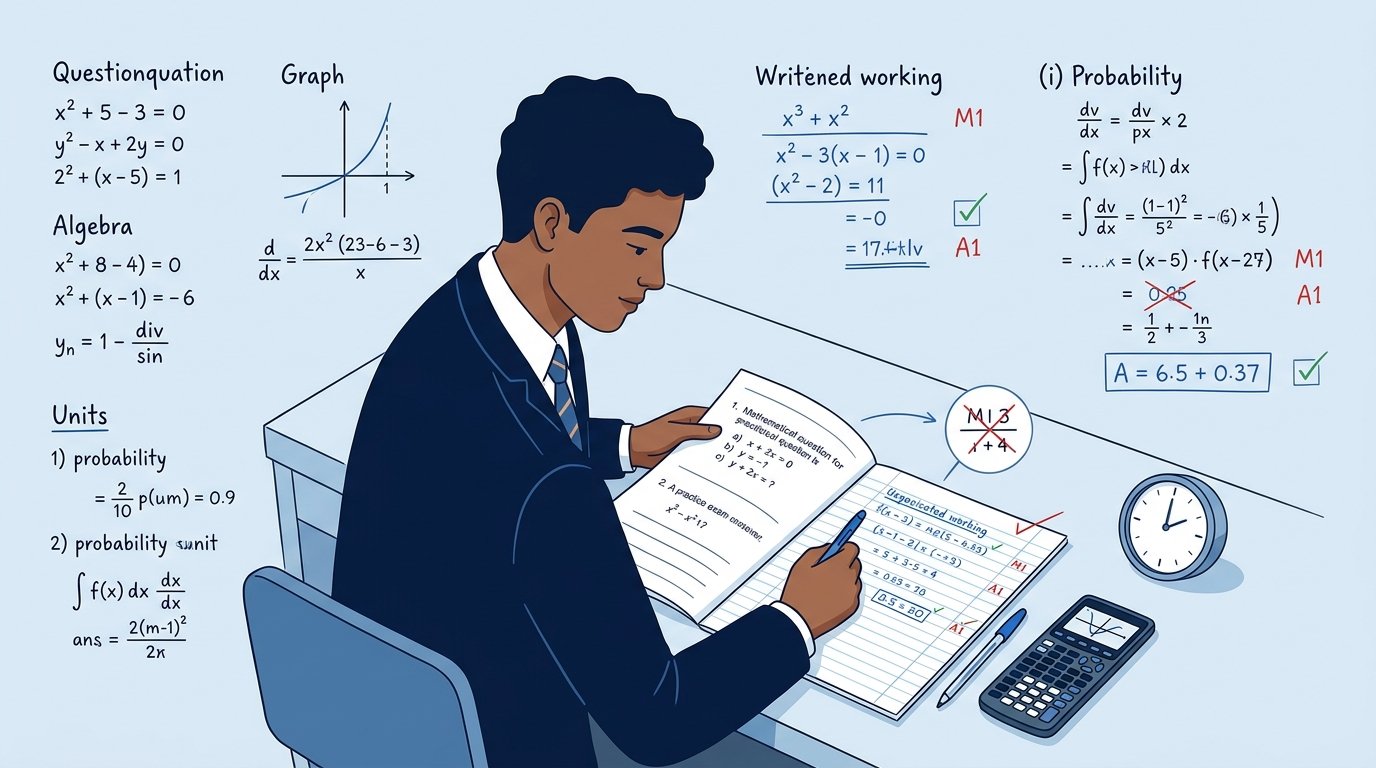
Show Your Working
Your working is evidence of your mathematical reasoning.
Even when you use a calculator, you should make the important mathematical steps visible.
Suppose you need to solve an equation numerically.
Don’t rely entirely on a calculator screen.
Show the equation you’re solving and indicate the values or method used.
This makes your solution easier to follow and gives you something to check.
It also helps distinguish a mathematical method error from a calculation error when you review your work later.
Don’t Turn Your Solution Into a Calculator Transcript
A calculator is a powerful tool in IB Math, but it shouldn’t replace mathematical communication.
Entering an expression and writing only the resulting number doesn’t always show how you reached the answer.
Your written solution should make the important reasoning clear.
For example, if you’re calculating a probability, identify the probability expression before giving the numerical result.
If you’re finding a derivative, show the derivative.
If you’re solving an equation, show the equation and the relevant transformations or numerical method.
The calculator performs calculations.
Your working should communicate the mathematics.
Avoid Early Rounding
Rounding too early can create unnecessary errors.
Suppose an intermediate calculation produces 3.746829…
and you immediately replace it with 3.75.
That rounded value is then used in several later calculations.
The final result can drift away from the expected answer.
Whenever possible, keep sufficient precision during intermediate calculations and round your final answer appropriately.
Your calculator can retain more precision than your written work needs to show.
This is particularly useful when several calculations are chained together.
Think About Whether Your Answer Makes Sense
Checking isn’t just about seeing whether the calculator gives an error message.
Ask whether the answer makes mathematical sense.
If you’re calculating a probability and obtain 1.7, something is wrong.
If you’re calculating a length and obtain a negative value when the context requires a physical distance, investigate.
If you’re finding a percentage and obtain an implausibly large result, check the calculation.
If you’re solving a real world problem and the result contradicts the conditions described, don’t automatically accept the calculator output.
Mathematical sense checking is a powerful final filter.
Pay Attention to Units
Units are easy to overlook.
If a question involves distance, time, area, volume, speed, or another measurable quantity, check whether the units matter.
A calculation can be numerically correct while the final response is incomplete because the required units aren’t included.
Also pay attention when the question uses different units.
For example, mixing hours and minutes or centimetres and metres without conversion can produce a numerically incorrect result even when the calculation itself looks reasonable.
Answer the Question That Was Asked
This sounds obvious, but it’s a common source of lost marks.
A question may involve several calculations but ultimately ask for one specific quantity.
You might correctly calculate an intermediate value and then stop.
Or you might calculate the derivative when the question actually asks for the gradient at a specific point.
Or you might calculate a probability but fail to interpret it in the context of the problem.
At the end of each part, reread the final sentence.
Ask:
Have I actually answered this question?
Don’t Ignore Interpretation
Some IB Math questions require more than a numerical answer.
You may need to explain what a value means in the context of the problem.
Suppose a calculation gives you a correlation coefficient.
The number itself isn’t always the complete response.
You may need to interpret the strength and direction of the relationship.
Similarly, if you’re solving an applied calculus problem, a derivative may represent a rate of change with a specific meaning.
The mathematics gives you the result.
Your conclusion explains what that result means.
Be Careful With “Show That” Questions
When a question asks you to show that a particular result is true, don’t simply write the result.
Your working should demonstrate how you arrive at it.
Start from the relevant expression or given information and show the mathematical steps leading to the required result.
This is another reason why working matters.
The examiner needs to see the mathematical reasoning rather than just the destination.
What to Do When You Don’t Know the Answer
Getting stuck doesn’t mean you should immediately leave the question blank.
First, identify what you do know.
Write down the relevant information.
Define variables.
Record a formula you think may apply.
Try a reasonable approach.
Even if you don’t reach the final answer, meaningful working can demonstrate mathematical progress.
More importantly, the attempt may help you recognise the next step.
If you’re still stuck after a reasonable attempt, move on and return later.
Don’t Let One Difficult Question Control Your Exam
This is one of the most important time management skills.
You may encounter a question that seems unusually difficult.
You try one method.
Then another.
Five minutes pass.
Then ten.
Meanwhile, other questions remain unanswered.
This can create a much bigger problem than the original difficult question.
If you’re making no progress, mark the question mentally and move forward.
You can return later with a fresh perspective.
Sometimes another question reminds you of a relevant technique.
Sometimes simply taking a break from the problem makes the structure clearer.
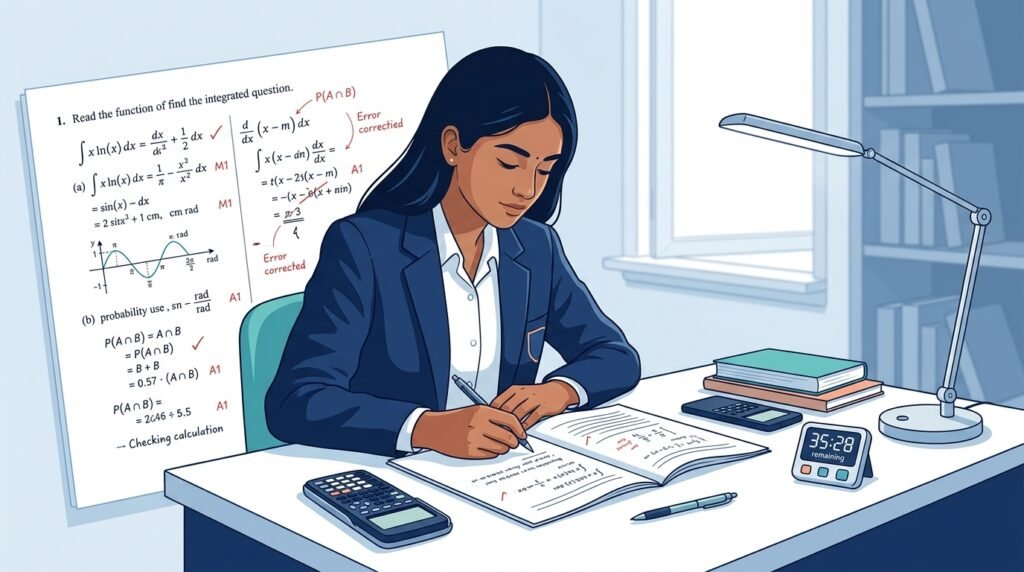
Manage Your Time Across the Paper
Time management isn’t simply about working quickly.
It’s about allocating your time sensibly.
If a question is worth relatively few marks, spending a disproportionate amount of time on it may not be sensible.
Likewise, you don’t want to spend most of your remaining time checking one question while leaving other questions incomplete.
Your exact strategy will depend on the structure and timing of your particular IB Math examination.
The important principle is to remain aware of your progress through the paper.
Practise Time Management Before the Exam
Time management shouldn’t be something you discover on exam day.
Use timed practice before the exam.
Start with smaller sets of questions.
Then practise larger sections.
Eventually, complete full papers under realistic conditions.
Afterward, analyse where your time went.
Did you spend too long on unfamiliar questions?
Did you rush the final section?
Did you spend too much time checking?
Did you lose time because your calculator work was inefficient?
Your timing problems can become another category of mistake to address.
Use Past Papers as More Than Practice
Past papers are valuable because they let you practise mathematics in an examination context.
But don’t simply complete one paper after another.
Analyse them.
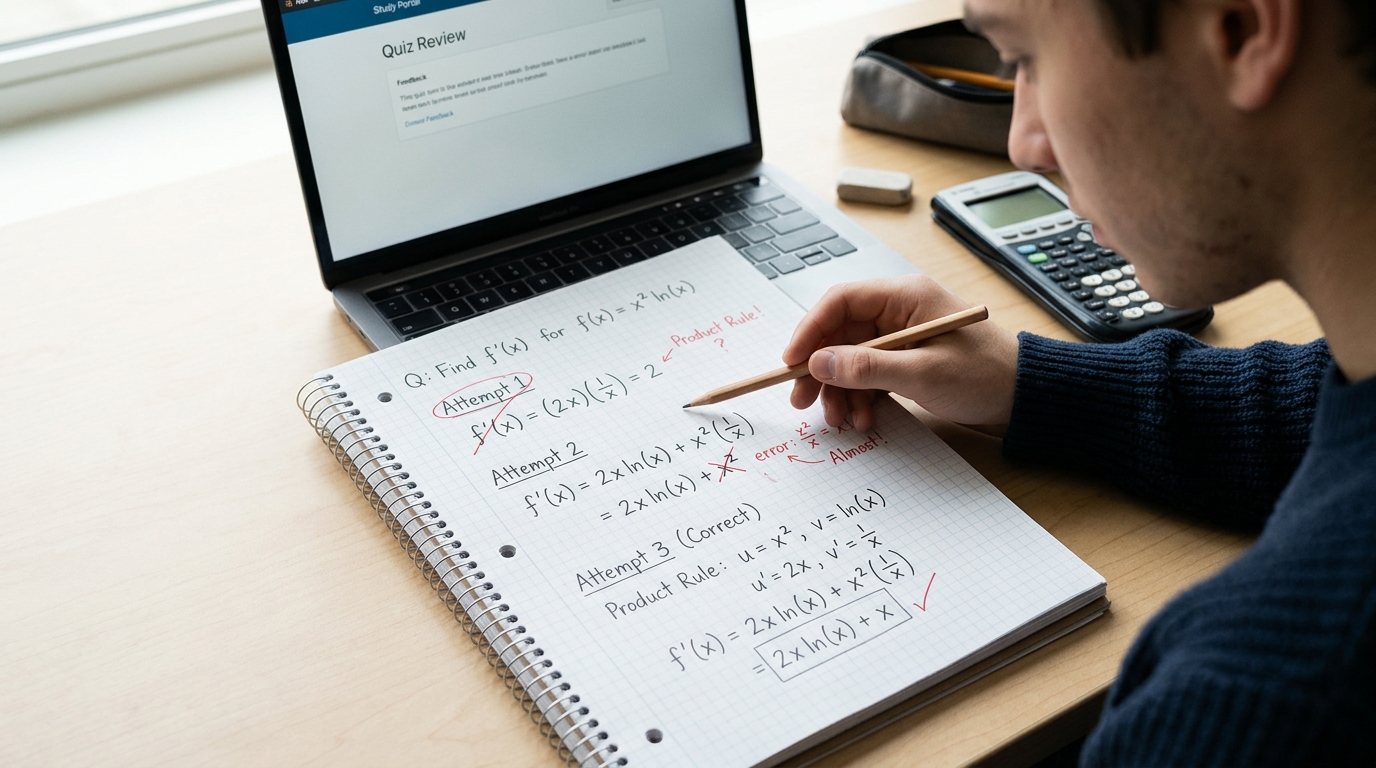
After finishing a paper, review every question where you lost marks.
Determine whether the problem was mathematical knowledge, method selection, calculation accuracy, interpretation, communication, or time management.
Then use that information to guide your next revision session.
A past paper should tell you what to practice next.
Practice Unfamiliar Questions
Exam technique isn’t developed only by repeating familiar question types.
You need to practice situations where the method isn’t obvious.
This forces you to ask:
What topic is this?
What mathematical relationship might apply?
What information matters?
What should I calculate first?
What assumptions am I making?
This type of practice develops mathematical decision making.
It’s also one of the best ways to identify whether you genuinely understand a concept or simply recognise a familiar question pattern.
Review Your Working After Practice
Don’t wait until the final exam to discover that you repeatedly make the same mistakes.
After completing practice questions, review your working.
Look for repeated patterns.
Maybe you often omit steps.
Maybe you use inconsistent notation.
Maybe you round too early.
Maybe you struggle to interpret the final answer.
Maybe you repeatedly choose the wrong method when a question is unfamiliar.
These patterns should become part of your revision plan.
Create an Exam Mistake Checklist
As you complete practice papers, create a short personal checklist based on your actual mistakes.
Your checklist might include things such as:
Check signs.
Keep full calculator precision.
Include units.
Show important working.
Read the final sentence again.
Interpret the answer.
Check whether the result is reasonable.
Don’t spend too long on one question.
The checklist should be personal.
If you never forget units, you don’t need to spend mental energy reminding yourself about them.
If you repeatedly round too early, that should be a priority.
Exam Technique Should Be Practised Alongside Mathematics
Don’t separate exam technique completely from mathematical practice.
When solving ordinary revision questions, occasionally practise reading carefully, showing complete working, checking units, and interpreting answers.
When you complete timed questions, analyse not only whether you got them right but how you approached them.
This turns exam technique into a habit rather than something you try to remember under pressure.
A Practical IB Math Exam Workflow
A simple workflow can help you stay organised.
Read the question carefully.
Identify what is given and what is required.
Determine the mathematical topic or relationship involved.
Write the first useful step.
Work through the mathematics clearly.
Use your calculator carefully.
Keep sufficient precision.
Check whether the result makes sense.
Answer the exact question.
Include the appropriate interpretation or units.
Then move on.
This process becomes faster with practice.
How Feedback Can Improve Exam Technique
You may know that you made mistakes, but still struggle to identify why.
This is where detailed feedback can be useful.
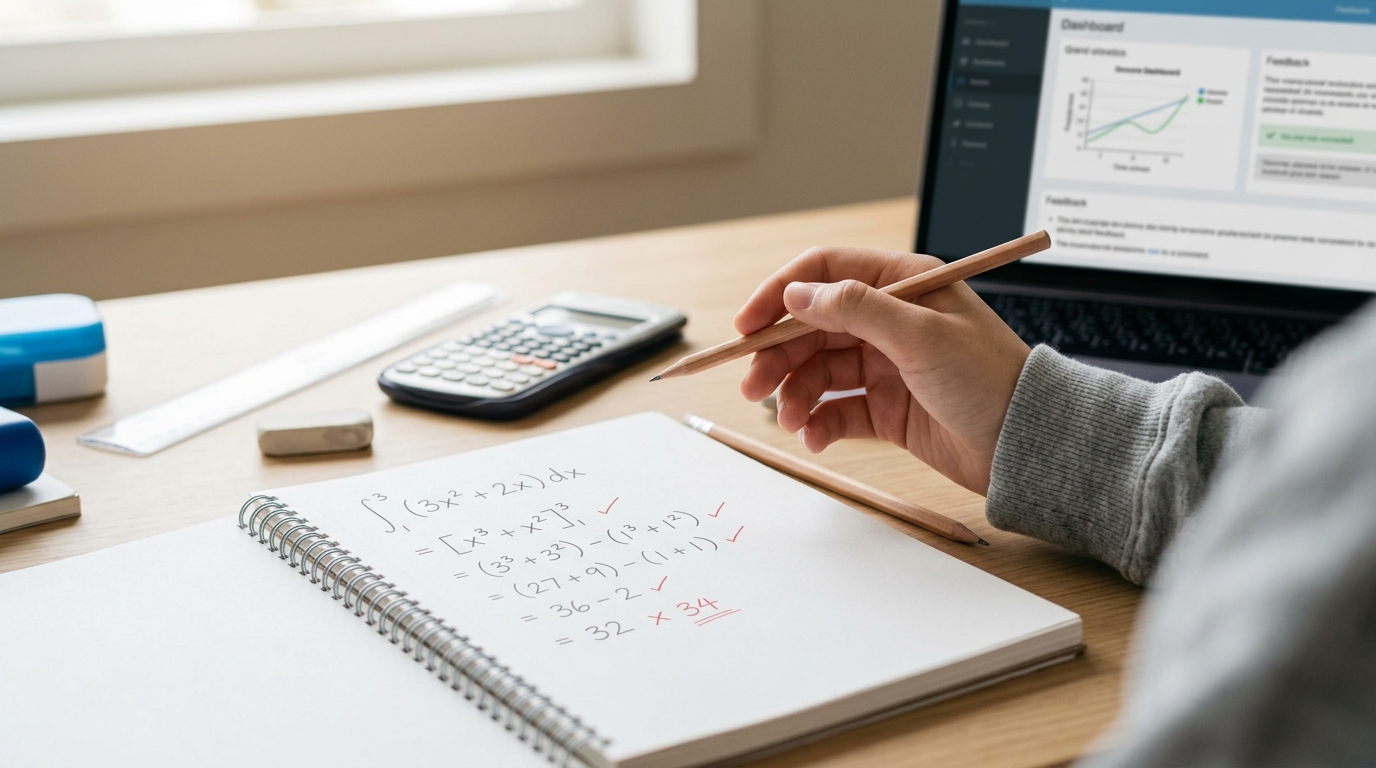
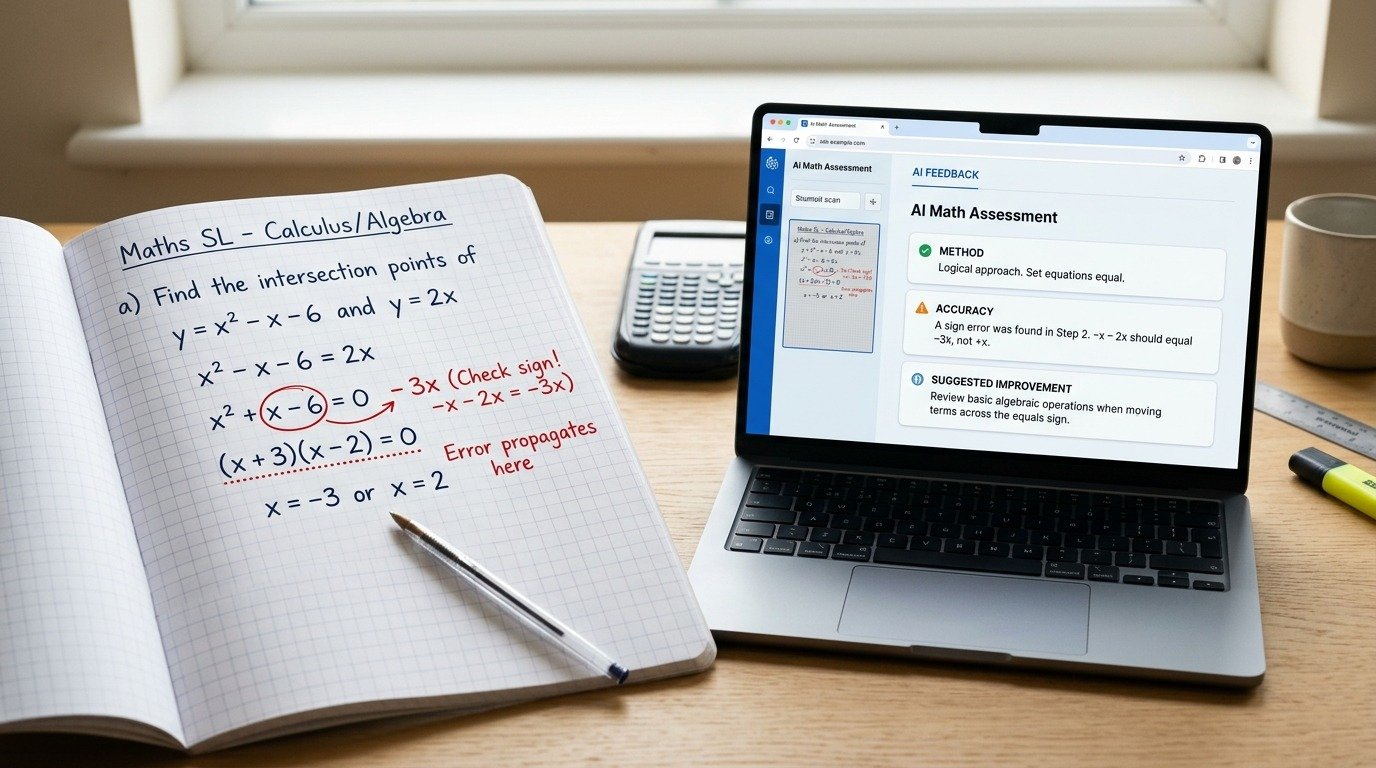
Suppose you repeatedly receive the correct numerical answer but your working is incomplete.
A simple answer checker may tell you that you’re right.
Examiner style feedback can instead draw attention to the quality of your mathematical communication.
Likewise, if you consistently choose an incorrect method but perform the calculations accurately, you need different feedback.
The problem isn’t arithmetic.
It’s method selection.
Mathzem’s IB Math Practice is designed around reviewing student working rather than focusing only on the final answer. Students can practise questions, upload their solutions, receive examiner style feedback, identify mistakes and weak areas, and use those results to guide future practice.
This connects exam technique with revision.
You’re not simply asking, “Did I get this question right?”
You’re asking, “What does my solution tell me about how I perform under exam conditions?”
Use Your Mistakes to Build a Better Revision Plan
Your exam technique will improve faster when you connect mistakes to specific actions.
If you lose marks because you don’t understand concepts, revise the mathematics.
If you choose the wrong method, practise mixed and unfamiliar questions.
If you make algebra mistakes, target algebra accuracy.
If you skip working, deliberately practise writing complete solutions.
If you run out of time, use timed practice.
If you don’t interpret answers, practise applied questions with written conclusions.
This is much more effective than simply deciding that you need to “be more careful.”
What Strong Exam Technique Looks Like
Strong exam technique doesn’t mean never getting stuck.
It means knowing what to do when you get stuck.
It doesn’t mean never making calculation errors.
It means catching avoidable errors when you check.
It doesn’t mean instantly recognising every unfamiliar problem.
It means having a process for breaking unfamiliar problems down.
It doesn’t mean writing pages of explanation.
It means making the important mathematics clear.
And it doesn’t mean rushing through every question.
It means using your time deliberately.
FAQs About IB Math Exam Technique
Is IB Math exam technique really important for getting a 7?
Yes, but exam technique cannot replace mathematical understanding. Once your mathematical knowledge is strong, improving how you apply, communicate, check, and manage that knowledge can help reduce avoidable lost marks.
How can I stop losing easy marks in IB Math?
Analyse your practice papers and identify why those marks are disappearing. Common causes include calculation errors, incomplete working, misreading questions, missing units, early rounding, and failing to answer the exact question.
Should I show all my working in IB Math?
You should show the important mathematical steps that demonstrate your method and reasoning. Avoid relying entirely on calculator outputs, particularly when the method itself is relevant to the solution.
What should I do when I get stuck on an IB Math question?
Identify what you know, write down relevant information, consider the mathematical relationships involved, and attempt a useful first step. If you’re making no progress after a reasonable attempt, move on and return later.
How can I improve my IB Math time management?
Practise under timed conditions and review where your time is being spent. Pay particular attention to questions where you spend a long time without making progress.
Should I use past papers for exam technique?
Yes. Past papers allow you to practise mathematical knowledge, question interpretation, timing, calculator use, and written communication in a realistic examination setting.
Conclusion
Good IB Math exam technique isn’t about finding shortcuts.
It’s about removing unnecessary barriers between what you know and the marks you can earn.
Read questions carefully.
Understand what you’re being asked.
Choose your method deliberately.
Show meaningful working.
Use your calculator carefully.
Avoid unnecessary early rounding.
Check whether your answer makes sense.
Interpret results when required.
Manage your time.
And most importantly, learn from the mistakes you make during practice.
If you repeatedly lose marks for the same reason, don’t simply tell yourself to “be careful next time.”
Identify the behaviour causing the mistake and practise changing it.
Over time, these small improvements can make your exam performance more consistent.
The aim isn’t to make every exam question easy. It’s to make sure that when you know the mathematics, your exam technique allows you to show it.
Quick Takeaway
The best exam technique is a repeatable process:
Read carefully → identify the task → choose the method → show the working → calculate accurately → check the result → answer the question.
Practise that process before exam day, and it becomes much easier to use when the pressure is on.