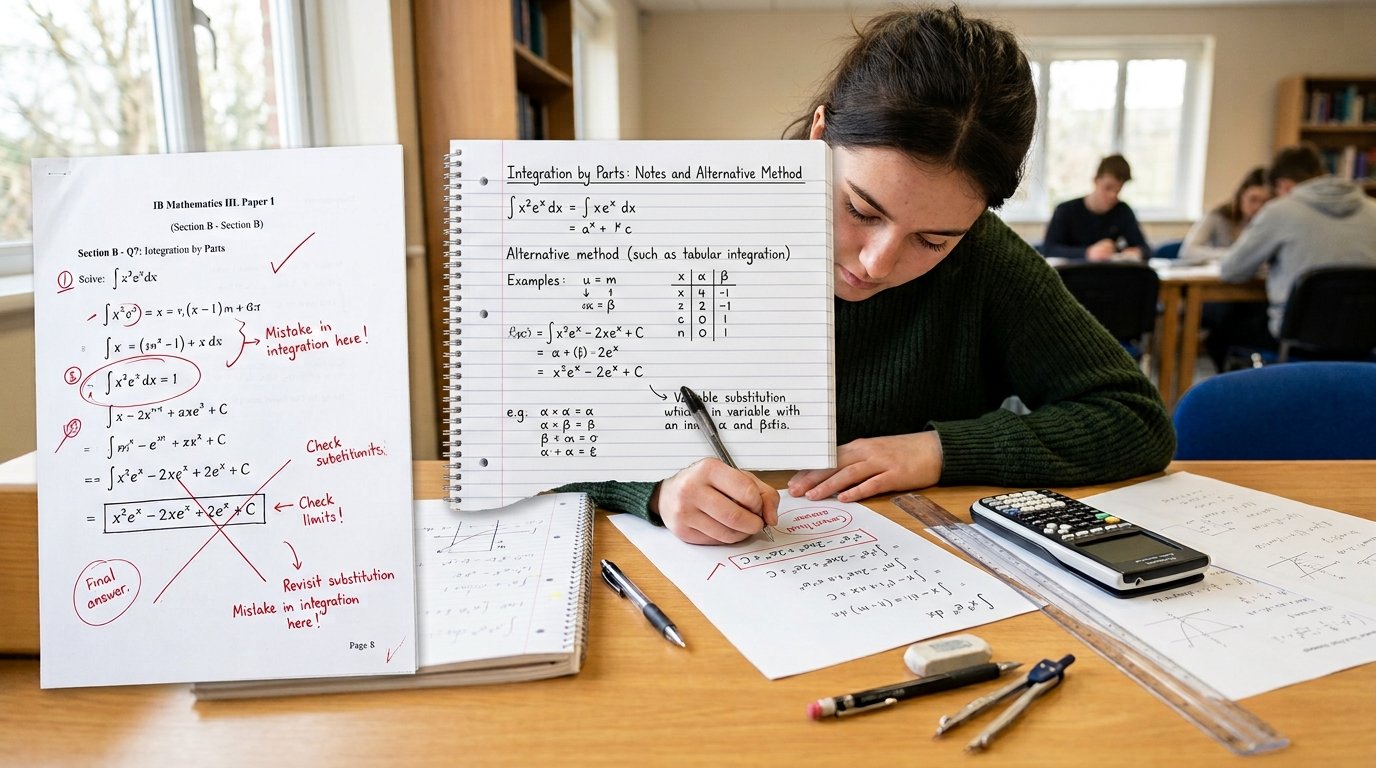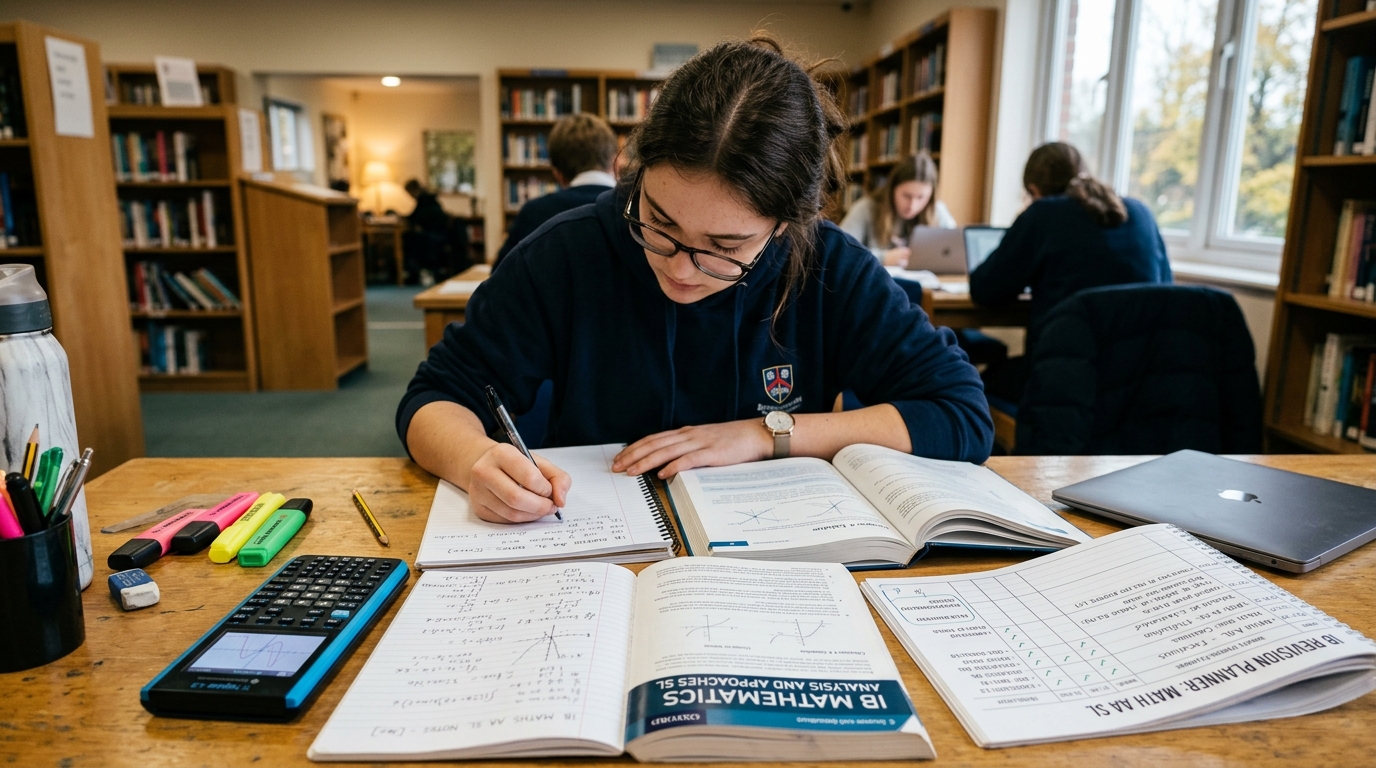
Choosing the right mathematics course is an important decision for every IB Diploma Programme student. If you enjoy algebra, functions, calculus, and logical problem solving but don’t need the additional depth of Higher Level mathematics, IB Maths AA SL could be the ideal choice.
This guide explains everything you need to know about IB Maths AA SL, including the syllabus, assessment structure, study strategies, common challenges, and practical tips for success.
Whether you’re deciding between IB Maths courses or preparing for your exams, this article will help you understand what to expect.
Table of Contents
What Is IB Maths AA SL?
IB Maths Analysis and Approaches Standard Level focuses on developing analytical thinking, mathematical reasoning, and problem solving skills.
The course explores mathematical concepts through algebraic methods rather than real world modelling. Students learn how to solve problems logically, communicate mathematical ideas clearly, and apply mathematics to unfamiliar situations.
Key areas include:
- Algebra
- Functions
- Trigonometry
- Statistics
- Probability
- Calculus
The course provides an excellent mathematical foundation for many university programs.
Who Should Choose IB Maths AA SL?

IB Maths AA SL is a good choice for students who:
- Enjoy mathematics
- Like solving logical problems
- Have strong algebra skills
- Plan to study science, business, economics, psychology, or similar subjects
- Want a balanced mathematics course without the additional depth of Higher Level
If you enjoy mathematical theory and plan to study mathematics, engineering, or physics at university, AA HL may be a better fit. If you prefer mathematical modelling and technology, AI SL or AI HL might suit your interests.
What Will You Learn?
Throughout the course, students develop both procedural skills and conceptual understanding.
You’ll learn how to:
- Solve equations
- Analyse graphs
- Apply calculus
- Interpret statistical information
- Communicate mathematical reasoning
- Solve unfamiliar problems
Rather than memorising procedures, you’ll learn how different mathematical concepts connect.
IB Maths AA SL Syllabus Overview
The syllabus is divided into five main areas.
Number and Algebra
Students study:
- Exponents
- Logarithms
- Sequences
- Financial mathematics
- Algebraic manipulation
Strong algebra skills support every other topic in the course.
Functions
Topics include:
- Linear functions
- Quadratic functions
- Polynomial functions
- Exponential functions
- Logarithmic functions
- Composite functions
- Inverse functions
- Graph transformations
Functions also provide the foundation for calculus.
Geometry and Trigonometry
Students learn:
- Trigonometric functions
- Radians
- Trigonometric equations
- Coordinate geometry
Questions often combine graphical interpretation with algebraic reasoning.
Statistics and Probability
Students explore:
- Data analysis
- Probability
- Probability distributions
- Statistical measures
- Correlation
Calculator skills are especially important in this topic.
Calculus
Calculus introduces students to:
- Limits
- Differentiation
- Integration
- Applications of calculus
Although the content is less extensive than AA HL, calculus remains one of the most important areas of the course.
Assessment Structure
IB Maths AA SL is assessed through external examinations and an Internal Assessment.
| Assessment | Weight |
|---|---|
| Paper 1 | 40% |
| Paper 2 | 40% |
| Internal Assessment | 20% |
Each assessment measures mathematical understanding, communication, and problem solving skills.
Internal Assessment
The Internal Assessment is an individual mathematical exploration.
Students investigate a mathematical topic of interest while demonstrating:
- Personal engagement
- Mathematical communication
- Reflection
- Use of appropriate mathematics
Choosing a topic that genuinely interests you often leads to a stronger exploration.
Is IB Maths AA SL Difficult?
AA SL is challenging, but it is more manageable than AA HL because it covers fewer advanced topics.
Students usually find the course manageable if they:
- Attend lessons consistently
- Practise regularly
- Strengthen algebra skills
- Review mistakes
- Complete IB style questions
Like all mathematics courses, steady progress is more effective than last minute revision.
Common Challenges
Students often struggle with:
- Algebra mistakes
- Graph interpretation
- Calculus applications
- Probability questions
- Time management during exams
Recognising these challenges early makes them much easier to overcome.
Study Tips for Success
A successful revision strategy includes several key habits.
Practise Every Week
Short, consistent study sessions are usually more effective than occasional long revision sessions.
Review Your Mistakes
Don’t simply check whether your answer is correct.
Instead, ask:
- Why did I lose marks?
- Which concept do I need to review?
- Could I communicate my method more clearly?
Complete Past Papers
Past papers help you become familiar with:
- IB question styles
- Mark schemes
- Time management
- Common question types
Review every mistake before attempting another paper.
Strengthen Weak Topics
Spend more time on the topics that challenge you rather than repeatedly solving questions you already understand.
Useful Resources
Helpful resources include:
- Class notes
- Revision textbooks
- Official Formula Booklet
- Past papers
- Video lessons
- Topic based practice questions
Using a combination of resources provides a more balanced learning experience.
How Mathzem Helps AA SL Students
Many students complete practice questions without fully understanding why they lose marks.
Mathzem helps students learn more effectively by providing AI examiner style feedback after every practice question.
Upload your working and receive feedback on:
- Marks awarded
- Missing method marks
- Mathematical errors
- Weak syllabus topics
- Suggested next steps
Your personalised dashboard also helps you:
- Identify strong and weak topics
- Build a personalised revision plan
- Keep a mistake journal
- Track progress across the syllabus
This allows you to focus your revision where it matters most.
Frequently Asked Questions About IB Maths AA SL
Is IB Maths AA SL enough for university?
Many university courses accept AA SL, but requirements vary. Always check the entry requirements for your chosen programme.
Is AA SL harder than AI SL?
AA SL focuses more on algebra, calculus, and analytical reasoning, while AI SL places greater emphasis on mathematical modelling and practical applications.
How many hours should I study each week?
Most students benefit from several hours of independent practice each week, increasing their revision time as exams approach.
Can I achieve a 7 in AA SL?
Yes. Students who understand concepts, practise consistently, and learn from their mistakes can achieve the highest grade.
Conclusion
IB Maths AA SL provides an excellent balance of mathematical theory and practical problem solving. It prepares students for a wide range of university courses while developing analytical thinking and logical reasoning.
Success comes from consistent practice, understanding concepts, and learning from every mistake.
If you’d like to identify your strongest and weakest topics before planning your revision, start with the Math Skill Scanner:
Then upload your IB Maths solutions to Mathzem IB Practice and receive AI examiner style feedback, personalised revision recommendations, and a student dashboard designed to help you improve throughout the course: