Introduction
Mathzem vs IB Math question bank websites have become one of the most popular revision resources for IB Math students.
They provide access to large collections of exam style questions organised by topic, making it easier to practise before assessments.
For many students, question banks are an important part of revision.
However, solving more questions does not always lead to better results.
Many students complete hundreds of questions but continue making the same mistakes because they receive very little feedback beyond the final answer or markscheme.
This raises an important question.
Is practising more questions enough, or should every question also help you improve?
This article explains what traditional question bank websites do well, where they have limitations, and how Mathzem takes a different approach by combining practice with AI examiner-style feedback and personalised revision tools.
Table of Contents
What Is an IB Math Question Bank?
A question bank is a collection of mathematics questions organized by:
- Topic
- Difficulty
- Examination paper
- Question type
Students commonly use question banks to:
- Revise individual topics
- Prepare for mock exams
- Practise under timed conditions
- Become familiar with IB exam questions
Question banks are valuable because they provide opportunities to apply mathematical concepts instead of only reading notes.
The Benefits of Traditional Question Banks
Question banks remain an excellent revision resource for many reasons.
Large Collection of Questions
Students can access many different question types across the IB syllabus.
Topic-Based Practice
Students can focus on individual areas such as:
- Calculus
- Functions
- Statistics
- Probability
- Vectors
- Complex Numbers
Exam Familiarity
Regular exposure to exam style questions helps students become more comfortable with IB assessment formats.
These are all important parts of effective revision.
Where Traditional Question Banks Can Fall Short
Although question banks provide valuable practice, they often leave students with unanswered questions.
After finishing a question, students may only receive the following:
- The correct answer
- A markscheme
- A worked solution
These resources explain how a question can be solved, but they do not always explain how the student’s own solution compares.
Students are often left wondering the following:
- Which step caused me to lose marks?
- Was my mathematical method correct?
- Did I lose method marks or only accuracy marks?
- Am I repeating the same mistake?
- Which topic should I revise next?
Without answers to these questions, revision can become less effective.
Practice Alone Does Not Always Lead to Improvement
Imagine two students.
Student A completes 300 practice questions but rarely reviews mistakes.
Student B completes 150 questions, carefully analyses every mistake, and adjusts their revision plan after each practice session.
Most teachers would expect Student B to improve more consistently because learning comes from reflection as well as repetition.
Practice creates opportunities.
Feedback creates improvement.
How Mathzem Takes a Different Approach
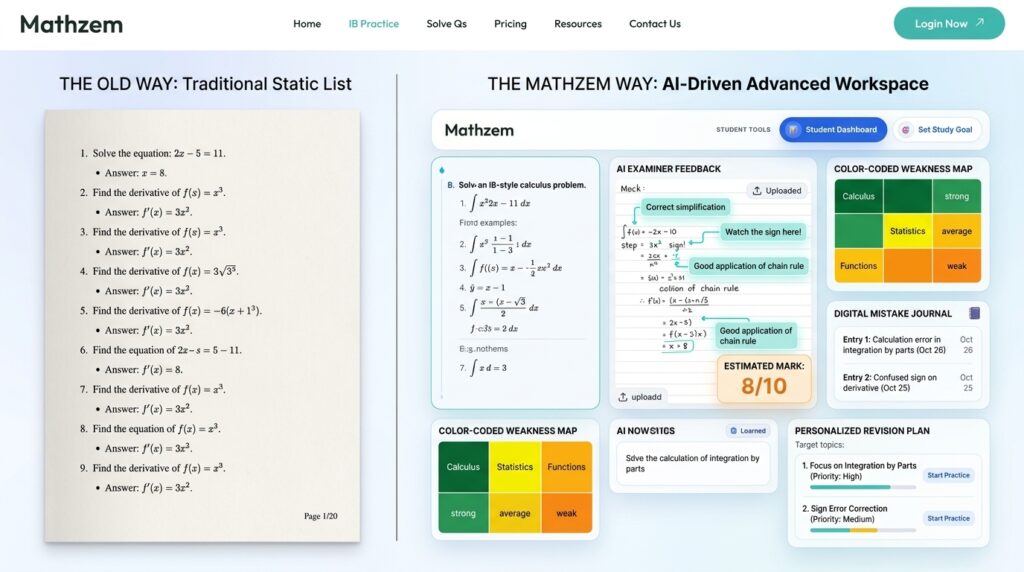
Mathzem includes IB-style practice questions, but the learning process does not end after answering them.
Instead, every completed question becomes part of a continuous improvement cycle.
The platform follows a simple workflow.
Practise
Students attempt IB style mathematics questions independently.
Upload
Students upload their complete working rather than only checking the final answer.
Review
The platform analyses the solution using AI examiner style feedback.
Improve
Students receive personalised recommendations for future revision.
This process helps transform practice into meaningful learning.
AI Examiner Feedback Instead of Answer Checking
One of the biggest differences between Mathzem and many traditional question bank websites is the type of feedback students receive.
Rather than only comparing answers, Mathzem analyses the student’s complete solution.
Students can review:
- Estimated marks
- Method marks
- Algebra mistakes
- Missing working
- Mathematical communication
- Next step recommendations
This helps students understand why marks were lost, not simply whether an answer was correct.
A Weakness Map Instead of Guesswork
Many students decide what to revise based on what feels difficult.
Unfortunately, feelings do not always match performance.
Mathzem automatically builds a Weakness Map as students complete more questions.
The dashboard highlights:
- Strong topics
- Developing topics
- Weak topics
- Areas where marks are consistently lost
Instead of revising everything equally, students can focus on topics that need the most attention.
Learning From Mistakes With the Mistake Journal
Traditional question banks often treat mistakes as isolated events.
Once students move to the next question, earlier mistakes are easily forgotten.
Mathzem’s Mistake Journal helps students identify recurring errors such as:
- Algebra mistakes
- Incorrect notation
- Calculator errors
- Probability misconceptions
- Lost method marks
This creates a long term record that supports more effective revision.
From Practice Questions to a Personal Revision Plan
Completing questions is only the first step.
Mathzem helps students use performance data to build a personalised revision plan.
Instead of asking:
“What topic should I revise today?”
Students can answer:
- Which topic costs me the most marks?
- Which mistakes occur most often?
- Which skills have improved?
- What should I practice next?
This makes revision more focused and efficient.
Which Resource Is Right for You?
Traditional question banks are useful if your goal is to access a large collection of practice questions.
Mathzem is designed for students who also want to understand their performance, identify weaknesses, and receive guidance on what to improve next.
Many students may even benefit from using both approaches as part of a balanced revision strategy.
The important point is that practice becomes more valuable when it is supported by meaningful feedback.
Conclusion
Question banks remain an important resource for IB Math revision because they provide opportunities to practise exam style questions.
However, answering more questions is only one part of effective learning.
Students also need to understand why marks are lost, identify recurring mistakes, and focus revision on areas that will have the greatest impact.
Mathzem builds on traditional practice by combining IB style questions with AI examiner feedback, Weakness Maps, Mistake Journals, and personalised revision recommendations.
The result is a learning process that helps students move beyond simply answering questions and towards continuous improvement.
Start Improving With Mathzem
Discover your strongest and weakest IB Math topics
Practice IB-style questions and upload your working
Receive AI examiner feedback and build a personalized revision plan.
FAQ About Mathzem vs IB Math Question
Are question bank websites useful for IB Math revision?
Yes. They provide topic based practice and help students become familiar with exam style questions.
What is the biggest limitation of traditional question banks?
Most provide answers and mark schemes but offer limited personalised feedback on a student’s own working and mistakes.
How is Mathzem different from a question bank?
Mathzem combines IB style practice questions with AI examiner feedback, estimated marks, a Weakness Map, a Mistake Journal, and personalised revision recommendations.
Should I stop using question banks?
Not necessarily. Question banks are valuable for practice. Adding detailed feedback and performance tracking can make that practice more effective.
How does Mathzem help students improve?
Mathzem helps students practise IB style questions, upload their working, receive AI examiner style feedback, identify recurring mistakes, track strong and weak topics, and create personalised revision plans.