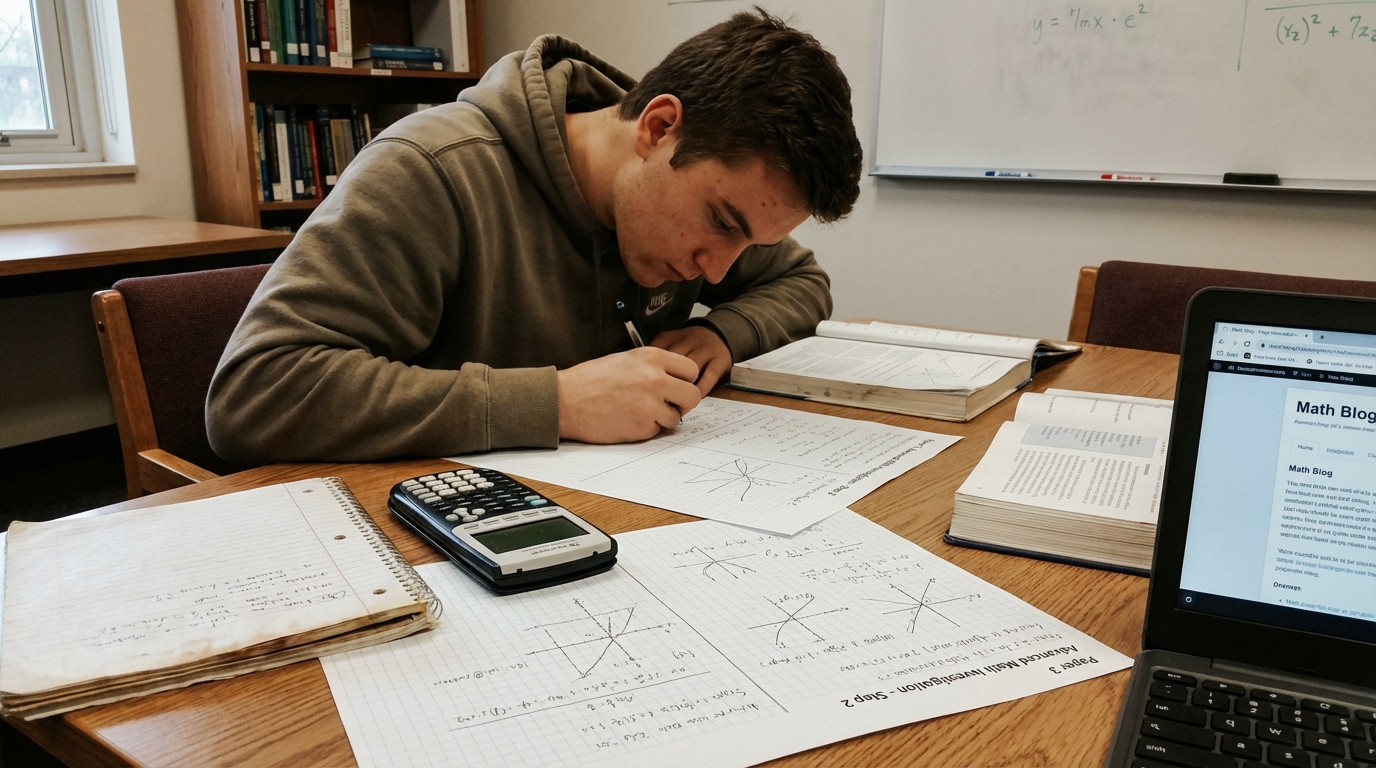
IB Math AA HL Paper 3 is different from other exam papers.
It is not just about solving questions.
It tests how well you can explore, model, and think mathematically.
Many students find Paper 3 challenging because it requires:
- Deeper understanding
- Logical reasoning
- Clear communication
The good news is that with the right strategy, you can approach it with confidence.
What Is Paper 3?
Paper 3 is an investigation-based exam for HL students.
You are given a problem or scenario and asked to:
- Explore patterns
- Develop mathematical models
- Justify your reasoning
- Interpret results
It often feels similar to a mini Internal Assessment (IA), but under timed conditions.
Key Skills Tested in Paper 3
Paper 3 focuses on:
- Problem-solving and reasoning
- Mathematical communication
- Modeling and generalization
- Interpreting results
It is less about memorization and more about thinking clearly.
Step-by-Step Strategy for Paper 3
1. Read the Problem Carefully
Start by understanding the situation fully.
Identify:
- What is given
- What needs to be found
- Any patterns or relationships
Don’t rush into calculations.
2. Break the Problem Into Parts
Paper 3 questions are usually structured in steps.
Each part builds on the previous one.
Focus on:
- Solving one part at a time
- Using earlier results in later steps
This makes the problem more manageable.
3. Look for Patterns
Many investigation questions involve identifying patterns.
For example:
- Sequences
- Function behavior
- Geometric relationships
Recognizing patterns helps you form general rules.
4. Show Clear Reasoning
Examiners want to see your thinking.
Make sure you:
- Explain your steps
- Justify formulas used
- Write logical conclusions
Clear communication can earn valuable marks.
5. Use Algebra Effectively
Algebra is essential in Paper 3.
You may need to:
- Form equations
- Generalize patterns
- Simplify expressions
Strong algebra skills make investigations easier.
6. Interpret Your Results
Always connect your answer back to the problem.
Explain:
- What your result means
- Whether it makes sense
- Any limitations
Interpretation is a key part of Paper 3.
Common Paper 3 Mistakes
Students often struggle because they:
- Rush without understanding the problem
- Skip explanations
- Focus only on calculations
- Panic when questions look unfamiliar
Remember, Paper 3 is designed to test thinking, not memorization.
How to Practice for Paper 3
Use Past Papers
Practice real Paper 3 questions to understand the format.
Focus on Understanding, Not Speed
Unlike other papers, depth of thinking matters more than speed.
Practice Explaining Solutions
Write full explanations, not just answers.
Strengthen Algebra Skills
Many investigation problems rely on algebraic reasoning.
Time Management Tips
Paper 3 is timed, so managing your time is important.
- Don’t spend too long on one part
- Move forward if stuck and return later
- Keep your working organized
Staying calm helps you think more clearly.
Need Help Preparing for IB Math HL?
If you want structured support for IB Math AA HL, our membership includes:
- Paper 3 strategy guides
- Step-by-step past paper solutions
- IA support and topic guidance
- Structured revision plans
Explore everything here:
https://mathzem.com/membership-pricing/
Having a clear approach can make Paper 3 much easier to handle.
Frequently Asked Questions About IB Math AA HL
1. Is Paper 3 difficult in IB Math AA HL?
It can be challenging because it tests reasoning and problem-solving rather than routine methods.
2. How is Paper 3 different from other papers?
It focuses on investigations, patterns, and explanations rather than standard questions.
3. Do I need to memorize formulas for Paper 3?
No. Understanding concepts and applying them logically is more important.
4. How can I improve in Paper 3?
Practice past papers, focus on reasoning, and work on explaining your solutions clearly.
5. Is Paper 3 similar to the IA?
Yes, it has similarities in terms of exploration and explanation, but it is done under exam conditions.
Conclusion
IB Math AA HL Paper 3 is less about memorizing methods and more about thinking mathematically. By focusing on understanding the problem, identifying patterns, and clearly explaining your reasoning, you can approach investigation questions with confidence.
Consistent practice and strong algebra skills will help you perform better and reduce uncertainty during the exam.