Statistics and probability are central topics in IB Math AI Statistics and Probability (Applications and Interpretation).
Unlike the Analysis and Approaches course, AI places a stronger emphasis on data analysis, modeling, and real-world applications. Many exam questions require interpreting statistical results rather than performing long calculations.
In this guide, we’ll explain:
- Key statistics topics in IB Math AI
- Core probability concepts
- Differences between SL and HL
- Common exam mistakes and preparation tips
Understanding these topics clearly can significantly improve your IB Math performance.
Table of Contents
Why Statistics is Important in IB Math AI
The AI course focuses on applying mathematics to real-world data.
Statistics helps students:
- Analyze trends in data
- Build mathematical models
- Make predictions based on probability
- Interpret real-world situations
Because of this, statistics questions appear frequently in IB exams.
Core Statistics Topics in IB Math AI
The syllabus includes several important statistical concepts.
1. Descriptive Statistics
Descriptive statistics summarize data using numerical measures.
Students learn to calculate and interpret:
- Mean
- Median
- Mode
- Standard deviation
- Range and interquartile range
These measures help describe the distribution of a dataset.
2. Scatter Plots and Regression
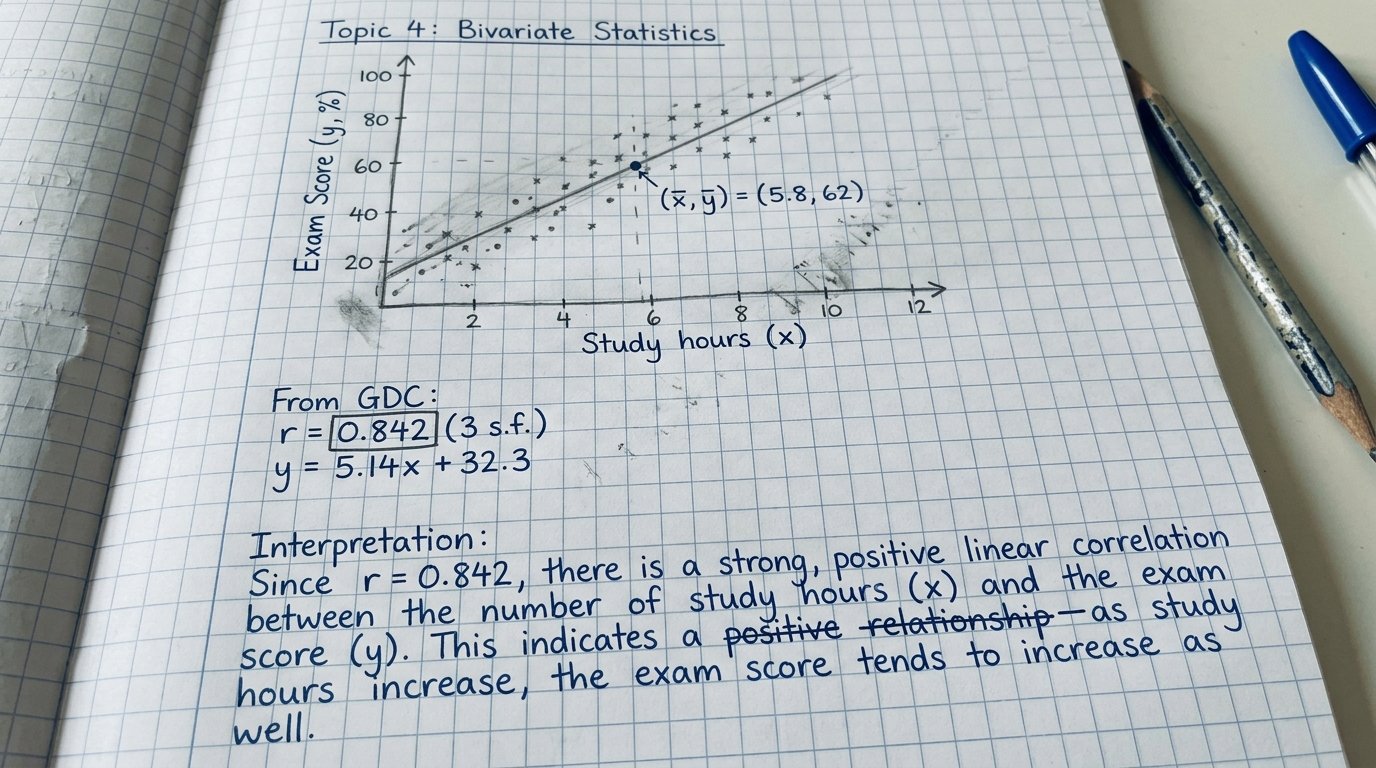
Scatter plots show relationships between two variables.
Students learn to analyze:
- Correlation between variables
- Regression models
- Strength and direction of relationships
Regression equations allow students to predict values based on data trends.
3. Normal Distribution
The normal distribution is one of the most important probability models.
Key ideas include:
- Bell-shaped distribution
- Mean and standard deviation
- Calculating probabilities within intervals
Students often use their calculators to determine probabilities and interpret results.
4. Hypothesis Testing
Hypothesis testing allows us to evaluate claims using data.
Students learn to:
- Formulate null and alternative hypotheses
- Interpret p-values
- Decide whether to reject a hypothesis
These methods are widely used in real-world research and analysis.
Probability in IB Math AI
Probability helps measure how likely an event is to occur.
In IB Math AI, students explore several probability concepts.
1. Basic Probability Rules
Students learn fundamental probability laws such as:
- Addition rule
- Multiplication rule
- Complement rule
These rules help calculate probabilities of simple and combined events.
2. Conditional Probability
Conditional probability describes the probability of an event occurring given that another event has already occurred.
Tree diagrams and tables are often used to solve these problems.
3. Discrete Random Variables
A random variable assigns numerical values to outcomes.
Students study probability distributions and calculate expected values.
These concepts are important in many statistical models.
Differences Between SL and HL
Both levels cover statistics and probability, but HL includes additional depth.
SL Focus
SL students mainly study:
- Descriptive statistics
- Regression and correlation
- Basic probability rules
- Normal distribution
HL Extensions
HL students explore more advanced topics such as:
- Additional probability distributions
- More complex statistical modeling
- Deeper interpretation of statistical results
Because of this, HL questions often require more detailed reasoning.
Common Statistics Mistakes Students Make
Students often lose marks in statistics because they:
- Misinterpret calculator results
- Forget to include units or context
- Confuse correlation with causation
- Misread probability questions
Statistics questions often require clear explanations, not just calculations.
Tips to Improve in Statistics and Probability
Here are some strategies that can help.
Practice Interpreting Results
Many questions require explaining what statistical values mean in context.
Learn Calculator Functions
The graphic display calculator is essential for regression and probability calculations.
Solve Past Paper Questions
Past exam questions help you understand how IB examiners test statistical concepts.
Need Structured Help with IB Math AI?
If you want structured guidance for IB Math topics like statistics, our membership includes:
- Step-by-step topic explanations
- Guided past paper solutions
- Internal Assessment support
- Structured revision plans for AA and AI courses
You can explore the full support system here:
https://mathzem.com/membership-pricing/
A clear study structure can make difficult topics far easier to manage.
Frequently Asked Questions About IB Math AI Statistics and Probability
1. Is statistics the most important topic in IB Math AI?
Yes, statistics and data analysis play a major role in the AI syllabus and appear frequently in exams.
2. Do I need to memorize statistical formulas?
Many formulas are provided in the formula booklet, but understanding when and how to apply them is essential.
3. Why is calculator knowledge important in AI?
Many statistical calculations require using the calculator for regression models, distributions, and probability functions.
4. Are probability questions difficult in IB Math AI?
They can be challenging if students misinterpret the problem, but practice with tree diagrams and probability rules helps.
5. What is the best way to improve in statistics?
Regular practice with real exam questions and careful interpretation of results.
Conclusion
Statistics and probability form a major part of the IB Math AI course. By understanding data analysis techniques, probability rules, and statistical models, students can interpret real-world information more effectively.
Consistent practice, strong calculator skills, and careful interpretation of results will help you perform confidently in IB Math AI exams.