You solve a trigonometric equation and get one correct angle. But the question asks you to find all solutions in a given interval.
Where are the other answers?
This is a common problem in IB Mathematics. Sine, cosine, and tangent repeat their values, so an equation can have several solutions within the same interval. Finding one angle is only the beginning.
The key is to understand the unit circle, use the correct symmetry, and check the interval carefully.
This guide explains how to solve trigonometric equations analytically and graphically, including equations that become quadratic in sine, cosine, or tangent. It focuses on IB Maths AA SL and AA HL.
Table of Contents
1. What are trigonometric equations?
A trigonometric equation contains one or more trigonometric functions.
Examples include:
[
\sin x=\frac12
]
[
2\cos x+1=0
]
[
\tan(2x)=\sqrt3
]
[
2\sin^2x-3\sin x+1=0
]
The objective is to find the values of the angle that satisfy the equation.
Unlike many ordinary algebraic equations, trigonometric equations can have multiple solutions because trigonometric functions are periodic.
For example:
[
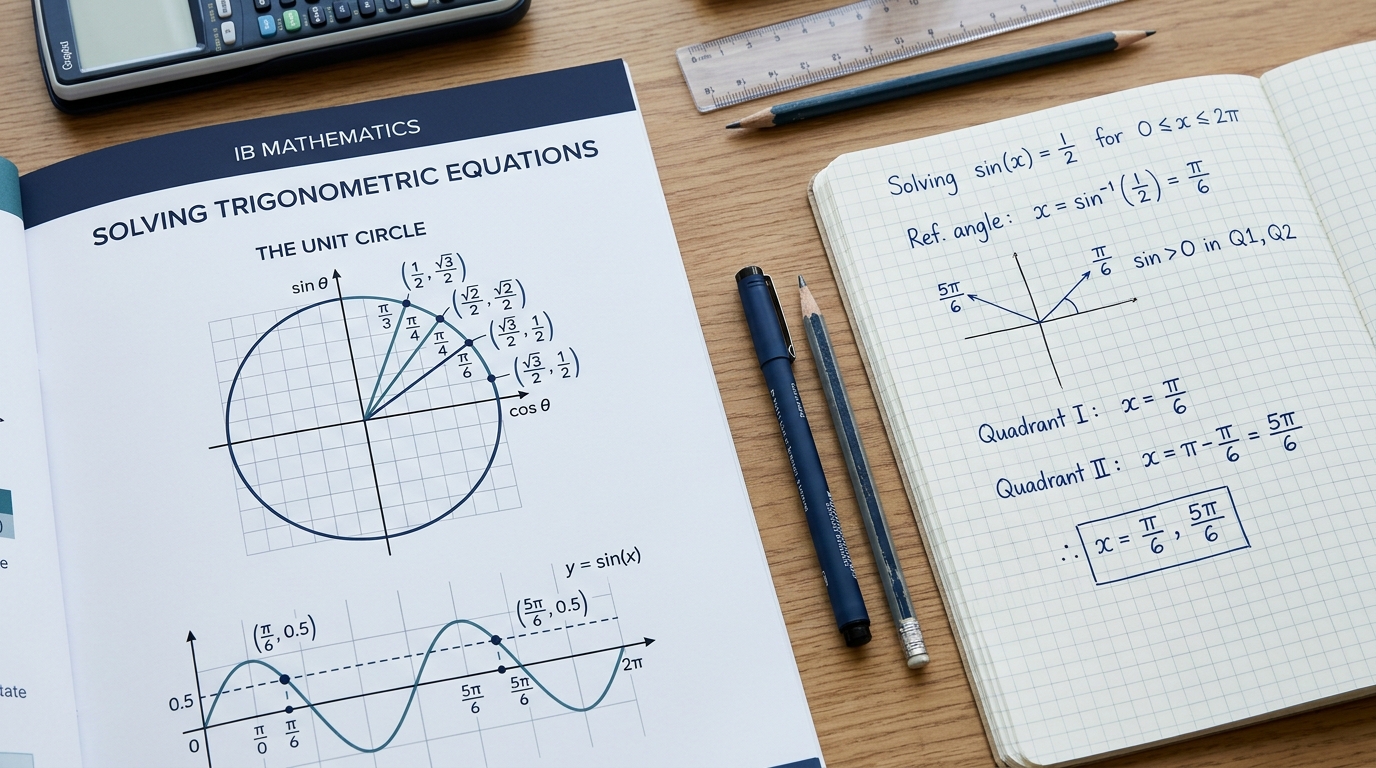
\sin x=\frac12
]
has two solutions between (0) and (2\pi):
[
x=\frac{\pi}{6},\quad \frac{5\pi}{6}
]
The interval matters because it determines which solutions you must include.
2. Understand the unit circle before solving
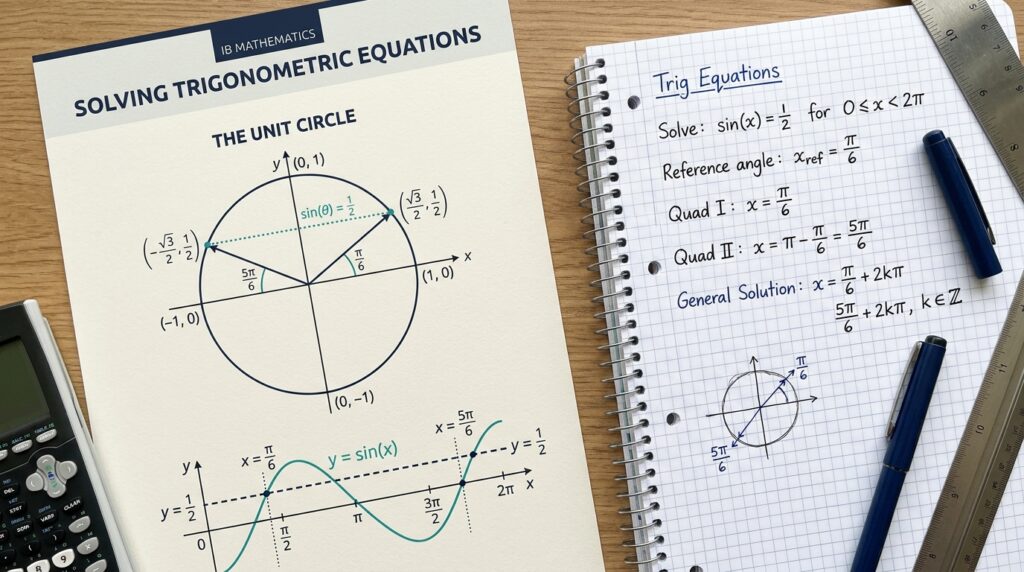
The unit circle is one of the most useful tools for solving trigonometric equations.
For a given angle:
[
(\cos x,\sin x)
]
represents the coordinates of the corresponding point on the unit circle.
This means:
- Cosine gives the horizontal coordinate.
- Sine gives the vertical coordinate.
The signs depend on the quadrant.
| Quadrant | Sine | Cosine | Tangent |
|---|---|---|---|
| First | Positive | Positive | Positive |
| Second | Positive | Negative | Negative |
| Third | Negative | Negative | Positive |
| Fourth | Negative | Positive | Negative |
For example, if:
[
\sin x=\frac12
]
sine is positive in the first and second quadrants.
The reference angle is:
[
\alpha=\frac{\pi}{6}
]
Therefore, the two solutions in one complete cycle are:
[
x=\frac{\pi}{6}
]
and:
[
x=\pi-\frac{\pi}{6}
=\frac{5\pi}{6}
]
This is why checking only the principal inverse sine value is not enough.
3. Solving equations involving sine
Consider:
[
\sin x=\frac{\sqrt3}{2}
]
for:
[
0\leq x\leq2\pi
]
Step 1: Find the reference angle.
We know:
[
\sin\frac{\pi}{3}=\frac{\sqrt3}{2}
]
Therefore:
[
\alpha=\frac{\pi}{3}
]
Step 2: Identify the possible quadrants.
Sine is positive in Quadrants I and II.
Step 3: Find both angles.
First quadrant:
[
x=\frac{\pi}{3}
]
Second quadrant:
[
x=\pi-\frac{\pi}{3}
]
[
x=\frac{2\pi}{3}
]
<text>Final answer:</text>
[
\boxed{x=\frac{\pi}{3},\frac{2\pi}{3}}
]
Both solutions lie in the specified interval.
4. Solving equations involving cosine
Now consider:
[
\cos x=-\frac12
]
for:
[
0\leq x\leq2\pi
]
Step 1: Find the reference angle.
[
\cos\frac{\pi}{3}=\frac12
]
The reference angle is:
[
\alpha=\frac{\pi}{3}
]
Step 2: Identify the quadrants.
Cosine is negative in Quadrants II and III.
Step 3: Find the solutions.
Quadrant II:
[
x=\pi-\frac{\pi}{3}
=\frac{2\pi}{3}
]
Quadrant III:
[
x=\pi+\frac{\pi}{3}
=\frac{4\pi}{3}
]
<text>Final answer:</text>
[
\boxed{x=\frac{2\pi}{3},\frac{4\pi}{3}}
]
The main difference between sine and cosine questions is the quadrants in which each function is positive or negative.
5. Solving equations involving tangent
Consider:
[
\tan x=-1
]
for:
[
0\leq x\leq2\pi
]
The reference angle is:
[
\alpha=\frac{\pi}{4}
]
Tangent is negative in Quadrants II and IV.
Therefore:
[
x=\pi-\frac{\pi}{4}
]
and:
[
x=2\pi-\frac{\pi}{4}
]
So:
[
\boxed{x=\frac{3\pi}{4},\frac{7\pi}{4}}
]
Remember that tangent has a period of (\pi), whereas sine and cosine have a period of (2\pi).
This difference matters when an interval contains more than one complete cycle.
6. Solving equations with a multiple angle
Some questions contain expressions such as:
[
\sin 2x=\frac12
]
for:
[
0\leq x\leq2\pi
]
A common mistake is to solve the equation as if the angle were simply (x).
Instead, introduce a new variable:
[
u=2x
]
Since:
[
0\leq x\leq2\pi
]
multiplying the entire interval by two gives:
[
0\leq u\leq4\pi
]
Now solve:
[
\sin u=\frac12
]
Within this interval, the solutions are:
[
u=\frac{\pi}{6},\frac{5\pi}{6},
\frac{13\pi}{6},\frac{17\pi}{6}
]
Since (u=2x), divide every solution by two:
[
x=\frac{\pi}{12},\frac{5\pi}{12},
\frac{13\pi}{12},\frac{17\pi}{12}
]
<text>Final answer:</text>
[
\boxed{
x=\frac{\pi}{12},
\frac{5\pi}{12},
\frac{13\pi}{12},
\frac{17\pi}{12}
}
]
The important step is adjusting the interval before finding the solutions.
7. Solving quadratic trigonometric equations
Some equations become quadratic when you treat a trigonometric expression as a variable.
Consider:
[
2\sin^2x-3\sin x+1=0
]
for:
[
0\leq x\leq2\pi
]
Step 1: Factorise the equation.
[
(2\sin x-1)(\sin x-1)=0
]
Step 2: Solve each factor separately.
First:
[
2\sin x-1=0
]
[
\sin x=\frac12
]
This gives:
[
x=\frac{\pi}{6},\frac{5\pi}{6}
]
Second:
[
\sin x-1=0
]
[
\sin x=1
]
This gives:
[
x=\frac{\pi}{2}
]
Step 3: Combine all solutions.
[
\boxed{
x=\frac{\pi}{6},
\frac{\pi}{2},
\frac{5\pi}{6}
}
]
Do not stop after solving the first factor. Every factor can produce additional valid solutions.
What if the equation contains cosine squared?
Consider:
[
2\cos^2x-3\cos x+1=0
]
Factorise:
[
(2\cos x-1)(\cos x-1)=0
]
Therefore:
[
\cos x=\frac12
]
or:
[
\cos x=1
]
For (0\leq x\leq2\pi), the solutions are:
[
\cos x=\frac12:
\quad x=\frac{\pi}{3},\frac{5\pi}{3}
]
[
\cos x=1:
\quad x=0,2\pi
]
The complete answer is:
[
\boxed{
x=0,\frac{\pi}{3},\frac{5\pi}{3},2\pi
}
]
Notice that both endpoints are included because the interval uses less than or equal to.
8. Solving trigonometric equations graphically
Not every trigonometric equation needs to be solved using algebra.
You can also use graphs to find intersections.
For example:
[
2\sin x=1
]
can be rewritten as:
[
\sin x=\frac12
]
Graph:
[
y=\sin x
]
and:
[
y=\frac12
]
The solutions are the points where the two graphs intersect.
For:
[
0\leq x\leq2\pi
]
the intersections occur at:
[
\boxed{x=\frac{\pi}{6},\frac{5\pi}{6}}
]
When is a graphical method useful?
A graph is particularly useful when:
- The equation does not factorise easily.
- You need numerical solutions.
- The question asks you to identify the number of solutions.
- The equation contains several trigonometric terms.
When using a graphical calculator, check the angle mode, viewing window, and intersection values. A graph can help you locate solutions, but you still need to make sure you have found every intersection in the interval.
9. How to check whether you have found every solution
Finding one correct answer is not enough when the question asks for all solutions.
Use this checklist.
- Read the interval carefully.
- Find the reference angle or use the appropriate algebraic method.
- Identify every relevant quadrant.
- Adjust the interval when the equation contains a multiple angle.
- Solve every factor if the equation is quadratic.
- Check whether the interval includes its endpoints.
- Substitute your answers into the original equation where practical.
For example, compare these intervals:
[
0\leq x\leq2\pi
]
and:
[
0\leq x<2\pi
]
The first includes (2\pi). The second does not.
For an equation such as:
[
\cos x=1
]
the first interval includes both (0) and (2\pi), while the second includes only (0).
That small symbol can change the final answer.
10. Common mistakes in IB Maths trigonometric equations
Mistake 1: Giving only one solution
You calculate the inverse sine or cosine and stop.
Correction: Use the unit circle to identify every quadrant where the equation is satisfied.
Mistake 2: Forgetting the interval
You find a mathematically valid angle that lies outside the requested range.
Correction: Check every answer against the exact interval.
Mistake 3: Forgetting to adjust a multiple angle
You solve (\sin 2x=\frac12) using an interval for (x) without considering the larger interval for (2x).
Correction: Define a new variable and transform the interval first.
Mistake 4: Mixing degrees and radians
You enter an angle in degrees while working with radians.
Correction: Check the calculator mode before using inverse trigonometric functions. IB examination questions generally assume radians unless otherwise indicated.
Mistake 5: Missing solutions from a quadratic equation
You solve one factor and forget the other.
Correction: Set every factor equal to zero and solve each resulting equation.
Mistake 6: Rounding too early
You use rounded decimal angles during later calculations.
Correction: Keep exact values such as (\frac{\pi}{6}) and (\frac{2\pi}{3}) whenever possible. Round only when required.
11. Practice questions
Try these questions without checking the solutions first.
Question 1
Solve:
[
\sin x=\frac12
]
for:
[
0\leq x\leq2\pi
]
Question 2
Solve:
[
\cos x=-\frac{\sqrt2}{2}
]
for:
[
0\leq x\leq2\pi
]
Question 3
Solve:
[
\tan x=\sqrt3
]
for:
[
0\leq x\leq2\pi
]
Question 4
Solve:
[
\sin 2x=1
]
for:
[
0\leq x\leq2\pi
]
Question 5
Solve:
[
2\sin^2x-3\sin x+1=0
]
for:
[
0\leq x\leq2\pi
]
Question 6
Solve:
[
2\cos^2x-1=0
]
for:
[
-\pi\leq x\leq\pi
]
Answer guide
Question 1
[
\boxed{x=\frac{\pi}{6},\frac{5\pi}{6}}
]
Question 2
Cosine is negative in Quadrants II and III.
[
\boxed{x=\frac{3\pi}{4},\frac{5\pi}{4}}
]
Question 3
Tangent is positive in Quadrants I and III.
[
\boxed{x=\frac{\pi}{3},\frac{4\pi}{3}}
]
Question 4
Let (u=2x).
Then:
[
0\leq u\leq4\pi
]
The solutions for (u) are:
[
u=\frac{\pi}{2},\frac{5\pi}{2}
]
Therefore:
[
\boxed{x=\frac{\pi}{4},\frac{5\pi}{4}}
]
Question 5
Factorise:
[
(2\sin x-1)(\sin x-1)=0
]
Therefore:
[
\boxed{
x=\frac{\pi}{6},
\frac{\pi}{2},
\frac{5\pi}{6}
}
]
Question 6
Rearrange:
[
\cos^2x=\frac12
]
Therefore:
[
\cos x=\pm\frac{\sqrt2}{2}
]
Within the given interval:
[
\boxed{
x=-\frac{3\pi}{4},
-\frac{\pi}{4},
\frac{\pi}{4},
\frac{3\pi}{4}
}
]
12. A practical revision routine
If you struggle with trigonometric equations, do not start by attempting the hardest questions.
Build your skills in stages.
| Session | Focus | Practice |
|---|---|---|
| 1 | Unit circle and reference angles | Find solutions using sine, cosine and tangent |
| 2 | Basic equations | Solve equations within one complete cycle |
| 3 | Extended intervals | Find every solution over several cycles |
| 4 | Multiple angles | Solve equations containing (2x), (3x) or other multiples |
| 5 | Quadratic equations | Factorise expressions involving trigonometric functions |
| 6 | Graphical solutions | Find intersections and numerical solutions |
| 7 | Mixed practice | Solve unfamiliar exam style questions |
After each session, review the working rather than checking only the final answers.
Ask yourself:
- Did I identify the correct reference angle?
- Did I use the correct quadrants?
- Did I account for the entire interval?
- Did I include every solution?
- Did I handle the endpoints correctly?
13. How Mathzem can help you practise trigonometric equations
Trigonometric questions are useful for practising mathematical accuracy because a small error can affect several later steps.
You might understand the unit circle but miss a second solution. You might factorise correctly but forget to check one of the factors. Or you might use the right method but make an error when adjusting the interval.
Mathzem lets you choose IB Mathematics practice by course, topic and focus area. You can attempt a question independently, upload your handwritten working and receive AI Examiner feedback.
The feedback can help you review your method, identify mistakes and understand where marks may have been lost. Your practice history and Weakness Map can also help you identify areas that need further attention.
The feedback provides learning support and estimated marks. It is not official IB marking.
You can also read our IB Maths trigonometry guide for a broader review of trigonometric ratios, graphs, identities and course differences.
Frequently Asked Questions About IB Maths Trigonometric Equations
Are trigonometric equations included in IB Maths AA?
Yes. The IB Mathematics Analysis and Approaches syllabus includes solving trigonometric equations in a finite interval, both analytically and graphically, under section 3.8. This content applies to SL and HL.
Do I need to learn the general solution of every trigonometric equation?
The syllabus guidance for section 3.8 states that the general solution of trigonometric equations is not required. Focus on finding all solutions within the specified finite interval.
Why are there multiple solutions to a trigonometric equation?
Sine, cosine and tangent are periodic functions. They repeat their values at different angles, so one equation can have several solutions within an interval.
Should I use degrees or radians?
Use the unit specified in the question. IB examination questions generally assume radians unless otherwise indicated. Check your calculator mode before calculating.
Can I use a graphical calculator?
Yes, graphical methods are included in the syllabus. Use the graph to locate intersections and check that you have found all solutions within the required interval.
How do I avoid missing solutions?
Identify the reference angle, check the relevant quadrants, adjust the interval for multiple angles, and test whether the endpoints are included.
Final thoughts
Solving a trigonometric equation is not just about using inverse sine, cosine, or tangent.
You need to understand where each function is positive or negative, how its values repeat, and how the interval affects the final answer.
Remember the main process:
- Rearrange the equation.
- Find the reference angle or factorise.
- Identify all possible solutions.
- Check the interval.
- Present every valid answer.
Practise these steps with different equations until finding all solutions becomes part of your normal working.
The aim is not simply to find an angle. It is to prove that you have found every angle the question allows.