You can know how to differentiate a function and still struggle with a IB Maths AA HL related rates question.
The difficulty is usually not the differentiation itself. It is understanding how two or more changing quantities are connected, forming the correct equation, and differentiating it with respect to time.
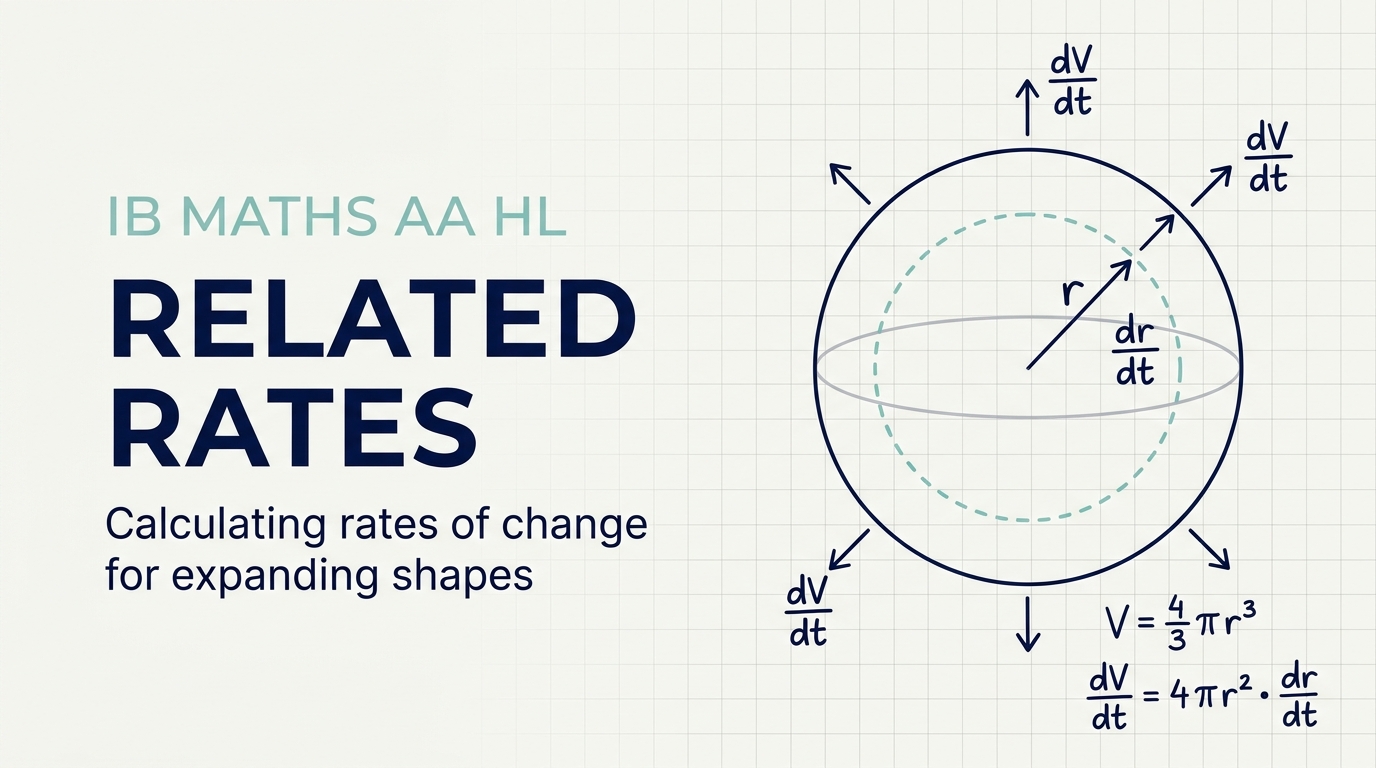
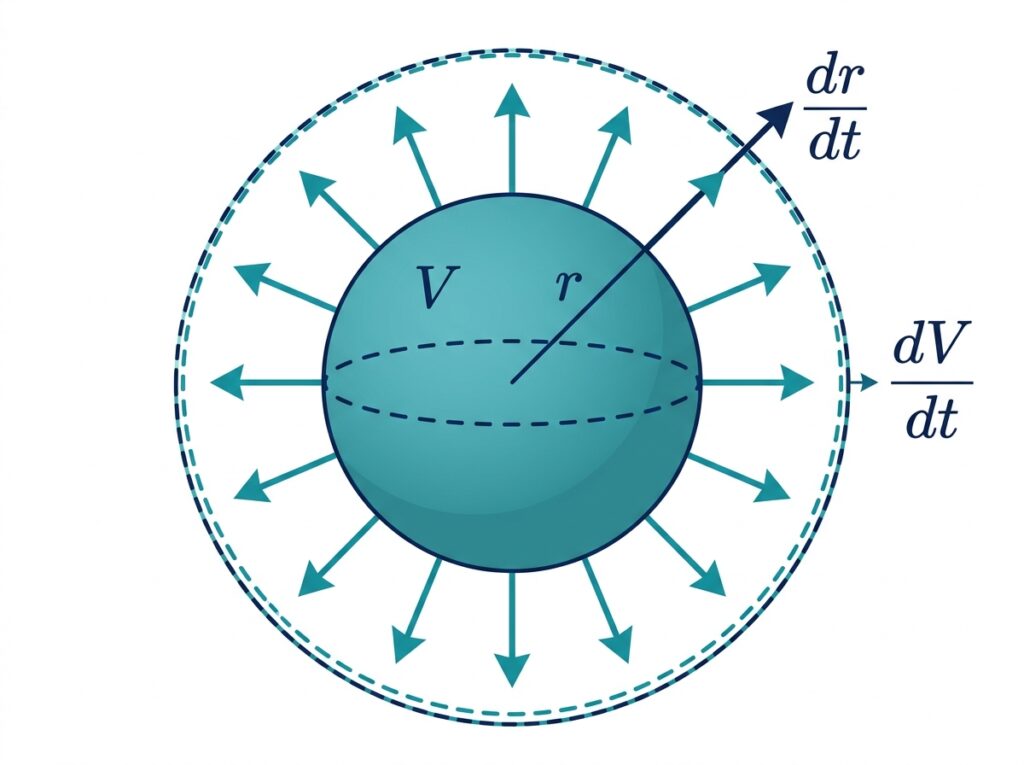
For example, imagine a balloon expanding as air enters it. Its radius increases, which means its volume also increases. If you know how quickly the radius is changing, can you calculate how quickly the volume is changing?
That is exactly the type of problem related rates questions are designed to test.
In this guide, you will learn how to recognise related rates problems, set up the equations, apply implicit differentiation, and avoid common mistakes in IB Maths AA HL.
Table of Contents
What are related rates in IB Maths?
Related rates problems involve two or more quantities that change over time.
These quantities are connected by a mathematical relationship. When one quantity changes, another may change as well.
For example:
- The radius and volume of an expanding sphere.
- The height and volume of water in a container.
- The distance and height of a ladder sliding against a wall.
- The dimensions and area of an expanding shape.
The objective is usually to calculate the rate of change of one quantity when the rate of change of another is known.
You will often see rates written using derivatives such as:
[
\frac{dx}{dt},\quad \frac{dy}{dt},\quad \frac{dV}{dt}
]
Here, (t) represents time.
For example, (\frac{dr}{dt}) represents how quickly a radius changes with time, while (\frac{dV}{dt}) represents how quickly volume changes.
The key idea: Build an equation connecting the changing quantities, then differentiate both sides with respect to time.
Why do related rates questions feel difficult?
There are three main challenges.
1. Translating the situation into mathematics
A question might describe a balloon, a ladder, or water flowing into a container. You need to identify the variables and the mathematical relationship between them.
For example, a sphere has a relationship between its radius and volume:
[
V=\frac{4}{3}\pi r^3
]
A student who does not recognise this relationship may struggle before even reaching the differentiation.
2. Differentiating with respect to time
This is where the chain rule becomes important.
If the radius (r) changes with time, then differentiating (r^3) with respect to time gives:
[
\frac{d}{dt}(r^3)
=3r^2\frac{dr}{dt}
]
You cannot simply write (3r^2). You must also include the derivative of (r) with respect to time.
3. Using the information at the correct stage
Many questions give a particular radius, height, or distance.
Students sometimes substitute these values into the original equation too early. This can remove the variables they need to differentiate.
A safer approach is to differentiate the relationship first and substitute the known values afterwards.
A step-by-step method for solving related rates questions
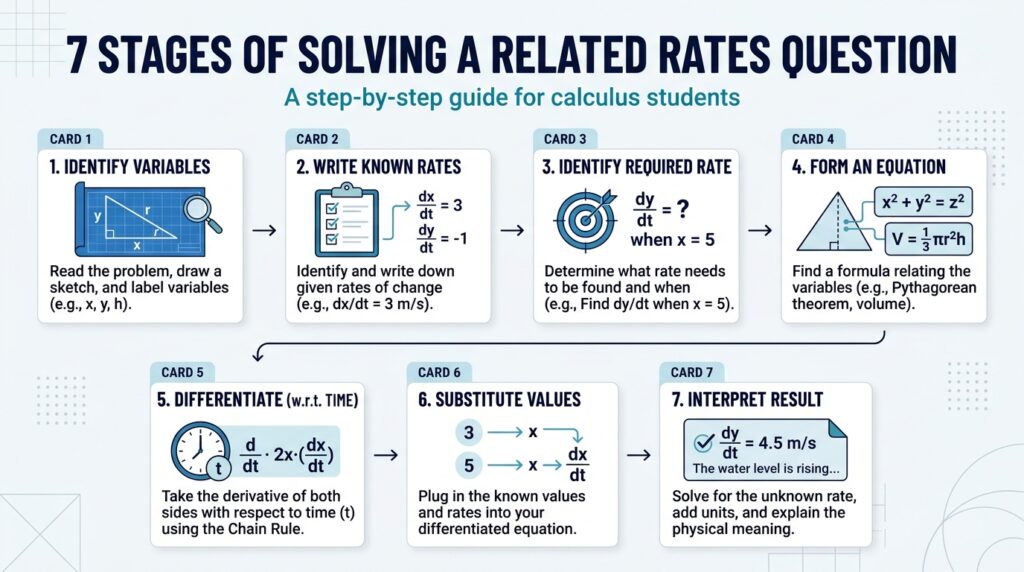
Use this process whenever you encounter an IB Maths AA HL related rates problem.
Step 1: Identify the changing quantities
Read the question and identify which quantities depend on time.
For example, a question about an expanding sphere may involve:
- Radius, (r)
- Volume (V)
- Time (t)
Step 2: Write down the given rate
Look for information such as:
[
\frac{dr}{dt}=0.2
]
This tells you that the radius is increasing at 0.2 units per second.
Step 3: Identify the required rate
The question may ask you to find:
[
\frac{dV}{dt}
]
This is the rate at which the volume changes.
Step 4: Form the mathematical relationship
Choose the equation connecting the variables.
For a sphere:
[
V=\frac{4}{3}\pi r^3
]
For a right angled triangle:
[
x^2+y^2=z^2
]
For a circle:
[
A=\pi r^2
]
Step 5: Differentiate with respect to time
Apply the chain rule or implicit differentiation as required.
Step 6: Substitute the known values
Use the values supplied in the question after differentiating.
Step 7: State your answer with units and interpretation
Check whether the rate is positive or negative, and make sure the units match the quantity being measured.
Worked Example 1: The volume of an expanding sphere
A spherical balloon is expanding. Its radius increases at a constant rate of (0.2\text{ cm s}^{-1}).
Find the rate of increase of its volume when the radius is (3\text{ cm}).
Step 1: Identify the information
We know:
[
\frac{dr}{dt}=0.2
]
[
r=3
]
We need to calculate:
[
\frac{dV}{dt}
]
Step 2: Write the volume equation
The volume of a sphere is:
[
V=\frac{4}{3}\pi r^3
]
Step 3: Differentiate with respect to time
Differentiating both sides gives:
[
\frac{dV}{dt}
=\frac{4}{3}\pi(3r^2)\frac{dr}{dt}
]
Simplifying:
[
\frac{dV}{dt}
=4\pi r^2\frac{dr}{dt}
]
Notice that we multiply by (\frac{dr}{dt}) because the radius is changing with time.
Step 4: Substitute the known values
Substitute (r=3) and (\frac{dr}{dt}=0.2):
[
\frac{dV}{dt}
=4\pi(3)^2(0.2)
]
[
=4\pi(9)(0.2)
]
[
=7.2\pi
]
Therefore:
[
\boxed{\frac{dV}{dt}=7.2\pi\text{ cm}^3\text{s}^{-1}}
]
Step 5: Interpret the answer
The volume of the balloon is increasing at approximately:
[
22.62\text{ cm}^3\text{s}^{-1}
]
The positive value makes sense because the balloon is expanding.
Worked Example 2: A ladder sliding against a wall
A ladder of length (5\text{ m}) rests against a vertical wall.
The bottom of the ladder moves away from the wall at a rate of (0.6\text{ m s}^{-1}).
Find the rate at which the top of the ladder moves down the wall when the bottom is (3\text{ m}) from the wall.
Step 1: Define the variables
Let:
- (x) Be the horizontal distance between the wall and the bottom of the ladder.
- (y) Be the vertical height of the top of the ladder.
We are given:
[
\frac{dx}{dt}=0.6
]
[
x=3
]
The ladder has a fixed length of (5\text{ m}).
We need to find:
[
\frac{dy}{dt}
]
Step 2: Use Pythagoras’ theorem
The ladder, wall, and ground form a right angled triangle.
Therefore:
[
x^2+y^2=25
]
When (x=3):
[
3^2+y^2=25
]
[
y^2=16
]
[
y=4
]
Step 3: Differentiate with respect to time
Differentiate:
[
x^2+y^2=25
]
Using the chain rule:
[
2x\frac{dx}{dt}
+2y\frac{dy}{dt}=0
]
Divide by 2:
[
x\frac{dx}{dt}
+y\frac{dy}{dt}=0
]
Step 4: Substitute the values
We know:
[
x=3,\quad y=4,\quad \frac{dx}{dt}=0.6
]
Substitute:
[
3(0.6)+4\frac{dy}{dt}=0
]
[
1.8+4\frac{dy}{dt}=0
]
[
4\frac{dy}{dt}=-1.8
]
[
\boxed{\frac{dy}{dt}=-0.45}
]
Step 5: Interpret the result
The negative sign tells us that the height is decreasing.
Therefore, the top of the ladder moves down the wall at:
[
\boxed{0.45\text{ m s}^{-1}}
]
This is an important lesson. The sign of a derivative tells you the direction of change, not just the size of the rate.
How implicit differentiation and the chain rule work together
Related rates questions often use implicit differentiation because the variables are connected through an equation rather than written as one simple function of another.
Consider:
[
x^2+y^2=25
]
Both (x) and (y) change with time.
When differentiating with respect to (t):
[
2x\frac{dx}{dt}
+2y\frac{dy}{dt}=0
]
Each variable needs its own time derivative.
This is an application of the chain rule.
If you need to strengthen this skill, revisit the chain rule and other differentiation techniques in the AA HL calculus guide.
Common mistakes in related rates questions
Even when students understand differentiation, a small setup error can affect the entire solution.
Mistake 1: Forgetting to differentiate with respect to time
Incorrect:
[
\frac{dV}{dt}=4\pi r^2
]
Correct:
[
\frac{dV}{dt}=4\pi r^2\frac{dr}{dt}
]
The second expression accounts for the fact that the radius changes over time.
Mistake 2: Substituting values too early
Suppose you know that the radius is (3\text{ cm}).
Do not immediately replace every occurrence of (r) with 3 before differentiating.
Keep the variable in the equation, differentiate first, and then substitute.
Mistake 3: Ignoring negative signs
A negative rate does not necessarily mean your calculation is wrong.
In the ladder example, the negative sign correctly showed that the height was decreasing.
Read the question carefully and explain the direction of change.
Mistake 4: Mixing units
If distance is measured in metres and time in seconds, the rate should be expressed in metres per second.
For volume, the corresponding unit is cubic metres per second.
Always check the units of the final answer.
Mistake 5: Treating every quantity as constant
Some quantities are fixed, while others change.
In the ladder example, the ladder length stays constant, but the horizontal and vertical distances change.
Recognising this distinction is essential when forming the equation.
How to practice related rates for IB Maths AA HL
Reading worked examples is useful, but you need to solve questions independently to become comfortable with the method.
Try this practice routine.
- Review the relationships: Make sure you can recognise the equations for circles, spheres, triangles, and other common shapes.
- Practice implicit differentiation: Work with equations containing two changing variables.
- Identify the given and required rates: Write these down before starting the calculation.
- Differentiate before substituting: Make this a consistent habit.
- Check signs and units: Explain what the final rate means.
- Attempt mixed questions: Practice recognizing which mathematical relationship applies without being told.
Related rates are part of a wider set of AA HL calculus applications and exam questions. You should also be comfortable with implicit differentiation and other higher level calculus content.
When practicing unfamiliar questions, focus on identifying the relationship before choosing a differentiation technique. This is the same kind of decision making explained in our guide to approaching unfamiliar IB Maths questions.
How Mathzem can help you practise related rates
Related rates questions are a good example of why checking only the final answer is not enough.
You might choose the correct equation but forget a time derivative. You might differentiate correctly but substitute the wrong value. Or you might obtain the right numerical result without explaining what the sign means.
With Mathzem, you can choose an IB Mathematics topic, attempt a practice question, and upload your written working for AI Examiner feedback.
The feedback is designed to help you understand your method, identify mistakes, and see where your working could improve. It provides learning feedback and estimated marks, not official IB marking.
You can then use the feedback to decide what to practise again.
Start with IB Maths practice questions on Mathzem and focus on showing every important step in your solution.
Frequently Asked Questions About IB Maths AA HL Related Rates
Are related rates part of IB Maths AA HL?
Yes. Related rates of change are included in the current AA HL calculus syllabus under AHL 5.14, alongside implicit differentiation and optimisation.
Do I need implicit differentiation for related rates?
Often, yes. When an equation connects two or more quantities that change with time, implicit differentiation allows you to differentiate the relationship directly.
Why do I need the chain rule in related rates?
Because the variables depend on time. When differentiating an expression such as (r^3) with respect to time, you must multiply by (\frac{dr}{dt}).
Should I substitute values before or after differentiating?
In most related rates problems, differentiate the original relationship first. Then substitute the known values and rates. This helps preserve the changing variables in the equation.
How do I know whether a rate should be positive or negative?
A positive rate means the quantity is increasing. A negative rate means it is decreasing. Always interpret the sign in the context of the question.
Are related rates the same as optimisation?
No. Both use differentiation, but they answer different questions. Related rates calculate how quickly quantities change over time. Optimisation finds maximum or minimum values of a function.
Final thoughts
Related rates questions become much easier when you stop treating them as complicated word problems and follow a consistent mathematical process.
Identify the changing quantities, establish their relationship, differentiate with respect to time, substitute the known values, and interpret the result.
Most importantly, do not rush the setup. A correct equation is the foundation of the entire solution.
Practise these questions with complete working, review the steps where you make mistakes, and build confidence in applying the chain rule and implicit differentiation.
Practise IB Maths with Mathzem, upload your working, and learn from the steps that matter.