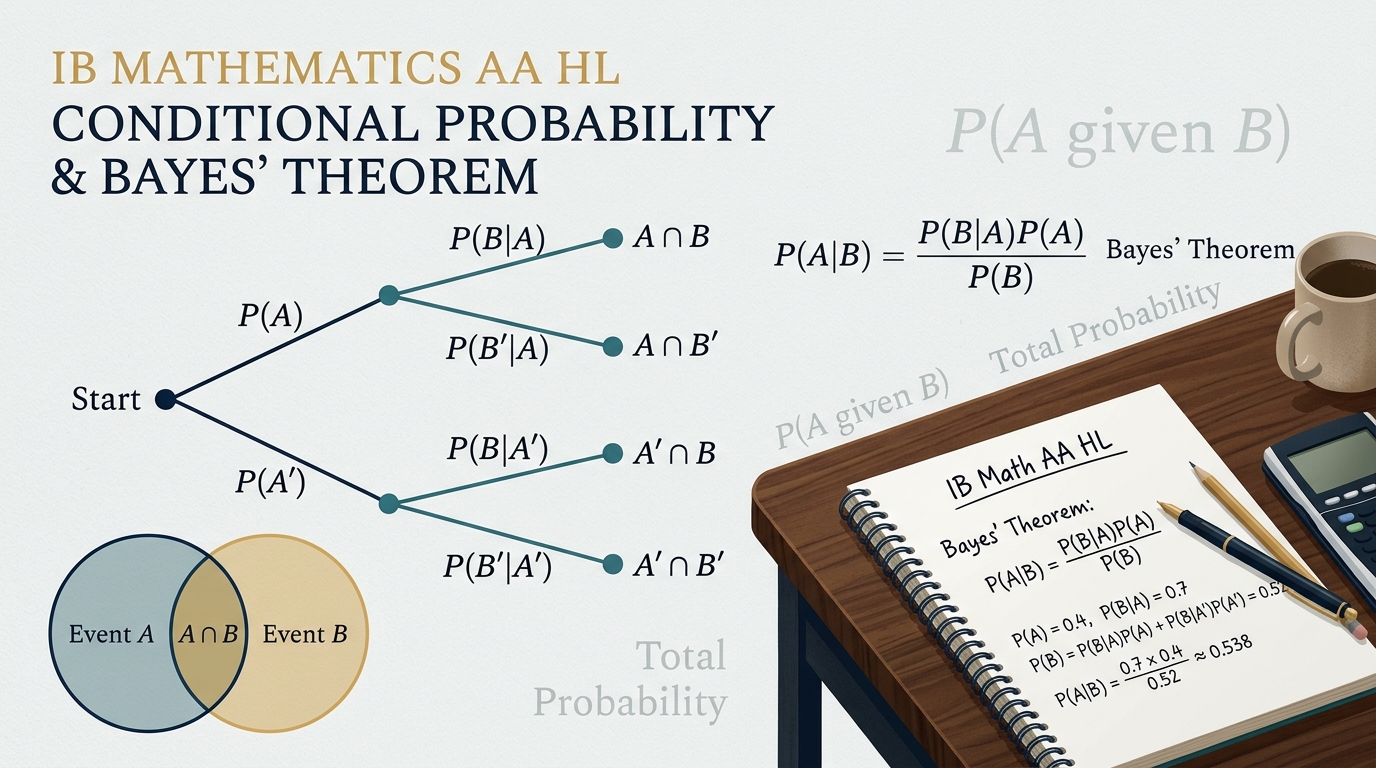
You can know the probability of two events and still calculate the wrong answer when a question adds one important condition.
For example, the probability that a student studies mathematics might be different from the probability that a student studies mathematics given that they take Higher Level mathematics.
That extra information changes the calculation.
This is the idea behind conditional probability. It also forms the foundation for more advanced questions involving probability trees, independence, and Bayes’ theorem.
In IB Maths AA HL conditional probability, the challenge is not always remembering a formula. It is identifying which event is being conditioned on, choosing the correct denominator, and interpreting the result.
This guide explains the main ideas with worked examples, common mistakes, and practice questions.
Table of Contents
1. What is IB Maths AA HL Conditional Probability?
Conditional probability measures the chance of an event happening when you already know that another event has happened.
The notation is:
[
P(A\mid B)
]
Read this as:
The probability of A given B.
The condition appears after the vertical line. This matters because it tells you which information is already known.
The formula is:
[
\boxed{P(A\mid B)=\frac{P(A\cap B)}{P(B)}}
]
provided that (P(B)>0).
Here:
- (P(A\mid B)) is the probability of A given B.
- (P(A\cap B)) is the probability that both A and B happen.
- (P(B)) is the probability of the condition B.
The denominator is the probability of the event after the vertical line.
That is one of the most important details to remember.
2. Worked example: Calculate a conditional probability
A school has 200 students.
- 120 study Mathematics.
- 80 study Physics.
- 50 study both mathematics and physics.
A student is selected at random. Given that the student studies Physics, find the probability that they also study Mathematics.
Let:
- (M) represent the event that the student studies Mathematics.
- (P) represent the event that the student studies Physics.
We know:
[
P(M\cap P)=\frac{50}{200}
]
and:
[
P(P)=\frac{80}{200}
]
We need to calculate:
[
P(M\mid P)
]
Using the conditional probability formula:
[
P(M\mid P)=\frac{P(M\cap P)}{P(P)}
]
Substitute the values:
[
=\frac{50/200}{80/200}
]
Therefore:
[
=\frac{50}{80}
]
[
\boxed{P(M\mid P)=0.625}
]
Answer: The probability is 0.625, or 62.5%.
Notice that we divided the number studying both subjects by the number studying Physics.
We did not divide by the total number of students because the question already tells us that the selected student studies Physics.
3. Conditional probability using a two way table
A two way table can make conditional probability questions easier to organise.
Suppose a group of students is classified by whether they study Mathematics and whether they study Physics.
| Studies Physics | Does not study Physics | Total | |
|---|---|---|---|
| Studies Mathematics | 50 | 70 | 120 |
| Does not study mathematics | 30 | 50 | 80 |
| Total | 80 | 120 | 200 |
Find the probability that a student studies Mathematics, given that they study Physics.
The condition tells us to focus only on the Physics column.
There are 80 students in that column.
Of those, 50 study Mathematics.
Therefore:
[
P(M\mid P)=\frac{50}{80}
]
[
\boxed{P(M\mid P)=0.625}
]
What if the condition changes?
Now find the probability that a student studies Physics, given that they study Mathematics.
This time, the condition is Mathematics. We use the Mathematics row.
There are 120 students who study Mathematics, and 50 of them also study Physics.
[
P(P\mid M)=\frac{50}{120}
]
[
\boxed{P(P\mid M)=\frac{5}{12}}
]
These answers are different:
[
P(M\mid P)\neq P(P\mid M)
]
This is a common source of mistakes. The order of the events matters.
4. Probability trees and conditional probability
Probability trees are useful when a question describes events happening in stages.
Consider a school where:
- 60% of students take Mathematics.
- 40% of students take Physics.
- Of the Mathematics students, 70% also take Physics.
- Of the students who do not take Mathematics, 20% take Physics.
Let:
- (M) mean the student takes Mathematics.
- (P) mean the student takes Physics.
The first branches are:
[
P(M)=0.6
]
[
P(M’)=0.4
]
The conditional probabilities on the second branch are
[
P(P\mid M)=0.7
]
[
P(P\mid M’)=0.2
]
The probability of taking both subjects is found by multiplying along the relevant branch:
[
P(M\cap P)=0.6\times0.7
]
[
=0.42
]
The probability of taking Physics but not Mathematics is:
[
P(M’\cap P)=0.4\times0.2
]
[
=0.08
]
To find the overall probability of taking Physics, add the two relevant branches:
[
P(P)=0.42+0.08
]
[
\boxed{P(P)=0.50}
]
Remember these two tree rules:
- Multiply probabilities along a single path.
- Add probabilities for separate paths that lead to the same event.
5. Independent events and conditional probability
Two events are independent when knowing that one has happened does not change the probability of the other.
For independent events A and B:
[
\boxed{P(A\mid B)=P(A)}
]
An equivalent relationship is:
[
\boxed{P(A\cap B)=P(A)P(B)}
]
Worked example
A fair coin is tossed and a fair six sided die is rolled.
Let:
- A be the event that the coin lands on heads.
- B is the event that the die shows 4.
The probabilities are:
[
P(A)=\frac12
]
[
P(B)=\frac16
]
The coin result does not affect the die result. Therefore, the events are independent.
The probability that both happen is:
[
P(A\cap B)=\frac12\times\frac16
]
[
\boxed{P(A\cap B)=\frac1{12}}
]
How to test independence
If you are given probabilities and asked whether two events are independent, check whether:
[
P(A\cap B)=P(A)P(B)
]
If the equality holds, the events are independent.
You can also check whether:
[
P(A\mid B)=P(A)
]
provided (P(B)>0).
Important: Mutually exclusive events are not generally independent. If two events cannot happen together and both have positive probability, knowing that one happened means the other cannot happen.
6. Bayes’ theorem
Bayes’ theorem allows you to reverse a conditional probability.
Suppose you know the probability of B given A, but the question asks for the probability of A given B.
These are not usually equal.
Bayes’ theorem gives:
[
\boxed{P(A\mid B)=\frac{P(B\mid A)P(A)}{P(B)}}
]
This formula is especially useful in questions involving medical tests, quality control, surveys, and classification.
The key is to distinguish between:
[
P(B\mid A)
]
and:
[
P(A\mid B)
]
The first asks for B given A. The second asks for a given B.
7. Worked example: A medical test and Bayes’ theorem
Suppose a condition affects 2% of a population.
A test has these characteristics:
- If a person has the condition, the test returns positive with probability 0.95.
- If a person does not have the condition, the test returns negative with probability 0.90.
A randomly selected person receives a positive result.
Find the probability that this person actually has the condition.
Let:
- (D) represents having the condition.
- (+) represent receiving a positive test result.
We know:
[
P(D)=0.02
]
[
P(D’)=0.98
]
[
P(+\mid D)=0.95
]
The probability of a false positive is:
[
P(+\mid D’)=1-0.90
]
[
=0.10
]
We need:
[
P(D\mid +)
]
Using Bayes’ theorem:
[
P(D\mid +)=\frac{P(+\mid D)P(D)} {P(+)}
]
First calculate the overall probability of a positive result.
A positive result can occur in two ways:
- The person has the condition and tests positive.
- The person does not have the condition and receives a false positive.
Therefore:
[
P(+)=P(+\mid D)P(D)+P(+\mid D’)P(D’)
]
Substitute:
[
P(+)=0.95(0.02)+0.10(0.98)
]
[
=0.019+0.098
]
[
=0.117
]
Now apply Bayes’ theorem:
[
P(D\mid +)=\frac{0.95(0.02)}{0.117}
]
[
=\frac{0.019}{0.117}
]
[
\boxed{P(D\mid +)\approx0.1624}
]
Answer: The probability that the person has the condition, given a positive result, is approximately 16.24%.
Why is the answer not 95%?
The 95% figure is the probability of a positive result when the person has the condition.
It is not the probability that a person has the condition when the test is positive.
The condition is relatively uncommon, so false positive results make up a substantial proportion of all positive results.
This example shows why reading the direction of a conditional probability carefully is essential.
8. Common mistakes in conditional probability questions
Mistake 1: Using the wrong denominator
In:
[
P(A\mid B)=\frac{P(A\cap B)}{P(B)}
]
the denominator is (P(B)), not (P(A)).
Always identify the event after the vertical line first.
Mistake 2: Reversing the condition
Do not assume:
[
P(A\mid B)=P(B\mid A)
]
These probabilities describe different situations.
Mistake 3: Adding instead of multiplying along a tree branch
When following one path through a probability tree, multiply the branch probabilities.
Add probabilities when combining separate paths that lead to the same outcome.
Mistake 4: Forgetting the complement
If a question gives the probability of a negative result, you may need:
[
P(+\mid D’)=1-P(-\mid D’)
]
Check whether the information describes a positive result, a negative result, or a false result.
Mistake 5: Assuming events are independent
Do not multiply (P(A)) and (P(B)) automatically.
That rule applies when the events are independent. Otherwise, use the appropriate conditional probability.
Mistake 6: Giving a decimal without interpreting it
If a question asks for a probability, a decimal may be sufficient. If it asks you to interpret the result, explain what the value means in the context.
9. A reliable method for solving exam questions
Use this sequence whenever you encounter a conditional probability problem.
Step 1: Define the events.
Write clearly what A and B represent.
Step 2: Identify the condition.
Look for phrases such as:
- Given that
- Knowing that
- Among those who
- If the selected person is
The condition tells you which group or event to use as the denominator.
Step 3: Choose a suitable representation.
Use a two way table when the information describes groups. Use a probability tree when events happen in stages. Use the formula directly when the probabilities are already given.
Step 4: Write the relevant formula.
For conditional probability:
[
P(A\mid B)=\frac{P(A\cap B)}{P(B)}
]
For Bayes’ theorem:
[
P(A\mid B)=\frac{P(B\mid A)P(A)}{P(B)}
]
Step 5: Check the result.
A probability must be between 0 and 1.
Also check that the denominator represents the condition in the question.
Step 6: Interpret the answer.
Include the requested units or context, such as a percentage or a probability rounded to a specified number of decimal places.
10. Practice questions
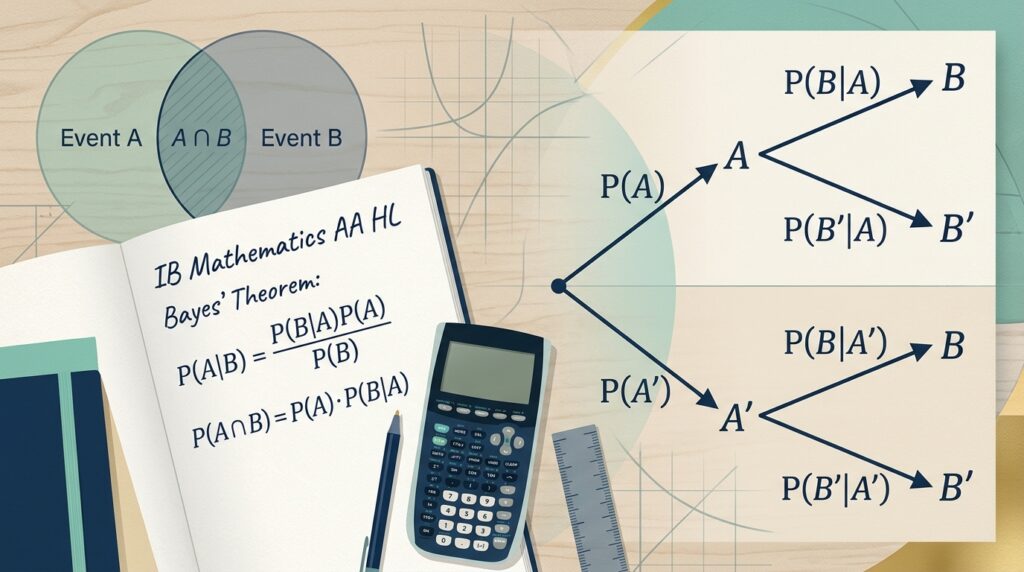
Try these questions before reading the answers.
Question 1: Basic conditional probability
A group contains 100 students. Of these, 45 study Biology, 60 study Chemistry, and 30 study both subjects.
A student is selected from those who study Chemistry.
Find the probability that the student also studies Biology.
Question 2: Conditional probability in a table
A survey records whether students travel to school by bus and whether they arrive before 8:00 am.
| Before 8:00 am | At or after 8:00 am | Total | |
|---|---|---|---|
| Travels by bus | 36 | 24 | 60 |
| Does not travel by bus | 18 | 22 | 40 |
| Total | 54 | 46 | 100 |
Find the probability that a student travels by bus, given that they arrive before 8:00 am.
Question 3: Probability tree
A factory uses two machines.
- Machine A produces 70% of the items.
- Machine B produces 30% of the items.
- Machine A produces defective items with probability 0.02.
- Machine B produces defective items with probability 0.05.
Find the probability that a randomly selected item is defective.
Question 4: Independence
Events A and B have:
[
P(A)=0.4,\quad P(B)=0.5
]
and:
[
P(A\cap B)=0.2
]
Determine whether A and B are independent.
Question 5: Bayes’ theorem
A company receives 60% of its orders from Supplier A and 40% from Supplier B.
Supplier A has a defect rate of 2%, while Supplier B has a defect rate of 5%.
An item selected at random is found to be defective.
Find the probability that it came from Supplier B.
Answers
Question 1
[
P(Biology\mid Chemistry)=\frac{30}{60}
]
[
\boxed{0.5}
]
Question 2
[
P(Bus\mid Before\ 8{:}00)=\frac{36}{54}
]
[
\boxed{\frac23}
]
Question 3
[
P(Defective)=0.70(0.02)+0.30(0.05)
]
[
=0.014+0.015
]
[
\boxed{0.029}
]
Question 4
[
P(A)P(B)=0.4(0.5)=0.2
]
This equals (P(A\cap B)), so the events are independent.
Question 5
First calculate the overall defect probability:
[
P(D)=0.60(0.02)+0.40(0.05)
]
[
=0.012+0.020=0.032
]
Then:
[
P(B\mid D)=\frac{0.40(0.05)}{0.032}
]
[
\boxed{0.625}
]
The probability is 62.5%.
11. How to improve at conditional probability
Reading a worked solution can help you understand a method, but you need to practise choosing the method yourself.
Use this routine:
Start with simple questions.
Practise identifying the condition and selecting the correct denominator.
Move to tables and trees.
Learn to translate written information into a clear mathematical structure.
Practise reversing conditional probabilities.
Use Bayes’ theorem to distinguish between the probability of a result given a cause and the probability of a cause given a result.
Mix different question types.
Do not practise only questions that announce which formula to use. In an examination, you need to recognise the structure yourself.
Review your working.
If your answer is wrong, identify whether the problem came from interpreting the condition, choosing the formula, calculating the denominator, or simplifying the result.
12. How Mathzem can help you practise probability questions
Conditional probability questions often involve several connected steps. A correct formula does not guarantee a correct answer if you have interpreted the information incorrectly.
Mathzem supports IB Mathematics practice through topic based questions and handwritten solution review.
You can select your IB Mathematics course, practise a relevant topic, solve the question on paper, and upload your working for AI Examiner feedback.
This gives you an opportunity to review where your method went wrong, whether you selected the correct conditional probability, and whether your calculations followed the information in the question.
Mathzem provides AI generated learning feedback and estimated marks. It does not provide official IB marking.
Frequently Asked Questions
What is the difference between (P(A\mid B)) and (P(B\mid A))?
(P(A\mid B)) is the probability of A when B is already known to have happened. (P(B\mid A)) is the probability of B when A is already known to have happened. They are not generally equal.
When should I use Bayes’ theorem?
Use Bayes’ theorem when you know a conditional probability in one direction but need the probability in the reverse direction.
How do I know which probability goes in the denominator?
In (P(A\mid B)), the denominator is (P(B)). The event after the vertical line is the condition.
Are independent events always mutually exclusive?
No. Independent events can happen together. Mutually exclusive events cannot happen together. If two mutually exclusive events both have positive probability, they are not independent.
Can I use a probability tree for Bayes’ theorem questions?
Yes. A probability tree can help you calculate the joint probabilities and the total probability needed for Bayes’ theorem.
Does conditional probability appear in IB Maths AA HL?
Conditional probability is included in Mathzem’s AA HL syllabus coverage. Check the official syllabus and assessment guidance for your examination session when planning revision.
Final thoughts
Conditional probability is about using information correctly.
Before calculating, identify what is already known. Then choose the right group, denominator, and formula.
Remember the main relationships:
[
P(A\mid B)=\frac{P(A\cap B)}{P(B)}
]
[
P(A\cap B)=P(A)P(B\mid A)
]
[
P(A\mid B)=\frac{P(B\mid A)P(A)}{P(B)}
]
Practise with tables, probability trees, independence questions, and Bayes’ theorem. Most importantly, explain what each probability represents.
That habit will help you avoid reversing conditions and make your working easier to check.