Getting a question wrong can be frustrating. Getting the same type of question wrong repeatedly is even more frustrating.
But mistakes are useful when you understand why they happened and use that information to change how you approach the next question.
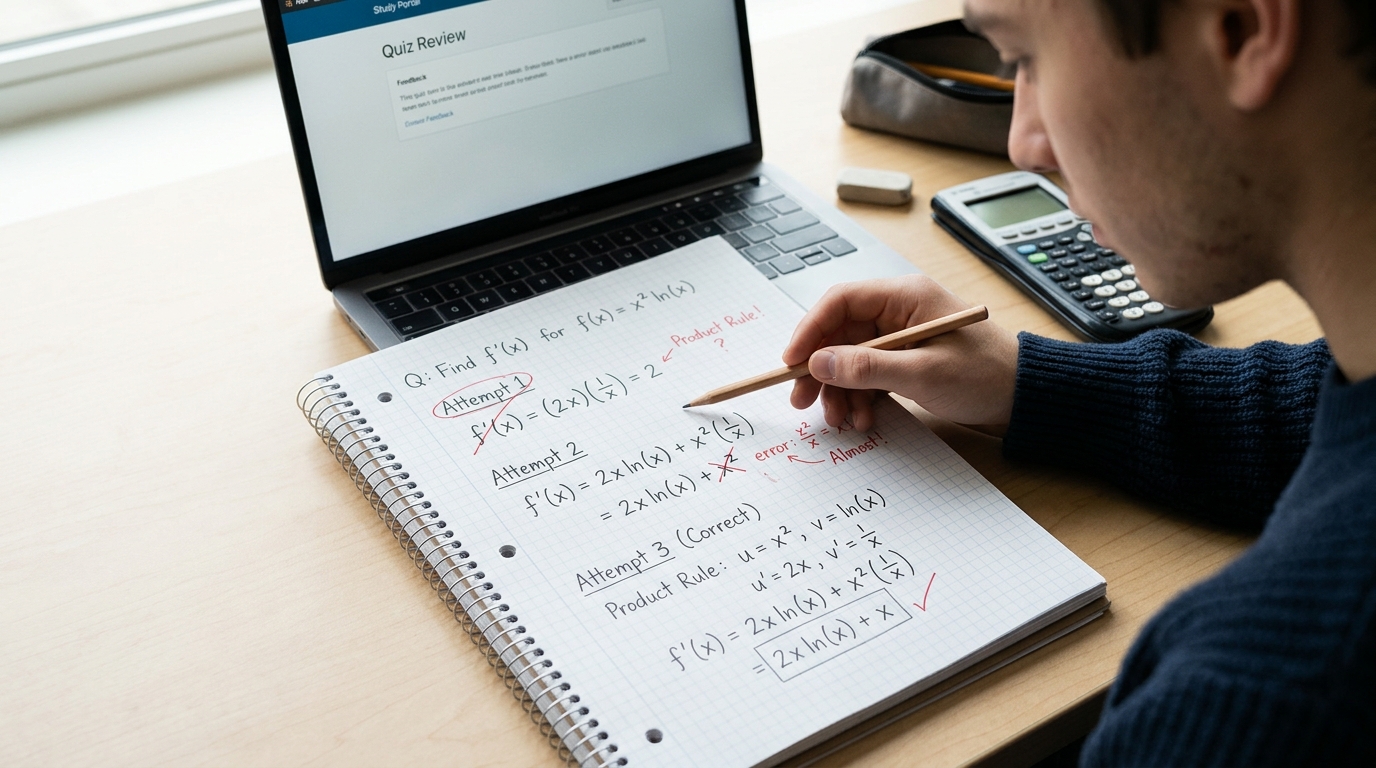
For IB Mathematics students, a mistake journal can turn incorrect answers into specific learning goals. Instead of simply checking the correct solution and moving on, you record the error, identify its cause, correct your approach, and test whether you can avoid the same mistake in a new question.
This article explains how to build that habit and how Mathzem’s Mistake Journal for IB Maths Revision supports evidence-based progress tracking.
Table of Contents
What Is a Mistake Journal for IB Math Revision?
A mistake journal is a record of mathematical errors you make while practicing. Its purpose is not simply to collect incorrect answers. It helps you understand recurring problems and take action to correct them.
For example, imagine you repeatedly make sign errors when expanding brackets or differentiating expressions.
If you only correct the answer and continue to the next question, you may not notice the pattern. But if you record the error, identify when it occurs, and practice checking that specific step, you can begin addressing the underlying problem.
A useful mistake journal should help you answer four questions:
- What mistake did I make?
- Why did I make it?
- What should I do differently next time?
- Can I solve a similar question correctly without help?
The final question is especially important. Understanding a correction is not the same as demonstrating that you can apply it independently.

Why IB Mathematics Students Repeat the Same Mistakes
Most mathematical errors do not happen randomly. They often come from habits, gaps in understanding, or difficulties applying a method under exam conditions.
Here are six common examples.
1. Sign errors in algebra and trigonometry
You may understand the correct method but lose accuracy when handling negative numbers.
For example:
[
-(x-4)=-x+4
]
A student may incorrectly write (-x-4), changing the expression.
If this happens repeatedly, your journal should identify sign handling as the issue rather than simply recording that the algebra question was incorrect.
2. Arithmetic errors during calculations
You may choose the correct formula, substitute the correct values, and still arrive at an incorrect answer because of a calculation slip.
In this case, you may not need to relearn the entire topic. You need to identify where your calculation became inaccurate and develop a consistent checking habit.
3. Choosing the wrong formula or method
In probability and statistics, selecting the appropriate distribution is an important part of solving a question.
You might know how to use a binomial distribution but fail to recognise when the conditions of a question make it appropriate.
Record the decision error. Then practise identifying the relevant method before carrying out any calculations.
4. Missing part of a multi part question
Some students complete the first part of a question correctly but overlook a later instruction.
For example, a question may ask you to calculate a value and then interpret it in context. Providing only the numerical result leaves the second requirement unanswered.
Your journal should record that the interpretation was missing, not just that the final response was incomplete.
5. Giving a calculator answer without mathematical context
A calculator can produce a numerical result, but your written response may still need mathematical setup, notation, units, or interpretation.
If you repeatedly write only the calculator output, practise showing the relevant mathematical statement and explaining what the result means.
6. Weak mathematical communication
You may understand the mathematics but lose clarity because you omit variables, units, notation, or explanations.
Record the exact communication issue. Then review how to present the relevant reasoning in a complete mathematical solution.
How to Create an Effective IB Math Mistake Journal
You do not need complicated software to start. A notebook or digital document can work.
The important thing is to record enough information to make the mistake useful for future revision.
A practical entry should include the following:
| Journal field | What to record |
|---|---|
| Topic | Algebra, calculus, probability, etc. |
| Question | The question or a short reference to it |
| Mistake | The incorrect step or missing requirement |
| Cause | Why the error occurred |
| Correction | What the correct method requires |
| Retest | A similar question attempted independently |
For example:
Topic: Differentiation
Mistake: Incorrect derivative after applying the chain rule.
Cause: Differentiated the outer function but forgot to multiply by the derivative of the inner function.
Correction: Identify the inner and outer functions before differentiating.
Retest: Attempt another composite function without looking at the previous solution.
This is far more useful than writing, “I got the differentiation question wrong.”
A Five Step Process for Learning From Every Mistake
Recording an error is only the beginning. The real improvement comes from what you do afterwards.
Step 1: Attempt the question independently
Start by solving the question without immediately looking at the answer.
Write down your method and show the intermediate steps. This gives you something meaningful to review.
If you are stuck, identify the exact point where you cannot continue rather than abandoning the entire question.
Step 2: Identify the exact incorrect step
Review your working and locate where the solution went wrong.
Was the formula incorrect? Did you make an algebraic error? Did you misunderstand the command term? Did you omit an explanation?
Be specific.
For example, “I chose the wrong distribution” is more useful than “I am bad at probability.”
Step 3: Understand the reason behind the mistake
This is where you need to go beyond correcting the answer.
Ask why the mistake happened.
Perhaps you memorised a formula without understanding its conditions. Perhaps you rushed through a negative sign. Perhaps you recognised a familiar question pattern and applied a method without checking whether it was appropriate.
Understanding the cause helps you choose the right corrective action.
Step 4: Correct the original question
Return to the original problem and solve it again using the correct method.
Do not simply copy the model solution. Try to reconstruct the reasoning yourself.
If necessary, use a hint or explanation to understand a difficult step, then complete the rest independently.
Step 5: Practise a similar question
This is the most important test.
A student may understand why an earlier answer was incorrect but still repeat the same mistake when the numbers or wording change.
Attempt a similar question without looking at the previous solution.
If you can apply the method correctly, you have stronger evidence that the correction is becoming part of your mathematical understanding.
If the same mistake appears again, keep working on it rather than assuming it has been resolved.
How Mathzem’s Mistake Journal Helps You Track Progress
A mistake journal becomes more useful when it helps you see how your errors change over time.
Mathzem includes a mistake journal designed to track mistake patterns and their progression. Its mistake states can include:
- Open: The mistake still needs attention.
- Improving: There is evidence that the student is making progress.
- Fixed or resolved: There is sufficient evidence that the issue has been corrected.
These states should reflect learning evidence, not simply a student’s feeling that they understand the explanation.
For example, suppose you make a sign error in an algebra question.
After reviewing the feedback, you correct the original solution and practise another question. Your later attempt may provide evidence that you have improved.
If the same error appears again, it should not be treated as permanently resolved.
This is an important distinction: progress should be based on what you can demonstrate in your mathematical working.
How the Mistake Journal and Weakness Map Work Together
The Mistake Journal and Weakness Map provide different perspectives on your learning.
The Weakness Map helps surface topics and focus areas where your performance indicates that more practice may be needed.
The Mistake Journal focuses on the errors themselves and how they change over time.
Imagine that your Weakness Map identifies calculus as an area needing attention.
Your Mistake Journal may reveal that one recurring problem is forgetting the chain rule when differentiating composite functions.
Now you have a much clearer revision target.
Instead of spending an entire session vaguely revising calculus, you can practise composite functions, review your working, and test whether the specific error is becoming less frequent.
One tool helps identify where to focus. The other helps you understand what needs correcting.
Mistake Journal for IB Math Revision Example: A Probability Question
Imagine you are solving a probability question involving a binomial distribution.
You select the correct distribution but substitute the wrong value for the number of trials.
Your final probability is therefore incorrect.
A useful journal entry might look like this:
Topic: Probability
Mistake: Used the wrong number of trials.
Cause: Confused the number of successful outcomes with the total number of trials.
Correction: Identify the total number of independent trials before substituting values into the binomial model.
Retest: Solve another question with different values and identify the parameters before calculating.
The next time you encounter a similar question, pause before using the calculator.
Identify the variables, check the assumptions, and confirm that each parameter represents the correct quantity.
This is how a recorded mistake becomes a practical exam habit.
Five Mistake Journal Habits That Make Revision More Effective
1. Record mistakes soon after attempting questions
The reasoning behind an error is easier to remember immediately after you have worked through the problem.
2. Use specific descriptions
Write “forgot to apply the chain rule” instead of “calculus mistake.”
Specific records lead to more useful revision tasks.
3. Look for recurring patterns
One arithmetic error may be an isolated slip. Similar errors across several attempts may indicate a habit that needs attention.
Avoid making broad conclusions from a single question.
4. Retest yourself
Do not consider a mistake corrected simply because you understand the explanation. Attempt a new question independently.
5. Revisit unresolved mistakes
A mistake that continues to appear deserves further attention. Include it in your revision rather than repeatedly practising only the topics you already find comfortable.
Turn Your Mistakes Into Better IB Math Performance
Improving in IB Mathematics does not mean never making mistakes. It means becoming better at recognising, understanding, and correcting them.
A useful mistake journal changes the way you respond to an incorrect answer.
Instead of thinking, “I got this wrong again,” ask:
- What exactly went wrong?
- Is this an isolated error or a recurring pattern?
- What should I practise to correct it?
- Can I now solve a similar question independently?
Mathzem brings practice, question specific AI Tutor guidance, AI Examiner feedback, the Weakness Map, and the Mistake Journal into a connected learning process.
You can practise an IB style question, review your written working, understand the error, and use that evidence to guide your next practice session.
Explore the learning tools at Mathzem.
Do not let the same mistake cost you learning opportunities twice. Record it, understand it, correct it, and prove that you can do better on the next question.