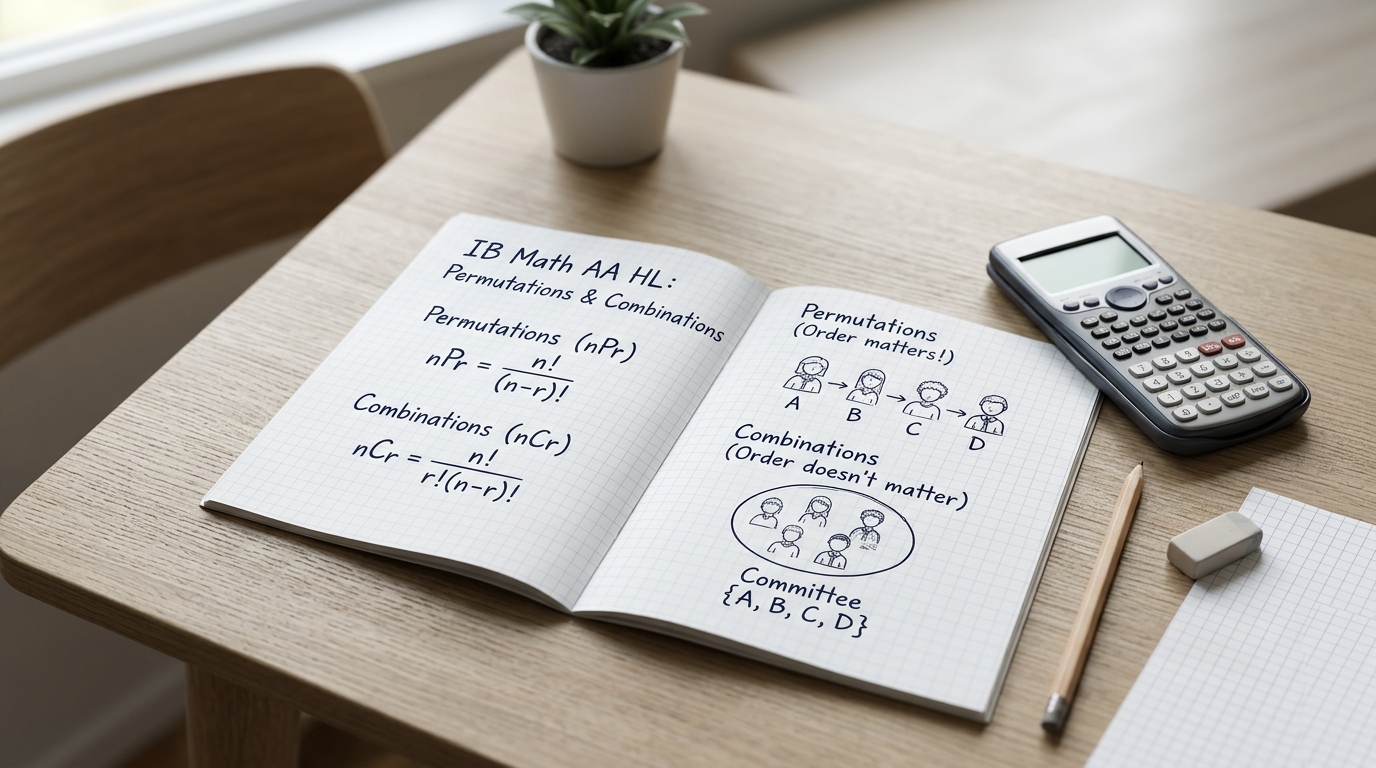
IB Maths AA HL Permutations and combinations are counting methods used to calculate how many different outcomes are possible.
The difficult part is often not the calculation. It is deciding which method the question requires.
If you are arranging students in a row, the order usually matters. If you are selecting students for a committee, the order usually does not matter. Choosing the wrong method can produce a completely different answer, even when your calculations are correct.
This guide explains how to recognise the difference, use factorials, solve questions with restrictions and avoid common mistakes in IB Maths AA HL.
Table of Contents
1. Start with the fundamental counting principles
Before using permutations or combinations, understand the two basic rules of counting.
The multiplication principle
Use multiplication when a task involves a sequence of choices.
Suppose you have four shirts and three pairs of trousers. If every shirt can be worn with every pair of trousers, the number of possible outfits is:
[
4\times3=12
]
You have four choices for the shirt and three choices for the trousers.
The addition principle
Use addition when you are choosing between separate alternatives that cannot happen together in the same outcome.
Suppose a student can travel by one of four bus services or one of two train services. If the options are distinct, the number of choices is:
[
4+2=6
]
The key distinction is whether you are combining choices or selecting between alternatives.
For longer questions, identify each stage of the process before deciding whether to multiply, add, or use a more specialised counting formula.
2. Understand factorials
Factorials appear in both permutations and combinations.
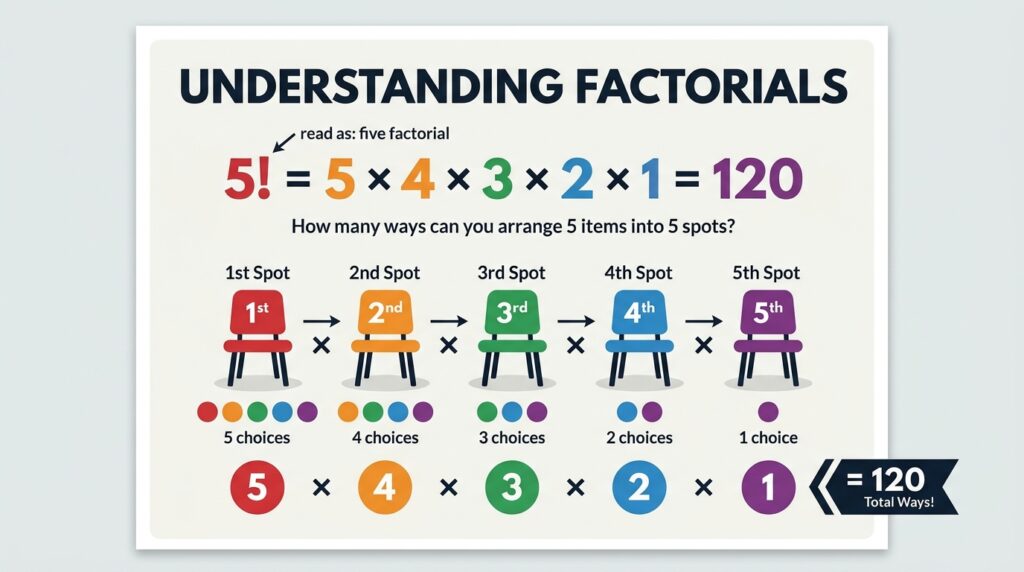
The factorial of a positive integer (n), written (n!), is the product of all positive integers from (n) down to one.
For example:
[
5!=5\times4\times3\times2\times1=120
]
Similarly:
[
4!=24
]
By definition:
[
0!=1
]
Factorials help count arrangements of distinct objects.
For example, five different books can be arranged on a shelf in:
[
5!=120
]
ways.
There are five choices for the first position, four remaining choices for the second, three for the third, two for the fourth and one for the final position.
Therefore:
[
5\times4\times3\times2\times1=120
]
This reasoning leads directly to the permutation formula.
3. What is a permutation?
A permutation counts arrangements in which order matters.
Suppose five students are competing for two distinct roles: captain and vice captain.
Choosing Alex as captain and Sam as vice captain is different from choosing Sam as captain and Alex as vice captain.
The positions are different, so the order matters.
The formula for selecting and arranging (r) objects from (n) distinct objects is:
[
{}^nP_r=\frac{n!}{(n-r)!}
]
Here, (n) is the total number of available objects and (r) is the number of positions being filled.
Worked example: Assigning roles
Five students are available for the roles of captain and vice captain. How many different assignments are possible?
Step 1: Identify the values.
[
n=5,\qquad r=2
]
Step 2: Use the permutation formula.
[
{}^5P_2=\frac{5!}{(5-2)!}
]
[
=\frac{5!}{3!}
]
Cancel the common factorial terms:
[
=5\times4
]
Therefore:
[
\boxed{20}
]
There are 20 possible assignments.
You can also obtain the answer using the multiplication principle: five choices for captain, followed by four remaining choices for vice captain.
Both methods work. The important part is recognising that the two roles are distinct.
4. What is a combination?
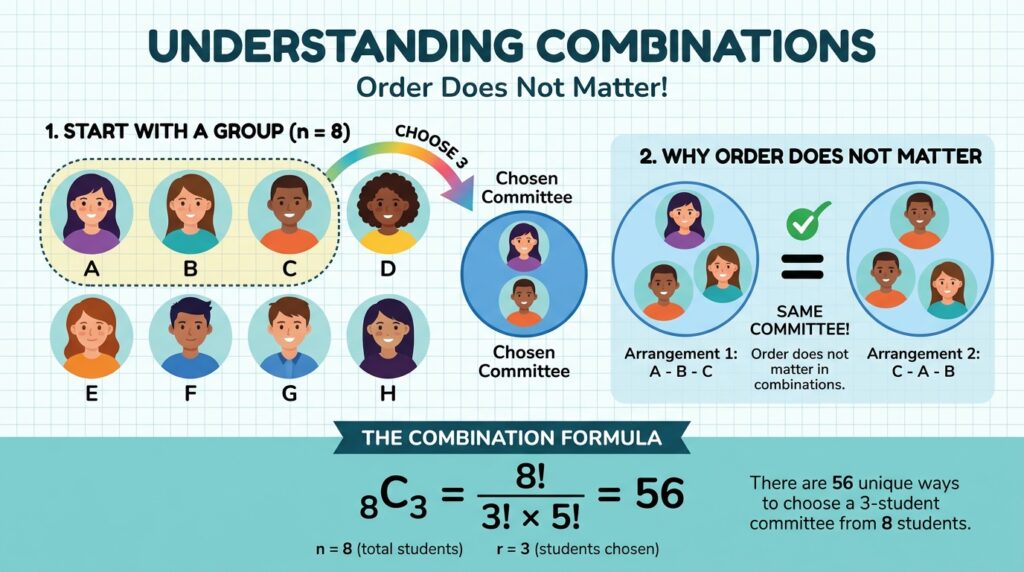
A combination counts selections in which order does not matter.
Suppose five students are available and you need to select two for a committee. Selecting Alex and Sam gives the same committee as selecting Sam and Alex.
The order does not create a new outcome.
The formula for choosing (r) objects from (n) distinct objects is:
[
{}^nC_r=\frac{n!}{r!(n-r)!}
]
You may also see this written as:
[
\binom{n}{r}
]
Both notations represent the same quantity.
Worked example: Selecting a committee
A group contains eight students. How many different committees of three students can be selected?
Step 1: Identify the values.
[
n=8,\qquad r=3
]
Step 2: Apply the combination formula.
[
{}^8C_3=\frac{8!}{3!5!}
]
Cancel the common factorial terms:
[
=\frac{8\times7\times6}{3\times2\times1}
]
[
=\frac{336}{6}
]
Therefore:
[
\boxed{56}
]
There are 56 possible committees.
Notice that we do not count the same committee several times just because its members can be listed in different orders.
5. How to decide between permutations and combinations
Use this question before selecting a formula:
Would changing the order produce a different outcome?
If the answer is yes, a permutation may be appropriate. If the answer is no, a combination may be appropriate.
| Question | Method | Reason |
|---|---|---|
| Selecting a committee of three | Combination | The selected members form the same committee in any order. |
| Assigning president, secretary, and treasurer | Permutation | Each role is different. |
| Choosing five questions from a list | Combination | The order of selection is irrelevant. |
| Arranging four students in a row | Permutation | Different positions produce different arrangements. |
| Selecting a team captain from a group | Permutation with one position, or direct counting | Each person represents a distinct possible choice. |
Do not rely only on keywords. The word “choose” often suggests a combination, but the complete situation determines the method.
For example, choosing three people and assigning each a different role involves arrangements, even though the question begins with the word “choose.”
6. How to solve permutation questions with restrictions
Some questions include conditions such as
- A particular person must be selected.
- Two people cannot both be selected.
- A number cannot begin with zero.
- A particular role must be assigned to one of several people.
These conditions change the number of available choices.
Worked example: Forming four digit numbers
How many four digit numbers can be formed using the digits 0 to 9 if no digit can be repeated?
Step 1: Count the choices for the first digit.
The first digit cannot be zero. There are nine choices, from 1 to 9.
Step 2: Count the choices for the second digit.
One digit has already been used. There are nine remaining choices, including zero if it has not been used.
Step 3: Count the remaining choices.
There are eight choices for the third digit and seven for the fourth.
Step 4: Multiply the choices.
[
9\times9\times8\times7
]
Therefore:
[
\boxed{4536}
]
There are 4536 possible four digit numbers.
A common mistake is to calculate (10\times9\times8\times7). That would include arrangements beginning with zero, which are not four digit numbers.
The lesson is to apply every restriction before multiplying.
7. How to handle questions involving a group that must stay together
Consider five distinct students who must stand in a row. Two particular students, A and B, must stand next to each other.
Treat A and B as a single block.
You now have four units to arrange: the block containing A and B, plus the other three students.
These four units can be arranged in:
[
4!=24
]
ways.
Within the block, A and B can stand in two orders:
[
AB\quad\text{or}\quad BA
]
Therefore, the total number of arrangements is:
[
4!\times2!
]
[
=24\times2
]
[
\boxed{48}
]
This block method is useful when a question requires particular objects or people to remain together.
Always check whether the order within the block can change. If it can, include those internal arrangements in your calculation.
8. How to count selections with a restriction
Sometimes it is easier to count all possible outcomes and subtract those that are not allowed.
This is called complementary counting.
Worked example: Selecting a committee
A committee of three students must be selected from eight students. Two particular students, A and B, cannot both be on the committee.
First, count all committees of three:
[
{}^8C_3=56
]
Now count the committees that contain both A and B.
If A and B are already selected, the third member can be any one of the remaining six students.
There are therefore six forbidden committees.
Subtract these from the total:
[
56-6
]
[
\boxed{50}
]
There are 50 valid committees.
This approach is often quicker than separating the allowed cases into several categories.
However, make sure the cases you subtract cover every forbidden outcome exactly once.
9. Common mistakes in permutations and combinations
Using a permutation when a combination is needed
If order does not change the outcome, counting different arrangements can overcount the answer.
Ask whether the same selected group can be listed in different orders without creating a new outcome.
Using a combination when order matters
Different roles, positions or rankings usually make order important.
For example, first place and second place are distinct outcomes.
Misinterpreting the restriction
A condition such as “cannot be first” changes the number of choices for the first position. It does not necessarily affect every later position.
Apply each restriction to the stage where it matters.
Forgetting that choices decrease
When repetition is not allowed, an object that has already been selected cannot be chosen again.
The number of available choices may decrease at each stage.
Expanding factorials unnecessarily
In expressions such as:
[
\frac{8!}{6!}
]
you can cancel the common factorial terms directly:
[
8\times7
]
This reduces arithmetic and makes your working clearer.
Failing to explain the counting method
For a multi stage question, briefly explain what each factor represents. This makes your reasoning easier to follow and helps you identify errors.
10. A focused revision plan
Use this five session plan to improve your counting skills.
Session 1: Counting principles and factorials
Practise multiplication and addition principles, followed by factorial calculations.
Session 2: Permutations
Work on arranging objects and assigning distinct roles. Explain why order matters in each question.
Session 3: Combinations
Practise selecting groups, committees and teams. Check that you are not counting the same group more than once.
Session 4: Restrictions
Solve questions involving positions, forbidden selections and objects that must stay together.
Session 5: Mixed exam questions
Attempt questions without deciding the method in advance. Identify the outcome, consider whether order matters, and select the appropriate counting method.
After each session, review incorrect answers. Do not simply memorise the correct formula. Explain why your original choice was wrong, then attempt a similar question independently.
11. How Mathzem can support your practice
Understanding the formula is only part of solving an IB Maths AA HL counting question. You also need to identify the structure of an unfamiliar problem and apply the correct method.
Mathzem allows you to practise IB style mathematics questions, upload your handwritten working and receive AI Examiner feedback on estimated marks, mistakes and your method.
For permutations and combinations, reviewing your working can help you check whether you identified the correct number of choices, applied restrictions consistently and explained your reasoning clearly.
Start with Mathzem IB Practice and read how AI Examiner feedback works.
The aim is to develop a repeatable process: understand what counts as a distinct outcome, choose the correct method, and check whether your answer fits the conditions.
Frequently asked questions about IB maths AA HL permutations
1. What is the difference between a permutation and a combination?
A permutation counts arrangements where order matters. A combination counts selections where order does not matter.
2. How do I know which formula to use?
Ask whether changing the order creates a different outcome. If it does, a permutation is usually appropriate. If it does not, a combination is usually appropriate.
3. What does factorial mean in counting questions?
The factorial of a positive integer is the product of all positive integers up to that number. For example, (4!=24).
4. How should I approach restrictions in counting questions?
Identify exactly which outcomes are allowed or forbidden. Then either adjust the available choices at each stage or count all outcomes and subtract the forbidden cases.
5. How can I improve at IB Maths AA HL counting questions?
Practise permutations and combinations separately first, then move to mixed questions with restrictions. Review why each method applies instead of memorising formulas alone.
Final takeaway
The most important skill in permutations and combinations is recognising what counts as a different outcome.
When order matters, consider permutations. When order does not matter, consider combinations. For restrictions, break the problem into stages or use complementary counting when it simplifies the reasoning.
With consistent practice, these questions become less about guessing a formula and more about building a clear counting argument.