Mathematically, Mathzem AI Tutor solve IB math questions step by step. IB Math Questions Step by Step
You are working on an IB Math question; the topic is clear, but something isn’t clicking.
Maybe you cannot identify the right method. Maybe you have started solving the question but do not know the next step. Or perhaps you can follow a worked solution but struggle to reproduce the steps on your own.
This is a common revision problem.
The answer isn’t always to read the full solution or ask someone to solve the question for you. Often, you need help with one specific part of the problem.
That is where step-by-step guidance can be useful.
Mathzem AI Tutor helps students work through IB Mathematics questions with different levels of support, from a small hint to a full explanation.
The key is to use that help without giving up your own mathematical thinking.
Table of Contents
Getting stuck is part of learning mathematics.
When you practise IB Math, not every question will feel straightforward.
You might know the relevant formula but not recognise when to use it.
You might choose the right method but make an algebraic error.
You might complete the first few steps correctly and then lose track of the reasoning.
These situations require different kinds of help.
If you consistently focus on a complete solution, you may overlook the opportunity to pinpoint the exact moment your understanding falters.
Instead, pause and ask yourself:
What do I not understand right now?
Is it the concept, the method, the next step, or a calculation?
Once you identify the problem, you can ask for more specific help.
How Mathzem AI Tutor works
Mathzem AI Tutor stays connected to the exact IB Math question you are working on.
This means you can ask for help in the context of your current problem rather than explaining the whole question again.
The tutor offers different types of support, so you can choose the level of guidance that suits your situation and response needs.
Here is how to use each one effectively and when each response is appropriate.
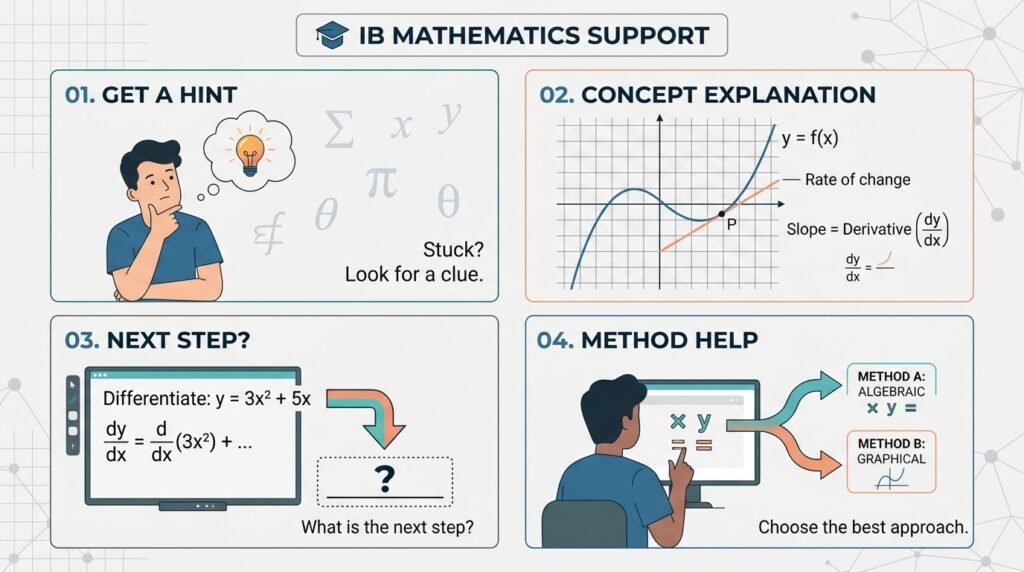
1. Ask for a hint when you want to keep thinking.

A hint is useful when you are close to making progress but need a small push.
Suppose you are solving a question involving differentiation. You have identified the function, but you are unsure how to begin.
Rather than asking for the complete solution, ask for a hint.
A useful hint should point you toward a relevant idea without doing all the work for you.
After receiving the hint:
- Read it carefully.
- Return to your work.
- Try the next step yourself.
- Check whether your approach makes sense.
This keeps you actively involved in solving the problem.
Best for: Students who understand most of the question but need help getting started or progressing.
2. Ask for an explanation when the concept is unclear.
Sometimes a hint is not enough.
You may not understand why a particular method works or what a mathematical expression means.
In this situation, ask for an explanation.
For example, you might understand how to differentiate a function mechanically but struggle to understand why the derivative helps solve a particular problem.
An explanation can help you connect the mathematical idea to the task you are trying to complete.
When using this type of support, focus on understanding the reasoning rather than memorising the wording.
Ask yourself:
- Why does this method apply here?
- What information in the question suggests using it?
- How would I recognise a similar problem in an exam?
The aim is to build understanding you can reuse.
Best for: Students who can follow steps but do not fully understand the underlying mathematics.
3. Ask for the next step when you lose momentum
Sometimes you understand the concept and have started correctly, but you cannot see what comes next.
This is different from not understanding the whole question.
You may have written the correct equation, simplified an expression, or calculated an initial value. The difficulty is continuing from there.
Ask the tutor for the next step.
Then try to complete that step yourself before asking for more help.
This approach is especially useful for multi-step questions, where understanding the sequence of operations matters.
Do not rush to reveal the entire solution if one more step is enough to keep you moving.
Best for: Students who have started a solution correctly but are unsure how to continue.
4. Ask for method help when you do not know what approach to use.
IB Mathematics questions often require you to recognise the right method before you start calculating.
You might know several formulas or techniques but be unsure which one fits the question.
For example, a question may include a function, a graph, and a condition you need to satisfy. You need to decide which mathematical relationship to use before calculating.
In this situation, ask for help with the method.
Focus on the connection between the wording of the question and the mathematics required.
Once you understand why a method applies, try to carry out the calculations independently.
This helps you practise an important exam skill: choosing an approach rather than simply following a familiar procedure.
Best for: Students who know the mathematics but struggle to decide which method a question requires.
5. Ask for a full solution when you need the complete reasoning.
Sometimes you make a genuine effort and still cannot solve the problem.
Perhaps you don’t understand the central concept, or several steps depend on one another in a way that is hard to follow.
A full solution can help in these situations.
However, how you review it matters.
Do not simply read the answer and move on to the next question.
Instead:
- Identify the main method used.
- Understand why the method applies.
- Follow the reasoning behind each major step.
- Set aside the solution.
- Attempt the question again independently.
- Try another question that uses a similar skill.
The last two steps matter most.
Following a solution is not the same as producing one yourself.
Best for: Students who need to see the complete reasoning after trying other forms of help.
6. Use follow-up questions to clear up specific confusion.
Understanding a solution often leads to another question.
You may understand the first three steps but not the fourth. You may understand the calculation but not why a particular assumption was used.
This is where subsequent conversation becomes valuable.
Instead of saying, “I do not understand the solution,” identify the exact part that confuses you.
For example, ask:
- Why can this expression be simplified in this way?
- Why is this method appropriate for the question?
- What does this result tell me concerning the original problem?
- Where did my approach differ from the correct method?
Specific questions are easier to act on because they focus attention on one gap in understanding.
Mathzem AI Tutor supports continued discussion around the question you are working on, helping you explore the reasoning rather than treating every question as a new topic.
A practical example of step-by-step tutoring
Imagine you are working on an IB Math question involving a quadratic function.
You need to determine an unknown value using a condition given in the question.
You know some relevant algebra, but you are unsure how to begin.
Here is one way to approach the problem with the tutor.
Stage 1: Attempt the question.
Read the condition and write down what you know. Try to express the information mathematically.
Stage 2: Ask for a hint.
If you cannot see how to start, ask for a hint rather than the full solution.
Use the hint to identify a possible relationship.
Stage 3: Continue independently.
Try applying the relationship yourself. If you are unsure how to proceed, ask for the next step.
Stage 4: Check your method.
If you are still confused about why the approach works, ask for method help or an explanation.
Stage 5: Complete the solution.
Finish the calculations and write a clear final answer.
Stage 6: Review your grasp.
Ask yourself whether you could solve a similar question without the same support.
This process turns the tutor into a learning guide instead of a source of answers to copy.
How to avoid becoming dependent on AI help
AI tutor solve IB Math is most useful when it supports your thinking, not when it replaces it.
If you ask for a full solution before attempting every question, you may learn the steps but not learn when or how to apply them independently.
Use these rules to keep your practice productive.
Try before asking.
Even a short attempt can show what you understand and where you need help.
Use the smallest useful hint.
Start with a hint or next step when possible. Ask for more support if you still need it.
Explain the method in your own words.
After reviewing a solution, explain why the main steps work. If you cannot explain them, revisit the relevant concept.
Reattempt the question.
Try solving it again without looking at the explanation.
Test the skill on another question.
A similar question can help you check whether you have learned the method rather than memorised one answer.
These habits help turn guided practice into independent mathematical ability.
How the tutor fits into your wider revision routine
The tutor is one part of a larger learning process.
You can begin with a question from Mathzem IB Practice, attempt it independently, and use the tutor when you need guidance.
Once you have completed your work, you can use the AI Examiner workflow to review your submitted solution where available.
If the feedback identifies a mistake you do not understand, return to the tutor and discuss that specific issue.
Then practise the skill again.
The complete learning cycle looks like this:
Practise → Attempt → Ask for targeted help → Complete the question → Review your working → Correct the mistake → Practise again.
Each stage serves a purpose.
The attempt shows what you can do independently.
The tutor helps you work through difficulties.
The examiner provides feedback on your submitted work.
Correcting and repeating practice helps you test whether you understand the mathematics.
Try this in your next IB Math question session.
Choose one question from a topic you find difficult.
Before asking for help, spend a few minutes trying it on your own.
Then use this simple decision rule:
- If you do not know how to begin, ask for a hint.
- If you do not understand the concept, ask for an explanation.
- If you know the method but cannot proceed, ask for the next step.
- If you cannot choose an approach, ask for method help.
- If you have tried and still cannot understand the problem, review a full solution.
After finishing the question, explain the method in your own words and attempt a similar question.
This gives you a practical way to check whether the help has improved your grasp.
Ready to practise? Explore Mathzem IB Practice and use the AI Tutor to work through your next IB Math question.
Final takeaway
You do not need the same kind of help for every difficult IB math question.
Occasionally you need a hint.
Sometimes you need a clearer explanation.
Sometimes you need help choosing a method or identifying the next step.
And sometimes you need to review the complete solution.
The key is to match the support to the problem you are facing.
Use the tutor to understand the mathematics, keep as much of the thinking as you can, and return to independent practice after receiving help.
The goal is not to solve one question with AI. It is to become more capable of solving the next question yourself.