Preparing for the IB Math AA HL exam tips can feel challenging, especially when exams cover a wide range of advanced topics. While understanding the syllabus is essential, your exam technique is just as important.
Many students lose marks because they rush, skip working, or misinterpret questions rather than because they don’t understand the mathematics.
This guide shares 15 practical exam tips that can help you maximise your marks across Paper 1, Paper 2, Paper 3, and your overall assessment.
Table of Contents
Why Exam Technique Matters
IB Maths exams reward more than correct answers.
Examiners also assess your ability to:
- Apply mathematical concepts
- Communicate your reasoning
- Use correct notation
- Select appropriate methods
- Solve unfamiliar problems
Strong exam technique can often be the difference between a 6 and a 7.
Tip 1: Know the Assessment Structure
Before revising, understand what each assessment requires.
| Assessment | Weight | Focus |
|---|---|---|
| Paper 1 | 30% | Non calculator mathematical reasoning |
| Paper 2 | 30% | Calculator based problem solving |
| Paper 3 | 20% | Extended Higher Level investigation |
| Internal Assessment | 20% | Mathematical exploration |
Tailor your revision to the skills tested in each paper.
Tip 2: Master the Fundamentals
Many difficult questions rely on simple mathematical skills.
Review topics such as:
- Algebra
- Functions
- Trigonometry
- Probability
- Calculus
A strong foundation makes advanced questions much easier.
Tip 3: Practise IB Style Questions
Textbook exercises are useful, but IB exam questions are different.
Regularly complete:
- Topic based questions
- Mixed questions
- Past paper questions
This helps you become familiar with IB command terms and marking style.
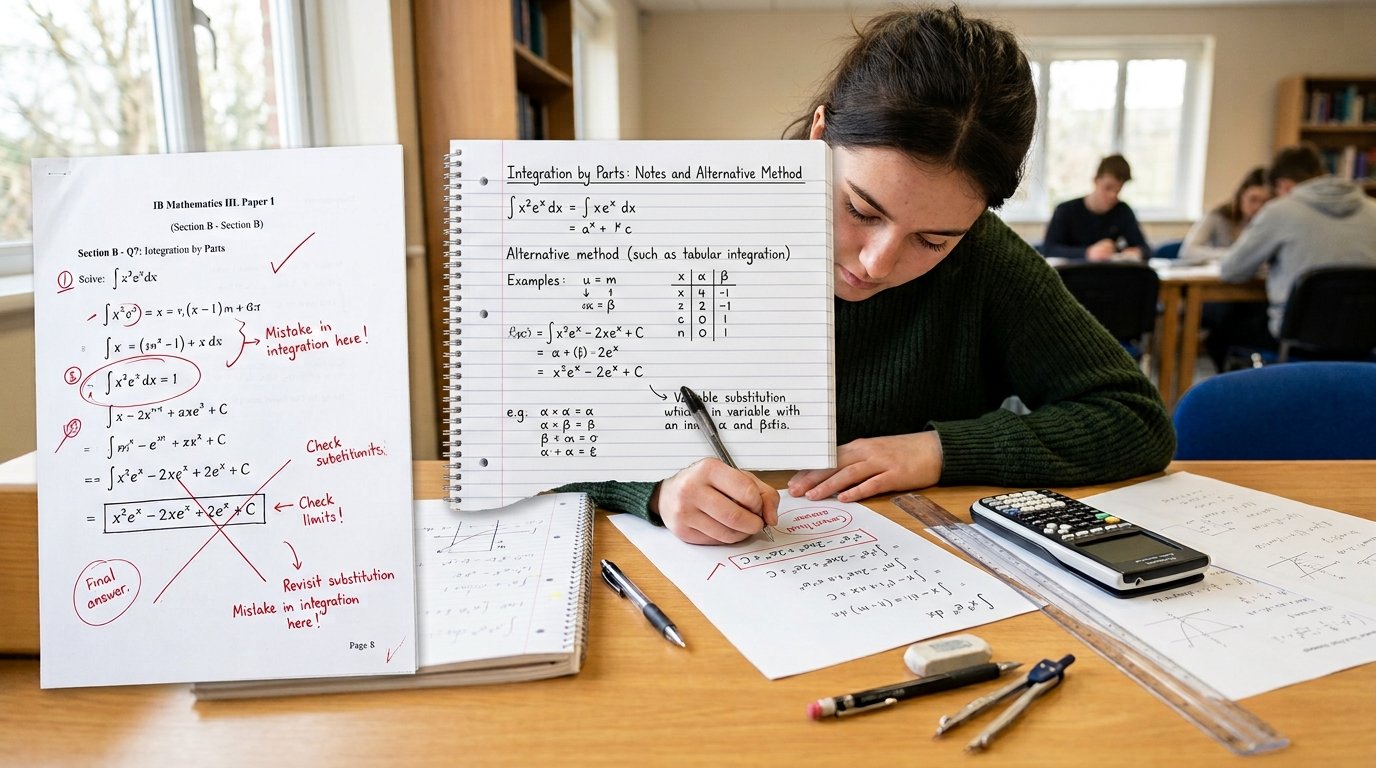
Tip 4: Learn From Every Mistake
Simply marking an answer as wrong isn’t enough.
Instead, ask:
- What caused the mistake?
- Was it conceptual?
- Was it algebra?
- Was it careless?
- How can I avoid repeating it?
Keeping a mistake log is one of the fastest ways to improve.
Tip 5: Show Your Working Clearly
IB examiners award method marks.
Even if your final answer is incorrect, clear mathematical working can earn valuable marks.
Avoid skipping steps unless they are completely obvious.
Tip 6: Manage Your Time
Don’t spend too long on one question.
If you’re stuck:
- Move on.
- Answer easier questions first.
- Return later with fresh thinking.
Leaving questions unanswered almost always costs more marks than making an educated attempt.
Tip 7: Read Every Question Carefully
Pay close attention to command terms such as:
- Show
- Hence
- Find
- Determine
- Justify
Missing one word can completely change what the examiner expects.
Tip 8: Check Your Calculator Skills
For calculator papers, know how to:
- Solve equations
- Find intersections
- Calculate statistics
- Use probability functions
- Work with matrices where appropriate
Practise these skills before exam day.
Tip 9: Don’t Memorise Solutions
IB questions often present familiar concepts in unfamiliar ways.
Instead of memorising examples, understand:
- Why a method works
- When to apply it
- How to adapt it
Understanding is much more valuable than memorization.
Tip 10: Review the Formula Booklet
Become familiar with the IB Formula Booklet before the exam.
Knowing where formulas are located saves time during the paper.
Remember that understanding when to use a formula is more important than simply recognising it.
Tip 11: Practice Under Exam Conditions
Complete full papers:
- Without interruptions
- Within the time limit
- Using only permitted resources
This builds both confidence and stamina.
Tip 12: Check Your Answers
If time remains, review:
- Signs
- Algebra
- Units
- Calculator entries
- Graph labels
- Final answers
Many easy marks can be recovered through careful checking.
Tip 13: Don’t Ignore Paper 3
Paper 3 often requires students to connect ideas from different topics.
Practise explaining your reasoning, not just performing calculations.
Tip 14: Build Confidence Gradually
Don’t compare yourself with other students.
Instead, measure progress by asking:
- Am I making fewer mistakes?
- Do I understand more concepts?
- Can I solve harder questions than last month?
Small improvements add up over time.
Tip 15: Revise Smart, Not Just Hard
Completing hundreds of questions is not always the best strategy.
Effective revision includes:
- Reviewing mistakes
- Strengthening weak topics
- Analysing examiner expectations
- Tracking your progress
Quality practice almost always beats quantity.
One Week Before the Exam
Use the final week to:
- Review summary notes
- Complete one or two timed papers
- Revise weak topics
- Check calculator functions
- Sleep well
- Avoid learning completely new material
Focus on reinforcing what you already know.
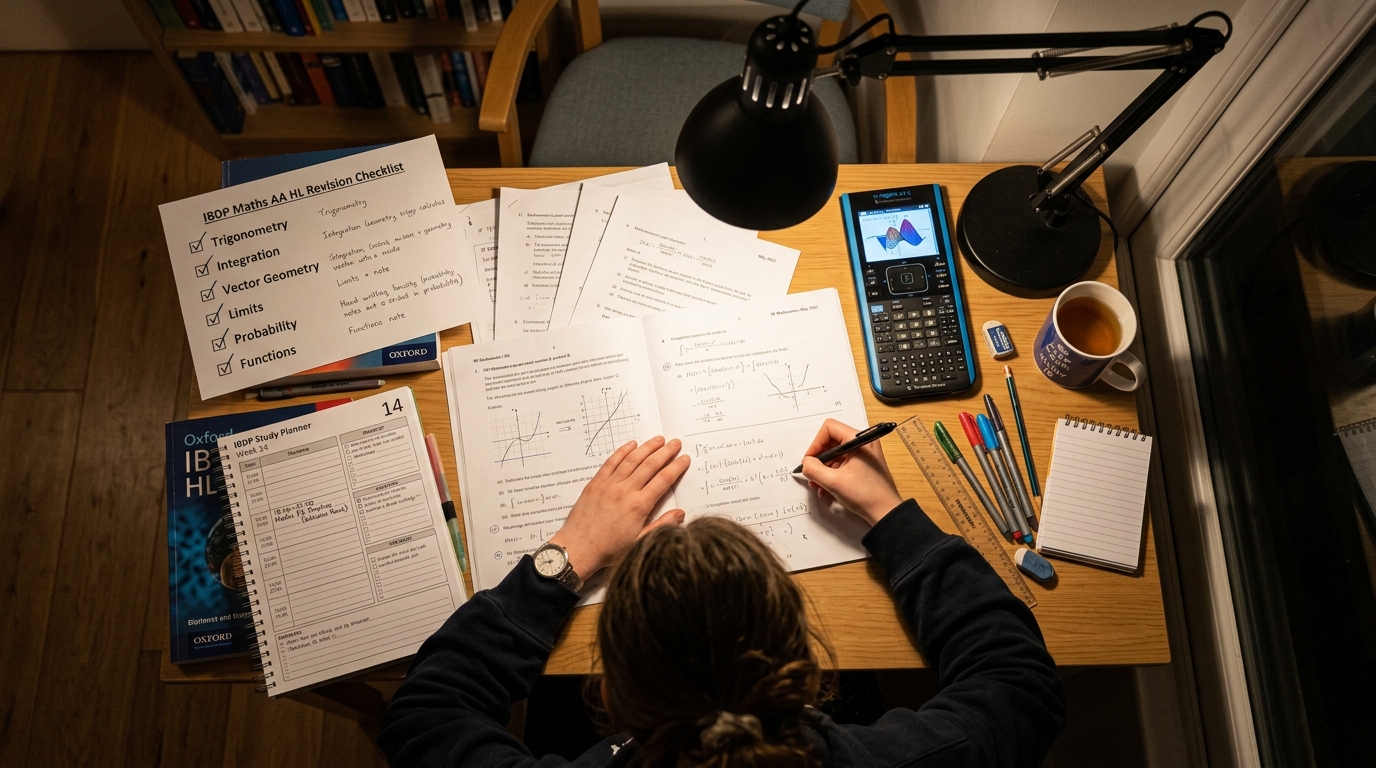
Exam Day Checklist
Before leaving for the exam, make sure you have:
- Approved graphing calculator
- Spare batteries or charger if permitted
- Pens and pencils
- Ruler
- Eraser
- Candidate information
Arriving prepared reduces unnecessary stress.
How Mathzem Helps You Prepare for IB Math AA HL Exams
Successful revision isn’t only about answering more questions. It’s about understanding where you lose marks.
Mathzem provides AI examiner style feedback after every practice question.
Upload your complete working and receive personalised feedback on:
- Marks awarded
- Missing method marks
- Calculation errors
- Weak syllabus topics
- Suggestions for improvement
Your personalised dashboard also helps you:
- Track progress across every topic
- Identify strengths and weaknesses
- Build a personalised revision plan
- Maintain a mistake journal
- Monitor improvement over time
This helps you spend more time improving the topics that will have the greatest impact on your final grade.
Frequently Asked Questions About IB Math AA HL Exam Tips
What is the best way to prepare for IB Math AA HL?
Study consistently, practise IB style questions, review mistakes carefully, and complete timed past papers.
How many past papers should I complete?
Quality matters more than quantity. Complete enough papers to become comfortable with the exam format, then carefully analyse every mistake.
Is exam technique really important?
Yes. Clear working, time management, and careful reading of questions can significantly improve your score.
How can I avoid careless mistakes?
Slow down when reading questions, show your working, and always leave time to check your answers before submitting your paper.
Conclusion
Strong preparation for IB Math AA HL is about more than learning formulas. The students who achieve the highest grades combine mathematical understanding with effective exam technique.
By practising consistently, reviewing mistakes, managing your time, and learning how IB examiners award marks, you’ll approach your exams with greater confidence.
Want to discover which topics need the most revision before your next exam? Start with the Math Skill Scanner:
Then upload your solutions to Mathzem IB Practice to receive AI examiner style feedback, identify weak areas, and build a personalised revision plan that helps you prepare more effectively for exam day: