Introduction to Problem with Traditional IB Maths Revision
Many IB Maths students revise in the same way.
They open the syllabus, start with the first topic, and work through every chapter one by one.
Functions this week.
Calculus next week.
Statistics after that.
The approach feels organised and productive.
Unfortunately, it often isn’t the most effective way to improve exam performance.
Table of Contents
The “study everything” problem
Traditional revision assumes every topic deserves equal attention.
In reality, that rarely happens.
A student might already be comfortable with functions and trigonometry but continue spending hours revising them because they feel familiar.
Meanwhile, probability or integration, the topics causing most of the lost marks, receive much less attention.
The result is obvious.
Students spend a lot of time studying but don’t improve where they need it most.
Most students don’t know their real weak areas
Ask an IB Maths student which topics they struggle with and you’ll often hear answers like:
- “Probably calculus.”
- “Maybe statistics.”
- “I’m not sure.”
The problem is that feelings are often inaccurate.
A student may believe calculus is their weakest topic because it feels difficult, while their exam results show they consistently lose more marks in algebra or probability.
Without data, students end up guessing what to revise.
Revision without feedback creates blind spots
After completing a practice paper, many students do one thing.
They check the mark.
If they scored 72%, they feel reasonably happy.
If they scored 58%, they decide to work harder.
But the percentage alone doesn’t answer the important questions:
- Which topic caused most of the lost marks?
- Which mistakes happen repeatedly?
- Which skills are improving?
- Which areas need immediate attention?
Without that information, revision becomes inefficient.
Effective revision is targeted revision
The highest scoring students rarely revise everything equally.
They focus their attention where it will create the biggest improvement.
That means:
- Spending less time on strengths.
- Spending more time on weaknesses.
- Tracking improvement over time.
- Adjusting revision priorities regularly.
This approach makes revision shorter, more focused, and more productive.
Why progress tracking changes everything
Imagine two students both study for ten hours per week.
The first student tracks only study time.
The second student tracks:
- Topics practised.
- Mistakes made.
- Examiner feedback.
- Weak areas.
- Improvement trends.
After several months, the second student usually has a much clearer understanding of their learning.
They know exactly where marks are being won and lost.
How Mathzem helps students revise smarter
Mathzem was built to solve this exact problem.
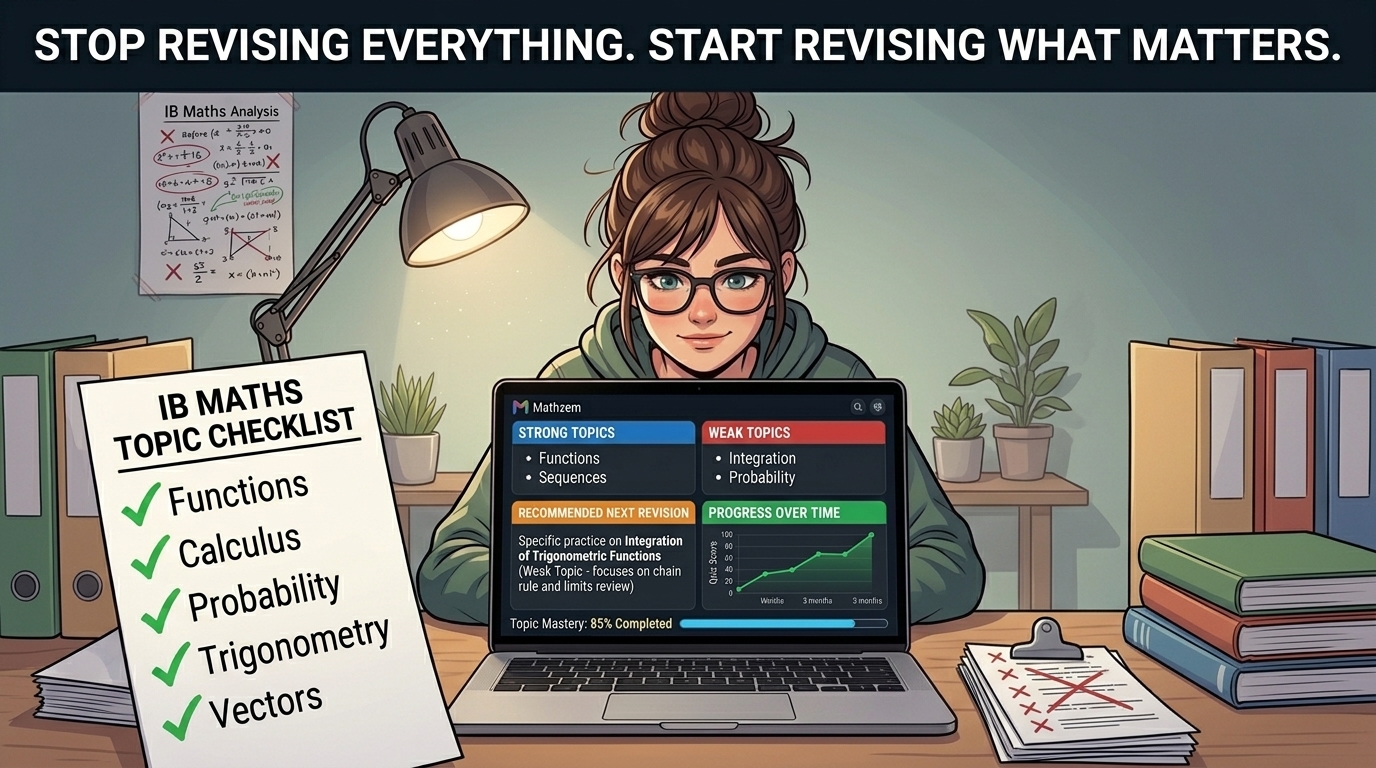
Instead of asking students to guess what needs revision, the platform helps them identify weak areas automatically.
After completing practice questions and uploading their work, students can see:
- Which topics consistently lose marks.
- Their strongest and weakest areas.
- Common mistakes that repeat.
- Progress over time.
- Recommended next topics to study.
This creates a personalised revision plan based on actual performance rather than assumptions.
The role of the student dashboard
A good learning dashboard should answer three questions immediately:
- What have I completed?
- What am I struggling with?
- What should I do next?
Many online learning platforms only answer the first question.
Mathzem’s Student Dashboard is designed to answer all three.
Students spend less time deciding what to revise and more time improving.
Stop revising topics you already know
One of the biggest hidden costs in revision is overstudying strengths.
Students naturally return to topics they enjoy or understand well because success feels good.
The difficult topics get postponed.
Then the exam arrives.
The same weak areas appear again.
Targeted revision prevents this cycle.
Final thoughts
Traditional IB Maths revision often relies on guesswork.
Students revise chapter by chapter without knowing whether those chapters are actually limiting their performance.
The future of effective revision is personalised.
Students need feedback, progress tracking, and clear guidance on where to focus next.
When revision becomes targeted, improvement becomes much easier to measure.
Frequently Asked Questions About Problem with Traditional IB Math Revision
Why isn’t topic by topic revision enough?
Because students rarely have equal strengths across every topic. Some areas need much more attention than others.
How can I identify my weakest IB Maths topics?
The best method is to analyse practice results, examiner feedback, and repeated mistakes over time.
Should I stop revising topics I’m good at?
No. Strong topics still need maintenance, but weak topics should receive more revision time.
How does Mathzem help with revision planning?
Mathzem tracks mistakes, identifies weak areas, measures progress, and recommends what students should study next.
Why is progress tracking important?
Tracking progress helps students see improvement over time and focus revision where it has the biggest impact.
Find Your Weak Areas First
Use the Math Skill Scanner to discover which IB Maths topics deserve your attention.
Turn Practice Into a Personal Revision Plan
Upload your work and receive AI examiner feedback, mistake analysis, and recommendations for what to revise next.
Study Smarter with Mathzem
Explore Mathzem Membership for access to AI feedback, progress tracking, the Student Dashboard, and personalised revision support.