Introduction
One of the most important decisions students face in their secondary school journey is whether to take GCSE maths higher or foundation tier. This choice affects not only exam performance but also future study and career opportunities.
In this guide, we’ll break down the differences, explore the pros and cons of each tier, and explain how Mathzem’s free GCSE maths courses can support students at both levels.
Table of Contents
What Are the GCSE Maths Tiers?
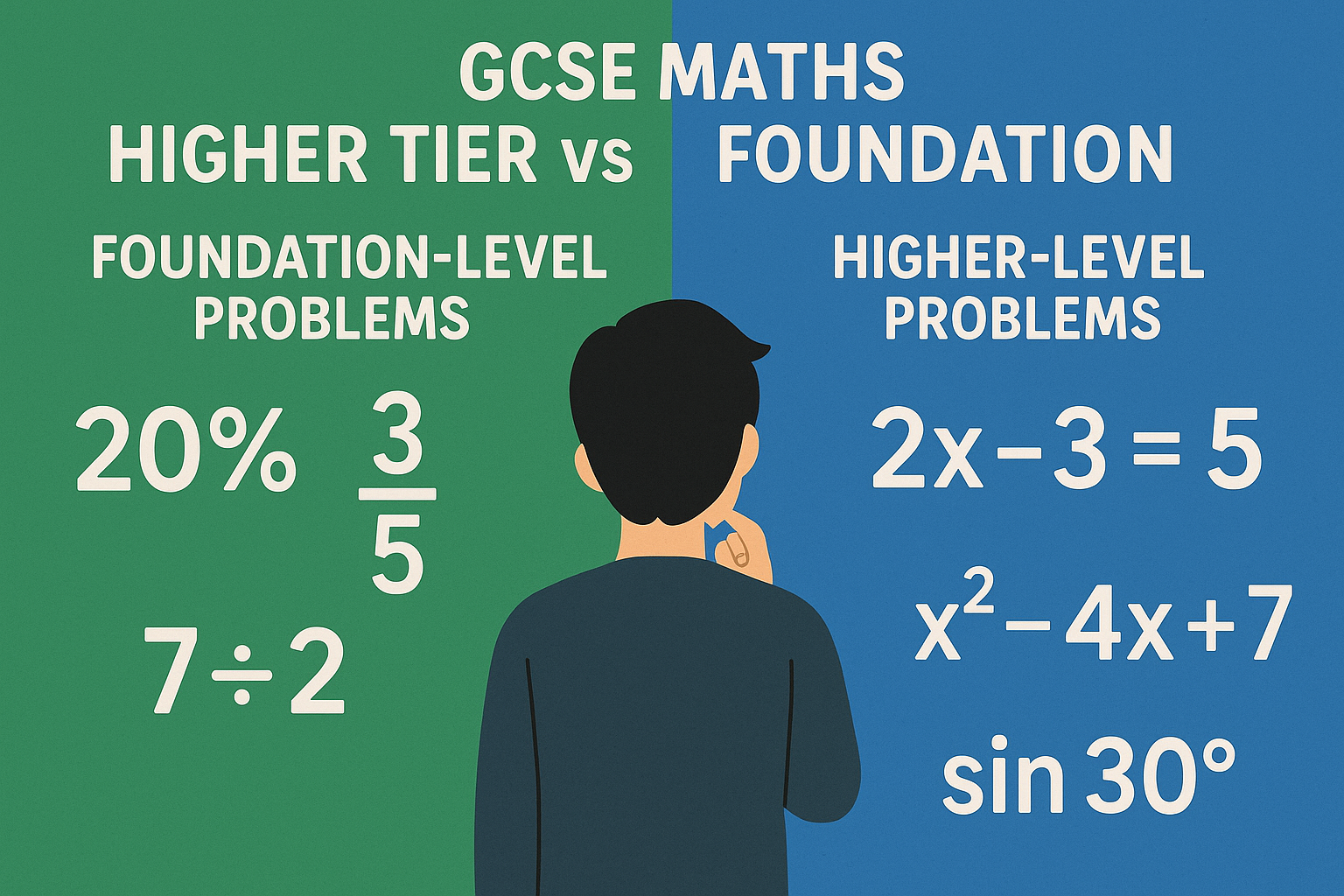
GCSE maths is split into two tiers: Foundation and Higher.
- Foundation Tier: Covers grades 1–5 with simpler questions and a more limited scope.
- Higher Tier: Covers grades 4–9 with more complex questions, including advanced topics.
Grading Differences Between Higher and Foundation
- Foundation Tier: You can achieve grades 1–5. Grade 5 is the maximum.
- Higher Tier: You can achieve grades 4–9, but if you perform poorly, you risk falling to a U (ungraded).
Exam Structure Overview
Both tiers consist of three papers:
- Paper 1: Non-calculator.
- Paper 2 and 3: Calculator allowed.
The main difference lies in difficulty and content range. Higher includes topics like algebraic fractions and advanced probability, while Foundation focuses on basics like ratios, percentages, and number operations.
Who Should Choose Foundation Tier?
Foundation tier is ideal for:
- Students who struggle with maths but aim to secure a pass.
- Those who need a grade 4 or 5 for future courses.
- Learners who prefer straightforward questions.
Who Should Choose Higher Tier?
Higher tier is best for:
- Students aiming for grade 6 or above.
- Those considering A-level maths or STEM careers.
- Confident learners ready to take on challenging problems.
Pros of Foundation Tier
- Accessible and straightforward questions.
- Lower risk of leaving the exam with no grade.
- Builds confidence for struggling students.
Cons of Foundation Tier
- Maximum grade capped at 5.
- Limits progression to advanced studies.
- May restrict university or apprenticeship options.
Pros of Higher Tier
- Wider grade range, up to grade 9.
- Keeps pathways open for A-levels and STEM subjects.
- Develops strong problem-solving skills.
Cons of Higher Tier
- Higher difficulty and more pressure.
- Risk of failing entirely if unprepared.
- Requires consistent practice and revision.
Who Should Choose Foundation Tier?
The Foundation Tier is often recommended if:
- You find maths particularly challenging.
- You’re aiming to secure a solid pass (Grade 4 or 5).
- Your future plans don’t require higher-level maths qualifications.
Who Should Choose Higher Tier?
The Higher Tier is ideal if:
- You’re confident with most GCSE maths topics.
- You’re aiming for Grades 6 to 9.
- You want to study A-level maths, science, or engineering.
- You need higher grades for entry into competitive sixth forms, colleges, or apprenticeships.
“How to Improve GCSE Maths Grade from 4 to 7.
How to Decide Between Higher and Foundation
To make the right choice, consider:
- Mock exam performance.
- Teacher recommendations.
- Long-term study or career goals.
The Role of Past Papers
Practising past papers can help students identify whether they’re better suited to GCSE maths higher or foundation. If you’re consistently scoring well on Foundation but struggling on Higher, Foundation might be safer.
Common Misconceptions About Foundation vs Higher
- Myth: Foundation students aren’t smart.
- Truth: Foundation is for those focusing on securing grades 4–5, not necessarily a reflection of intelligence.
- Myth: Higher tier is always better.
- Truth: If unprepared, students risk failing the exam entirely.
Can You Move From Foundation to Higher?
Yes, students can move between tiers before final exam entry. Many schools wait until late Year 11 to make a final decision.
Real Student Experiences
Some students who initially struggled with Foundation later switched to Higher after focused revision. Others found success staying at Foundation and achieving the grades needed for their future pathways.
Revision Strategies for Foundation Students
- Focus on securing marks in basic topics.
- Practise number operations, percentages, and ratios.
- Use step-by-step worked examples on Mathzem.
Revision Strategies for Higher Students
- Work on algebra, probability, and trigonometry.
- Focus on tackling 5–6 mark questions.
- Use Mathzem’s Higher Tier courses for advanced guidance.
Why Mathzem Helps Both Foundation and Higher Students
Mathzem provides free GCSE maths courses tailored for both Foundation and Higher tiers. Whether you’re aiming for a solid pass or pushing for a grade 9, Mathzem offers:
- Interactive lessons.
- Past paper walkthroughs.
- Expert exam tips.
GCSE Maths Resources
Take the guesswork out of your GCSE maths preparation. Start today with Mathzem’s free resources, designed to help both Foundation and Higher students succeed.
Common misconceptions and pitfalls to avoid
Choosing between tiers can feel daunting. Many GCSE myths make the decision seem fixed. Start by separating fact from fear and use clear evidence to guide your choice.
Myths about who can or cannot take Higher
One common myth is that Higher is only for the top set. This is not true. With effort and support, many pupils move from mixed-ability groups into Higher. Schools like Harris Federation and Harris Academy often allow tier movement when progress is consistent.
Another false idea is that if you’re not top in Year 9, you can’t take Higher. Progress from Year 9 to Year 11 varies a lot. Use topic tests and timed papers to show your readiness, not past labels.
Misinterpreting mock exam results
Mocks are useful but can be misleading. A single poor mock might reflect illness, stress, or unfamiliar format. Treat one result as a data point, not a decision-maker.
An unusually high mock should prompt careful checking across topics. Look for consistent performance in number, algebra, and geometry. If strengths are uneven, balance your tier choice with focused revision.
Overconfidence vs undue caution: finding balance
Overconfidence risks choosing Higher without adequate preparation and missing target grades. Undue caution risks settling for Foundation when you could aim higher. Both errors limit future options.
Make evidence-based decisions using multiple timed papers, topic tests, and teacher judgement. Track progress weekly, seek targeted support, and use resources like Mathzem for objective diagnostics and incremental practice.
Practical steps to avoid mock exam pitfalls include:
- Rotate at least three timed papers under exam conditions.
- Log topic-level scores to spot consistent gaps.
- Request specific feedback from your teacher or tutor on weaker topics.
- Use a platform such as Mathzem to measure progress and to practise the exact skills needed for gcse maths higher or foundation.
When you weigh GCSE Maths Higher or Foundation, combine mock results with steady evidence. This approach reduces the influence of GCSE myths and protects you from mock exam pitfalls while keeping your options open.
FAQs About GCSE maths higher or foundation
What is the difference between GCSE maths higher and foundation?
Foundation is for grades 1–5, while Higher covers grades 4–9.
Which tier is harder?
Higher tier is more challenging but offers access to top grades.
Can I move from Foundation to Higher?
Yes, students can switch tiers before final entries.
Is Foundation easier?
Yes, but it caps your grade at 5.
What’s the risk of taking Higher?
If you struggle, you may score a U.
Which tier does Mathzem support?
Mathzem supports both Foundation and Higher with free resources.
Conclusion
Choosing between GCSE maths higher or foundation is a key decision. Foundation is best for students securing a pass, while Higher opens doors to advanced opportunities. With the right support, especially from Mathzem’s free resources, students can make the best choice for their future.