
Mathematical Induction for IB Maths AA HL: Worked Examples
Mathematical induction is different from most other topics in IB Maths AA HL.
You are not simply calculating an answer or applying a formula. You are constructing a mathematical proof that a statement is true for every positive integer in a given range.
This can feel unfamiliar at first.
You might understand the statement you need to prove but struggle with the order of the steps. Or you might reach the correct result without explaining why it follows for every integer.
The good news is that mathematical induction follows a clear structure.
Once you understand the process, you can apply it to divisibility, summation formulas, inequalities, and other mathematical statements.
In this guide, we will explain the method, work through examples, and identify the mistakes that can cost you marks.
Table of Contents
1. What is mathematical induction?
Mathematical induction is a proof technique used to establish that a mathematical statement is true for every integer from a specified starting value.
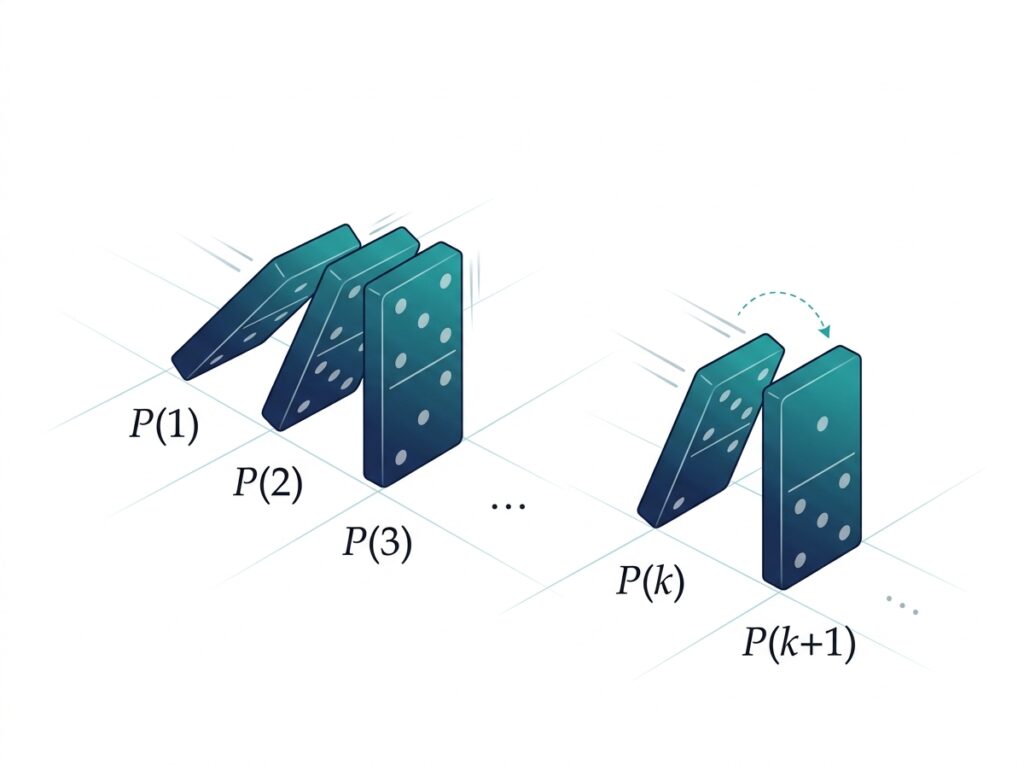
Think of it like a row of dominoes.
For every domino to fall, two things must happen:
- The first domino must fall.
- Each domino must cause the next domino to fall.
Mathematical induction follows the same logic.
You first prove the statement for the initial value. Then you prove that if it is true for one integer, it must also be true for the next integer.
This gives you two main stages:
Base case: Prove the statement is true for the starting value.
Inductive step: Assume the statement is true for an arbitrary integer (k), then prove that it is true for (k+1).
When both stages are established, the statement follows for all integers from the starting value.
2. The four steps of an induction proof
A complete mathematical induction proof usually follows this structure.
Step 1: State the proposition
Identify the statement you want to prove.
For example:
[
1+2+3+\cdots+n=\frac{n(n+1)}{2}
]
You need to prove that this formula works for every positive integer (n).
Step 2: Prove the base case
Start with the smallest allowed value.
Here, the starting value is (n=1).
The left hand side is:
[
1
]
The right hand side is:
[
\frac{1(1+1)}{2}=1
]
Both sides are equal.
Therefore, the statement is true for (n=1).
Step 3: Make the inductive assumption
Assume the statement is true for (n=k), where (k) is a positive integer.
This gives:
[
1+2+3+\cdots+k=\frac{k(k+1)}{2}
]
This is called the inductive hypothesis.
You are allowed to use this statement in the next part of your proof.
Step 4: Prove the statement for (k+1)
Now consider the expression when (n=k+1):
[
1+2+3+\cdots+k+(k+1)
]
Using the inductive hypothesis:
[
=\frac{k(k+1)}{2}+(k+1)
]
Put the terms over a common denominator:
[
=\frac{k(k+1)+2(k+1)}{2}
]
Factorise:
[
=\frac{(k+1)(k+2)}{2}
]
This is exactly the original formula with (n=k+1).
Therefore, if the statement is true for (k), it is also true for (k+1).
Since the base case is true, the formula holds for all positive integers (n).
3. Worked example: Prove a summation formula
Consider the statement:
[
1+3+5+\cdots+(2n-1)=n^2
]
Prove that it is true for every positive integer (n).
This is a useful example because the expression contains a sequence of odd numbers.
Step 1: Base case
Let (n=1).
Left hand side:
[
1
]
Right hand side:
[
1^2=1
]
Therefore, the statement is true for (n=1).
Step 2: Inductive assumption
Assume the statement is true for (n=k).
[
1+3+5+\cdots+(2k-1)=k^2
]
Step 3: Prove the statement for (n=k+1)
The next odd number after (2k-1) is:
[
2(k+1)-1=2k+1
]
Therefore, consider:
[
1+3+5+\cdots+(2k-1)+(2k+1)
]
Using the inductive assumption:
[
=k^2+(2k+1)
]
Simplify:
[
=k^2+2k+1
]
Factorise:
[
=(k+1)^2
]
This is the required expression for (n=k+1).
Conclusion
The statement is true for (n=1), and if it is true for (n=k), it is also true for (n=k+1).
Therefore:
[
\boxed{1+3+5+\cdots+(2n-1)=n^2}
]
for all positive integers (n).
4. Worked example: Prove divisibility using induction

Divisibility questions are another common way to practise mathematical induction.
Consider the statement:
[
6\mid(7^n-1)
]
Prove that it is true for all positive integers (n).
The notation means that (7^n-1) is divisible by 6.
Step 1: Base case
Let (n=1).
[
7^1-1=6
]
Since 6 is divisible by 6, the statement is true.
Step 2: Inductive assumption
Assume that the statement is true for (n=k).
This means:
[
7^k-1=6m
]
where (m) is an integer.
This assumption gives us an expression we can use in the next step.
Step 3: Prove the statement for (n=k+1)
We need to show that:
[
7^{k+1}-1
]
is divisible by 6.
Rewrite the expression:
[
7^{k+1}-1=7(7^k)-1
]
Add and subtract 7:
[
=7(7^k-1)+6
]
Using the inductive assumption:
[
=7(6m)+6
]
Factorise:
[
=6(7m+1)
]
Since (m) is an integer, (7m+1) is also an integer.
Therefore, the expression is divisible by 6.
Conclusion
The statement is true for (n=1), and the truth of the statement for (n=k) implies its truth for (n=k+1).
Hence:
[
\boxed{6\mid(7^n-1)}
]
for every positive integer (n).
Important exam point: In divisibility proofs, do not stop after obtaining a multiple of the required number. Explain why the remaining factor is an integer.
5. Worked example: Prove an inequality using induction
Induction can also establish inequalities.
Consider:
[
2^n\geq n+1
]
for all positive integers (n).
Step 1: Base case
Let (n=1).
[
2^1=2
]
and:
[
1+1=2
]
Therefore:
[
2\geq2
]
The statement is true for (n=1).
Step 2: Inductive assumption
Assume that:
[
2^k\geq k+1
]
for some positive integer (k).
Step 3: Prove the statement for (k+1)
We need to show:
[
2^{k+1}\geq k+2
]
Start with the left hand side:
[
2^{k+1}=2\times2^k
]
Using the inductive assumption:
[
2^{k+1}\geq2(k+1)
]
Therefore:
[
2^{k+1}\geq2k+2
]
Since (k) is positive:
[
2k+2\geq k+2
]
Thus:
[
2^{k+1}\geq k+2
]
The statement is true for (k+1).
Conclusion
Since the base case is true and the inductive step has been established:
[
\boxed{2^n\geq n+1}
]
for all positive integers (n).
Why this example matters: In inequality proofs, you must pay attention to the direction of the inequality. Multiplying both sides by a positive number preserves the inequality direction.
6. How to recognise when induction is needed
Not every mathematical statement requires induction.
Look for questions that ask you to prove a statement for all positive integers or all integers from a specified starting value.
Common question patterns include:
| Question pattern | Possible approach |
|---|---|
| Prove a summation formula | Use the inductive hypothesis and add the next term |
| Prove a divisibility statement | Express the next case as a multiple of the required integer |
| Prove an inequality | Use the assumed inequality and establish the next case |
| Prove a formula involving powers | Rewrite the expression using the previous power |
| Prove a statement about a sequence | Relate the next term to the previous term |
The wording of the question matters.
If you are asked to prove a statement for every positive integer, check whether induction is an appropriate method.
7. Common mistakes in mathematical induction
Understanding the method is one thing. Writing a complete proof under exam conditions is another.
Here are some mistakes to avoid.
Mistake 1: Forgetting the base case
Some students start by assuming the statement is true for (n=k).
But an inductive assumption alone does not establish that the process starts.
You must prove the initial case separately.
Mistake 2: Assuming the statement is true for every integer
You should assume it is true for one arbitrary integer (k), not for all integers.
Your task is to use that single assumption to establish the next case.
Mistake 3: Proving the wrong expression
When moving from (k) to (k+1), every part of the original statement must be updated correctly.
For example, if the original expression contains:
[
2n-1
]
then the next term is:
[
2(k+1)-1=2k+1
]
A common error is to use the previous term again.
Mistake 4: Not using the inductive hypothesis
The purpose of the inductive assumption is to help you prove the next case.
If you simply expand the expression without using the assumed result, your proof may become unnecessarily complicated or incomplete.
Mistake 5: Skipping algebraic steps
Even if you understand the transformation, the examiner needs to follow your reasoning.
Show how you substitute the assumption, simplify the expression, and reach the required result.
Mistake 6: Writing an incomplete conclusion
Finish by stating that the base case is true and the inductive step has been established.
Then conclude that the statement holds for all integers in the required range.
8. A reliable structure for exam answers
When you see an induction question, use the following structure.
Base case
Substitute the starting value and show that both sides are equal, or that the required property holds.
Inductive assumption
Assume the statement is true for (n=k).
Write the full mathematical expression.
Inductive step
Start with the expression for (n=k+1).
Use the inductive assumption.
Simplify until you obtain the required expression.
Conclusion
State that the base case is true and the inductive step is established.
Therefore, the statement is true for all integers in the required range.
Keeping this structure consistent makes your proofs easier to write and check.
9. Practice questions: Test your understanding.
Try these questions without looking at the worked examples.
Question 1: Summation
Prove by mathematical induction that:
[
1+2+3+\cdots+n=\frac{n(n+1)}{2}
]
for every positive integer (n).
Question 2: Divisibility
Prove that:
[
5\mid(6^n-1)
]
for every positive integer (n).
Question 3: Inequality
Prove that:
[
3^n\geq2n+1
]
for every positive integer (n).
Question 4: Sum of squares
Prove that:
\frac{n(n+1)(2n+1)}{6}
]
for every positive integer (n).
Question 5: A challenge
Prove that:
[
4^n-1
]
is divisible by 3 for every positive integer (n).
Practice advice: Write the complete proof for each question. Do not only check whether the final expression is correct. The goal is to demonstrate the base case, inductive assumption, and inductive step.
10. How to improve at induction questions
Mathematical induction becomes easier through repeated practice.
But simply reading several worked solutions is not enough.
Use this practice routine:
First, identify the statement.
Write down exactly what you need to prove and the starting value.
Second, complete the base case.
Make sure you can verify the initial value independently.
Third, write the inductive assumption.
Practise stating the full expression for (n=k).
Fourth, focus on the transition.
This is usually the most challenging part. Start with the expression for (k+1) and look for a way to use the inductive assumption.
Finally, review the proof.
Check that your algebra is correct, your conclusion is complete, and every part of the argument is justified.
Once you can solve straightforward questions, move towards unfamiliar statements and longer proofs.
11. How Mathzem can help you practise proof questions
Mathematical induction requires clear written reasoning.
You need to show more than a final answer. Each stage of the proof must connect logically to the next.
Mathzem supports IB Mathematics practice through exam style questions and handwritten solution review.
You can:
- Choose your IB Mathematics course and a relevant topic.
- Attempt a question on paper.
- Upload a picture of your handwritten working.
- Review AI Examiner feedback on your method and mistakes.
- Identify which part of your proof needs improvement.
For example, you might complete the base case correctly but make an error when substituting the inductive assumption.
Or you might reach the correct expression for (k+1) but forget to explain why the result proves divisibility.
Reviewing your working can help you identify these specific issues.
Mathzem provides AI generated learning feedback and estimated marks, not official IB marking.
Frequently Asked Questions About Mathematical Induction for IB Maths AA HL
Is mathematical induction part of IB Maths AA HL?
Mathematical induction is included in Mathzem’s AA HL syllabus coverage. Students should check the syllabus and assessment guidance applicable to their examination session.
What are the two main parts of mathematical induction?
The two main parts are the base case and the inductive step. You prove the initial case, then show that truth for an arbitrary integer (k) implies truth for (k+1).
Why do we assume the statement is true for (n=k)?
The inductive assumption allows you to establish a logical link between one case and the next. You use it to prove the statement for (n=k+1).
Can mathematical induction be used for inequalities?
Yes. It can be used to prove inequalities for all integers in a specified range, provided the base case and inductive step are established correctly.
Is checking the first few values enough?
No. Checking several examples can help you identify a pattern, but it does not prove that the statement is true for every positive integer.
What is the most difficult part of an induction proof?
For many students, the inductive step is the most challenging part. The key is to rewrite the expression for (k+1) so that you can use the inductive assumption for (k).
Final thoughts
Mathematical induction is a proof technique built around a simple logical structure.
Prove the first case.
Assume the statement is true for one integer.
Use that assumption to prove the next case.
Then write a clear conclusion.
The difficulty usually lies in the algebra needed to connect the inductive assumption to the next case. That is why regular practice matters.
Start with summation formulas, move to divisibility, and then practise inequalities and unfamiliar statements.
Most importantly, write every stage of your proof. In mathematics, a correct conclusion is valuable, but a clear justification is what makes it a proof.