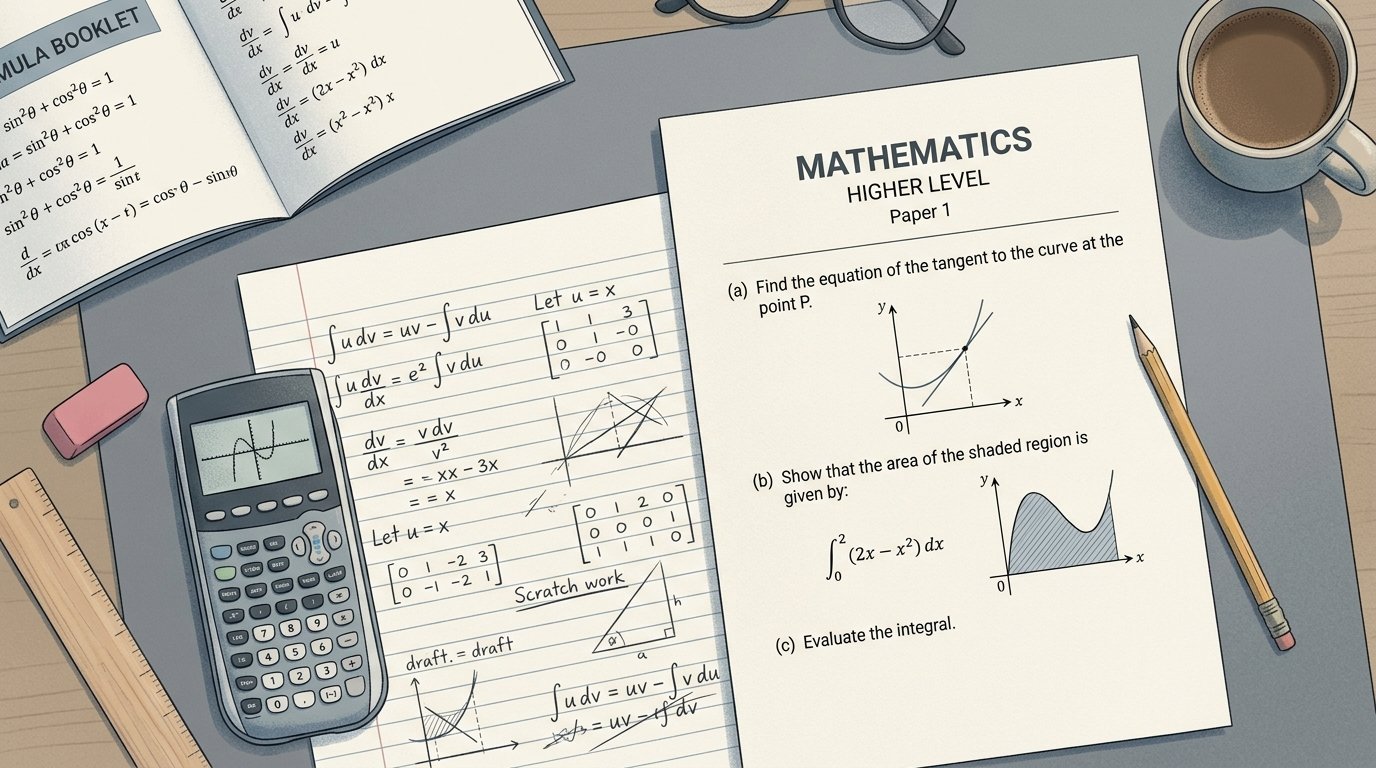
You sit down to practise an IB Mathematics question. You read it carefully, identify the information you have been given, and try to decide what to do next.
But you get stuck.
You could keep trying, spend several minutes going in circles, or open the full solution and see how the question is solved.
The third option feels tempting. You get the answer, understand the steps, and can move on to the next question. But there is a problem: understanding someone else’s solution is not the same as being able to solve the question independently.
A better approach is to ask for a hint before the full solution.
A hint gives you a direction without doing all the thinking for you. It helps you make progress while preserving the opportunity to practise the mathematical reasoning you will need in an IB exam.
Table of Contents
1. Why looking at the full solution too early can hold you back
Full solutions are useful learning resources. They can explain a method, clarify a confusing step, and show how mathematical ideas fit together.
The problem is not reading solutions. The problem is reading them before you have made a meaningful attempt.
When you look at a complete solution, the method and sequence of steps are already visible. Each step can seem obvious because you know where the solution is going.
During an exam, however, you will not have those steps in front of you. You must recognise the relevant concept, choose an appropriate method, and decide how to proceed.
For example, suppose an IB Mathematics question asks you to determine an unknown parameter in a function.
You may know the relevant formula but feel unsure about how to begin. If you immediately read the complete solution, you might follow the algebra successfully without learning how to recognise the first step next time.
If you ask for a hint instead, you have to make the next decision yourself.
That decision is part of the learning process.

2. What makes a good hint?
A useful hint reduces uncertainty without removing the main challenge of the question.
It might help you identify a relevant formula, notice a relationship between two pieces of information, or consider a particular mathematical technique.
For example, imagine you are working on a quadratic function question and need to determine an unknown value.
A complete solution might show every substitution, rearrangement, calculation, and conclusion.
A hint could instead direct your attention to the information given in the question and ask which property of a quadratic function connects that information to the unknown value.
The hint does not finish the problem. It helps you decide what to investigate next.
A good hint should leave you with something meaningful to do.
3. Use this process when you get stuck
Instead of opening the full solution immediately, follow a simple sequence.
Step 1: Make your own attempt
Read the question and identify what you need to find. Write down the relevant information, formulas, diagrams, or equations.
Even if you cannot finish the question, record what you understand so far.
This gives you a starting point and makes it easier to identify where you need help.
Step 2: Identify the exact obstacle
Try to be specific about what is stopping you.
Are you unsure which topic the question tests? Do you recognise the topic but not the method? Have you started the calculation but become stuck during the algebra? Or do you have an answer but cannot explain why your method works?
These are different problems, so they need different kinds of support.
The more clearly you identify the obstacle, the more useful the help can be.
Step 3: Ask for a hint before the full solution
Request a hint that helps you identify the next step without revealing the entire solution.
Read the guidance, then return to your own working. Try to apply the hint before asking for more help.
This is where the learning happens. You are using the guidance to make a mathematical decision yourself.
Step 4: Try the next step independently
Do not simply read the hint and move on.
Write down the next equation, choose the relevant method, or complete the next calculation. Check whether your new step makes sense in the context of the question.
If you are still stuck, ask for a more specific explanation or another hint.
Step 5: Request a fuller explanation when needed
Sometimes a hint will not be enough. You may have a gap in your understanding of a formula, a mathematical concept, or a particular technique.
At that point, ask for an explanation of the method or request the full solution.
The goal is not to avoid full solutions. It is to use them when they provide the most value.
Step 6: Close the solution and try again
After studying the explanation, return to the original question and solve it again without looking at the guidance.
If you can reproduce the method and explain why the steps work, you have made progress towards independent problem solving.
For an even stronger check, try a similar question and see whether you can recognise the method without being told which one to use.
4. How Mathzem AI Tutor can support this habit
Mathzem AI Tutor provides contextual help while you work on an IB Mathematics question. You can use it to request a hint, get an explanation, understand the next step, ask for help with a method, or request a full solution.
The key is choosing the level of support that matches your current difficulty.
If you know the topic but cannot get started, begin with a hint.
If you have started correctly but do not understand a particular step, ask for an explanation of that step.
If you are unsure how to apply a method, request guidance on the method itself.
If you have tried these approaches and still do not understand the question, a full solution can help you study the reasoning from beginning to end.
You can then return to the question and attempt it independently.
The value of AI tutoring is not simply getting through a question. It is learning how to approach the next question with less help.
You can explore Mathzem at mathzem.com.
5. How to tell whether a hint actually helped
Receiving a hint does not automatically mean you have learned the concept. You need to check what you can do afterwards.
After using a hint, ask yourself these questions:
- Can I explain why the hint was relevant to the question?
- Can I complete the next step without requesting the same guidance again?
- Can I explain why my chosen method works?
- Can I solve the question again without viewing the solution?
- Can I apply the same idea to a similar question?
If you can answer these questions confidently, the hint has helped you develop more than familiarity with the answer.
If you cannot, identify the part that remains unclear and return to it. You may need to revisit the underlying concept before attempting another question.
This is a more useful way to evaluate your progress than simply counting how many questions you have completed.
6. When should you stop asking for hints?
Hints are useful, but they should not become a way to avoid learning the underlying mathematics.
If you repeatedly need help with the same concept, pause your question practice and review that concept directly.
For example, if you struggle with rearranging equations across several different topics, the issue may not be the individual questions. You may need to strengthen your algebra skills.
Once you have reviewed the concept, return to the questions and test whether you can use it independently.
You should also avoid asking for a new hint after every small step when you already know what to do. Give yourself time to think, make decisions, and check your work.
The aim is to gradually reduce the amount of support you need.
7. Turn each difficult question into a learning opportunity
A difficult question can reveal more than a gap in your knowledge. It can show you where your problem solving process breaks down.
You might understand the relevant concept but struggle to choose the method. You might choose the correct method but make an algebraic error. Or you might reach a plausible answer without knowing how to justify it.
These difficulties require different kinds of practice.
When you finish a question, take a moment to identify what helped you make progress and what you would do differently next time.
If you used a hint, record the idea that unlocked the question. If you needed a full explanation, identify the concept or method you need to revisit.
Over time, this habit can help you become more aware of your own learning and more deliberate about what to practise next.
Final thoughts
When you get stuck on an IB Mathematics question, you do not have to choose between struggling indefinitely and immediately reading the full solution.
There is a useful middle ground: make an attempt, ask for a hint, apply the guidance, and request a fuller explanation only when you need one.
This approach keeps you involved in the reasoning instead of turning practice into a sequence of answers to read.
Use Mathzem AI Tutor to get contextual help on the question you are working through, and give yourself the opportunity to finish the reasoning independently.
The goal is not just to understand today’s solution. It is to be better prepared to solve tomorrow’s question on your own.
Start practising with Mathzem and make your next difficult question an opportunity to learn.