Introduction
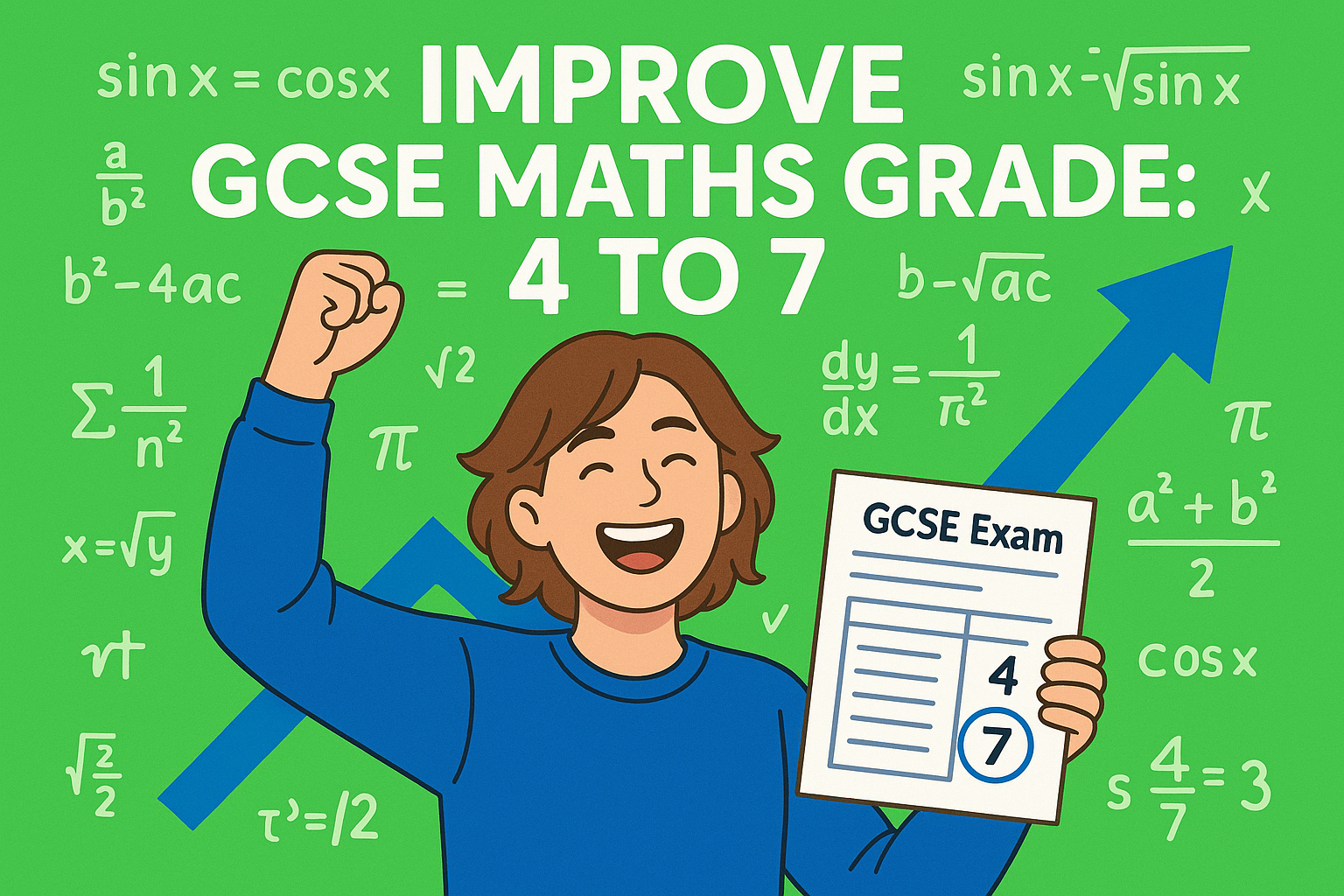
Improve GCSE maths grade 4 to 7 may feel like a huge leap, but with the right strategies, it’s absolutely achievable. Many students remain stuck at grade 4 because they focus only on passing instead of mastering key concepts. If you’re aiming higher—whether for future education, apprenticeships, or personal confidence—then adopting a structured, consistent approach can turn that grade 4 into a solid 7.
Table of Contents
Understanding the GCSE Maths Grading System
To improve your GCSE maths grade, it’s crucial to understand how grades are awarded.
- Foundation Tier covers grades 1–5.
- Higher Tier covers grades 4–9.
- You must score across three papers (one non-calculator, two calculator).
The difference between a grade 4 and a grade 7 is not just knowledge—it’s accuracy, exam technique, and deeper understanding of topics.

Why Students Get Stuck at Grade 4
Many students stay at grade 4 because:
- They focus only on “easy” questions and avoid challenges.
- They don’t practice enough past papers.
- They fail to review mistakes, repeating the same errors.
- They rely too much on memorization instead of understanding.
Recognizing these habits is the first step to breaking free from them.
Setting the Right Mindset
Success in GCSE maths begins with the right mindset. Adopting a growth mindset means believing you can improve with effort and persistence. Strategies include:
- Replacing “I can’t do this” with “I can’t do this yet.”
- Tracking progress weekly to see small improvements.
- Practicing mindfulness to reduce exam anxiety.
Confidence plays as big a role as ability when moving from a grade 4 to a 7.
Building a Solid Foundation
Before tackling harder questions, revisit the basics. Strengthen your skills in:
- Multiplication, fractions, decimals, percentages.
- Algebra fundamentals (expanding brackets, solving equations).
- Geometry basics (angles, area, perimeter).
Without a strong foundation, higher-level problems become impossible.
Using Mathzem as a Primary Resource
If you’re serious about improving your GCSE maths grade, start with Mathzem. It provides:
- Free GCSE maths courses for both foundation and higher tier.
- Past paper practice with step-by-step solutions.
- Topic-based lessons that help you focus on weaknesses.
Unlike generic websites, Mathzem is tailored for GCSE success, making it the best starting point for grade improvement.

Effective Revision Strategies
Improving requires smart revision, not just long hours. Some strategies:
- Active recall – testing yourself instead of rereading notes.
- Spaced repetition – revisiting topics regularly over time.
- Interleaving – mixing different topics in a single study session.
Create a weekly timetable that balances all areas of maths.
Mastering Past Papers
Past papers are your best training ground. To move from a 4 to 7:
- Attempt papers under timed conditions.
- Mark carefully with official schemes.
- Record every mistake in a logbook and practice it again later.
This process ensures you not only answer correctly but also understand why.
Learning Exam Techniques
Getting a 7 requires not just knowledge but exam skills:
- Always show your working—you get marks for method.
- Underline command words like “explain” or “prove.”
- Use the final 10 minutes to check for calculation slips.
Mastering exam technique can often be the difference between grades.
Boosting Weak Areas
Most grade 4 students struggle with:
- Algebra – equations, inequalities, factorization.
- Geometry – transformations, circle theorems.
- Probability & statistics – understanding data and probabilities.
Tackle these systematically by using Mathzem lessons and past papers.
Using Online Tools and Apps
Alongside Mathzem, apps like Quizlet, Seneca, and Mathswatch can be helpful. But remember—focus on GCSE-specific content instead of general maths practice.
Group Study vs Individual Study
Studying with peers can help explain tricky topics, while solo study allows deep concentration. A mix of both is ideal.
Managing Time Wisely
Moving from a grade 4 to 7 requires consistency. Plan:
- 1–2 hours per day of focused revision.
- Break sessions into manageable chunks.
- Prioritize weak topics instead of revising only what you enjoy.
Staying Motivated
It’s easy to feel overwhelmed. Stay motivated by:
- Tracking small wins (improving scores in past papers).
- Rewarding yourself for hitting study goals.
- Visualizing the opportunities a grade 7 opens for you.
Improve GCSE Maths Grade
👉 Ready to boost your grade? Start today with Mathzem’s free GCSE maths courses and past paper practice. Take control of your revision and move from a grade 4 to 7 with confidence.
FAQs About Improve GCSE Maths Grade
How long does it take to improve from grade 4 to 7 in GCSE maths?
With consistent daily practice, most students can achieve this in 4–6 months.
What is the hardest part about moving from 4 to 7?
Understanding higher-level algebra and exam technique are the biggest challenges.
Can I improve my grade without a tutor?
Yes, using Mathzem and past papers effectively can replace tutoring.
Which topics should I focus on first?
Start with your weakest topics, often algebra and geometry, while maintaining strong basics.
Is grade 7 achievable for everyone?
Yes, with the right mindset, resources, and consistent practice.
What role do past papers play in improving grades?
They help identify mistakes, improve time management, and prepare you for exam conditions.
Conclusion
Improve GCSE maths grade from 4 to 7 is not about working harder—it’s about working smarter. By setting the right mindset, strengthening your foundation, and using resources like Mathzem, you can steadily climb towards that grade 7. Remember, progress takes time, but with consistent effort, it’s within your reach.



One Response