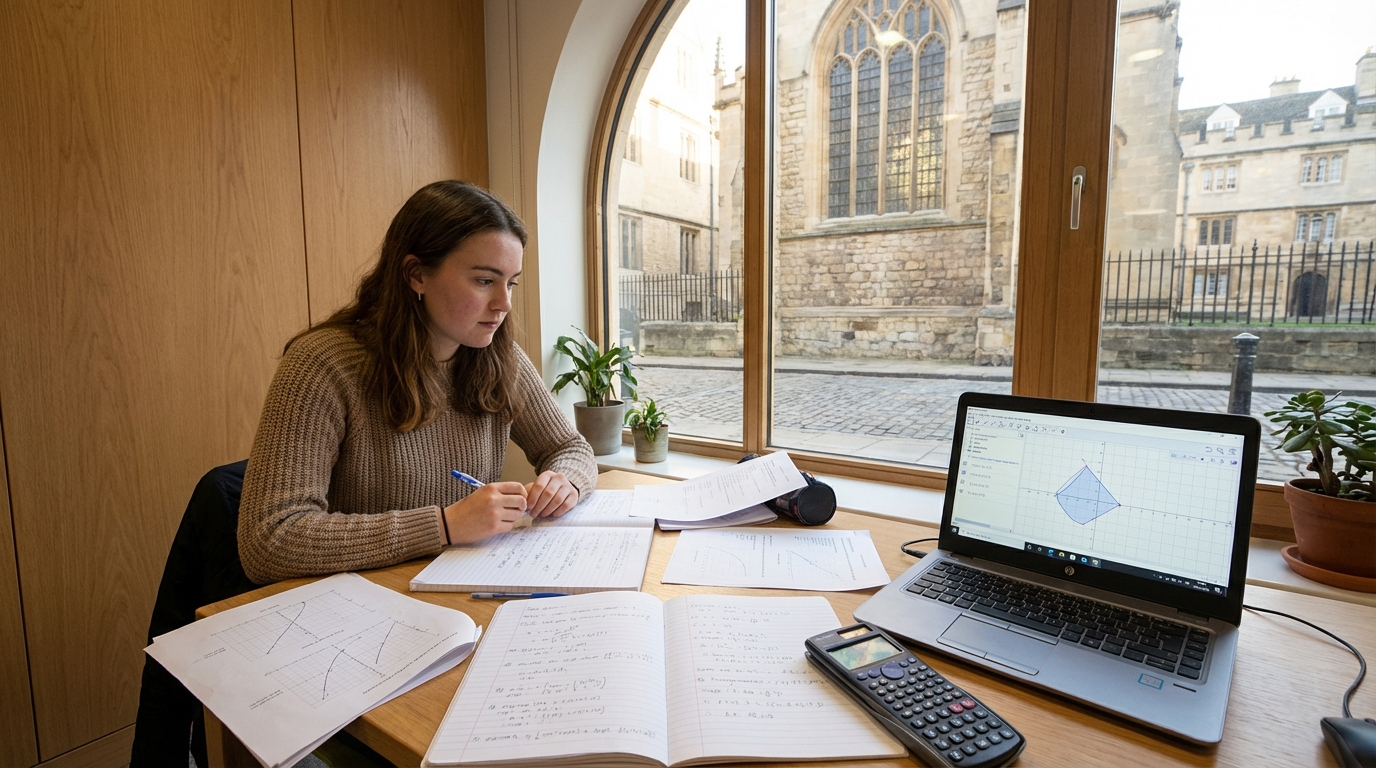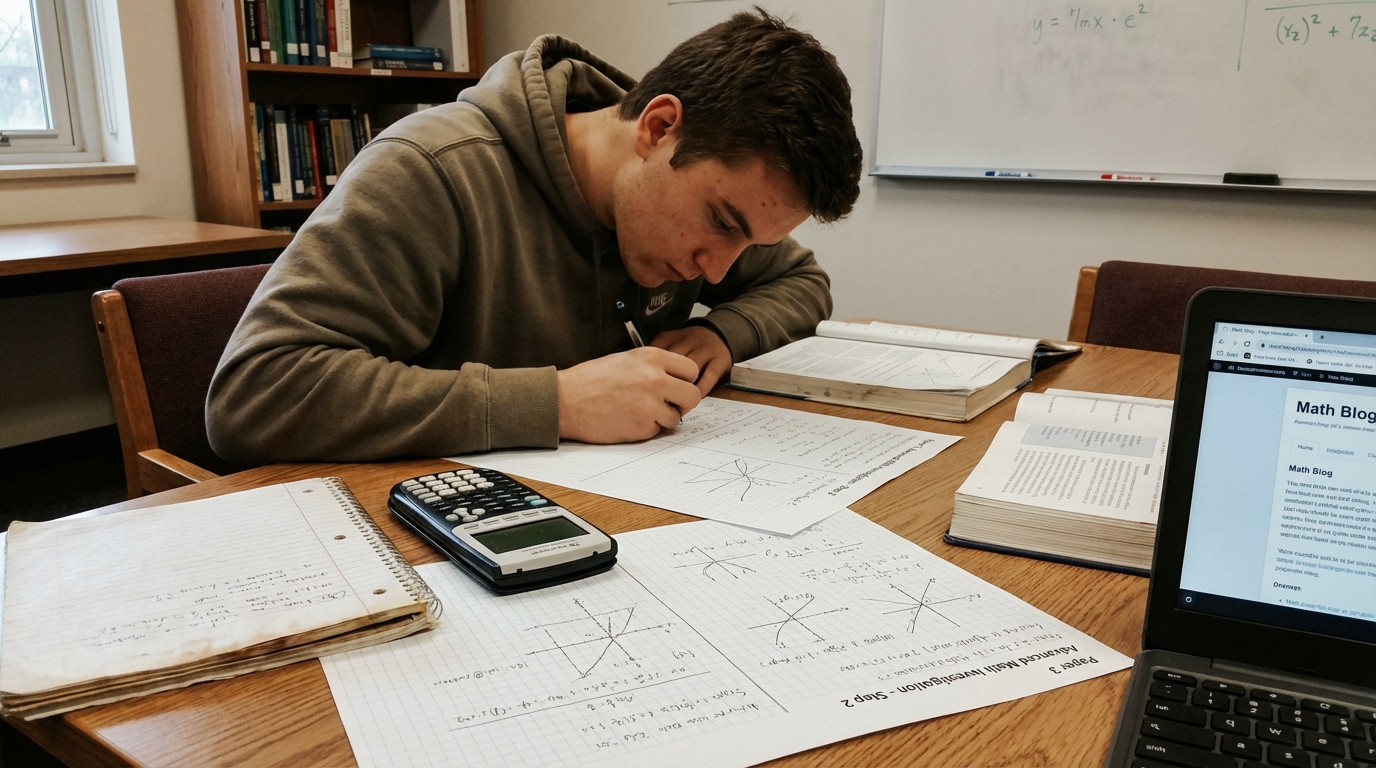
Past papers are the single most powerful revision tool for IB Maths AA HL (Analysis and Approaches Higher Level). Yet many students use them incorrectly rushing through questions, checking answers too quickly, or doing too few papers to see real improvement.
At Mathzem, we see a clear pattern: students who use past papers strategically improve dramatically, while those who treat them as last-minute practice often stay stuck at the same grade.
This guide explains how to use IB Maths AA HL past papers effectively, step by step, to maximise your score.
Table of Contents
Why Past Papers Matter So Much in AA HL
AA HL exams are not random. They follow predictable patterns in:
- Topic weighting
- Question structure
- Level of difficulty
- Mark allocation
- Common traps and pitfalls
Past papers teach you how the IB thinks not just what content to revise.
Students aiming for a 6 or 7 must use past papers consistently and deliberately.
When Should You Start Using Past Papers?
Ideal Timeline
- Early Year 12: Topic-based past paper questions
- Mid Year 12: Mixed questions
- Early Year 13: Full papers under timed conditions
- Final 3–4 months: Intensive past paper cycles
Starting early builds confidence and reduces exam anxiety later.
Step 1: Start with Topic-Based Past Paper Questions
Before attempting full papers, isolate topics:
- Differentiation
- Integration
- Functions
- Sequences and series
- Trigonometry
- Vectors
- Proofs
- Differential equations
Why this works
- You focus on one skill at a time
- Mistakes are easier to identify
- You build technique without time pressure
This is especially important for HL calculus.
Step 2: Move to Mixed Questions
Once individual topics feel comfortable, practise mixed questions that combine multiple ideas.
These questions simulate real exam challenges where:
- calculus meets algebra
- modelling meets interpretation
- multiple steps are required
Mixed practice prepares you for Paper 2 and Paper 3 complexity.
Step 3: Practise Full Papers Under Timed Conditions
This is where many students struggle, but also where the biggest gains happen.
Timing guidelines
- Paper 1: 2 hours
- Paper 2: 2 hours
- Paper 3: 1 hour
Rules
- No pauses
- No checking notes
- Real exam conditions
- Use approved calculator only
Timed practice builds stamina and sharpens decision-making.
Step 4: Learn How to Mark Your Work Properly
Doing a past paper is only 40% of the work. The other 60% is reviewing it correctly.
Use the markscheme to:
- Understand how marks are awarded
- Learn preferred methods
- See where method marks are lost
- Identify poor notation
- Improve clarity of working
Never just check final answers — study how marks are given.
Step 5: Create a Mistake Log (This Is Critical)
Top AA HL students keep a detailed error log.
Your log should include:
- Topic
- Question reference
- Error type (concept, algebra, exam technique)
- Correct method
- Prevention strategy
Review this log weekly. It stops you repeating the same mistakes.
At Mathzem, we require all AA HL students to maintain one, it’s one of the fastest ways to raise grades.
Step 6: Analyse Patterns in Questions
After several papers, you’ll notice patterns such as:
- Certain calculus techniques repeating
- Similar modelling setups
- Common exam traps
- Frequently tested topics
When you start predicting questions before reading them, you’re on track for a 7.
Step 7: Focus on Exam Technique, Not Just Content
Past papers help refine technique:
- Knowing when to move on
- Deciding which questions to skip temporarily
- Writing concise working
- Avoiding unnecessary steps
- Structuring answers clearly
Many students lose marks due to poor technique — not lack of knowledge.
Step 8: Use IB Maths AA HL Past Papers to Prepare for Paper 3
Paper 3 is unique and requires:
- Extended reasoning
- Interpretation
- Justification
- Modelling decisions
Preparation tips
- Practise only Paper 3 questions initially
- Focus on explanations, not just calculations
- Use markschemes to study examiner language
Paper 3 mastery often separates a high 6 from a 7.
How Many Past Papers Do You Need?
For students aiming high:
- Paper 1: 8–10 papers
- Paper 2: 8–10 papers
- Paper 3: 4–5 papers
Quality matters more than quantity but consistency is key.
How Mathzem Helps Students Use Past Papers Effectively
At Mathzem, we don’t just give students past papers, we teach them how to use them.
Our support includes:
- Guided past paper walkthroughs
- Exam-technique training
- HL calculus clinics
- Personalised mistake analysis
- Weekly progress tracking
- Targeted improvement plans
Students who follow our structured approach often see rapid grade improvement.
👉 Explore Mathzem membership options:
https://mathzem.com/membership-pricing/
FAQs IB Maths AA HL Past Papers
Q1: Is it possible to overuse past papers?
Yes, if you don’t analyse mistakes properly. Reflection is essential.
Q2: Should I redo past papers?
Yes. Re-doing papers after correction helps reinforce correct methods.
Q3: What if I score poorly on early past papers?
That’s normal. Early mistakes are learning opportunities.
Q4: Are old syllabus papers still useful?
Some topics overlap, but focus mainly on the current syllabus.
Q5: Should I attempt every question in a paper?
Not always. Learn when to move on and come back later.
Conclusion
Past papers are the backbone of successful IB Maths AA HL preparation but only if used correctly. By starting early, practising under exam conditions, reviewing marks chemes carefully, and tracking your mistakes, you transform past papers from practice into progress.
With the right approach, past papers stop being intimidating and become your strongest revision tool.
If you want structured guidance and expert support to maximise your results, Mathzem is here to help.
View membership and pricing options:
https://mathzem.com/membership-pricing/