IB Math IA Explained: Rubric, Example and Tips
The IB Math Internal Assessment (IA) is worth 20% of your final grade.
That means it can move you from a 5 to a 6. Or from a 6 to a 7.
Yet many students treat it like a side project. That’s a mistake.
In this guide, you’ll learn:
- How the IB Math IA is marked
- What each rubric criterion actually means
- A clear example structure you can follow
- Practical tips to maximize your score
Let’s break it down properly.
Table of Contents
What Is the IB Math Internal Assessment?
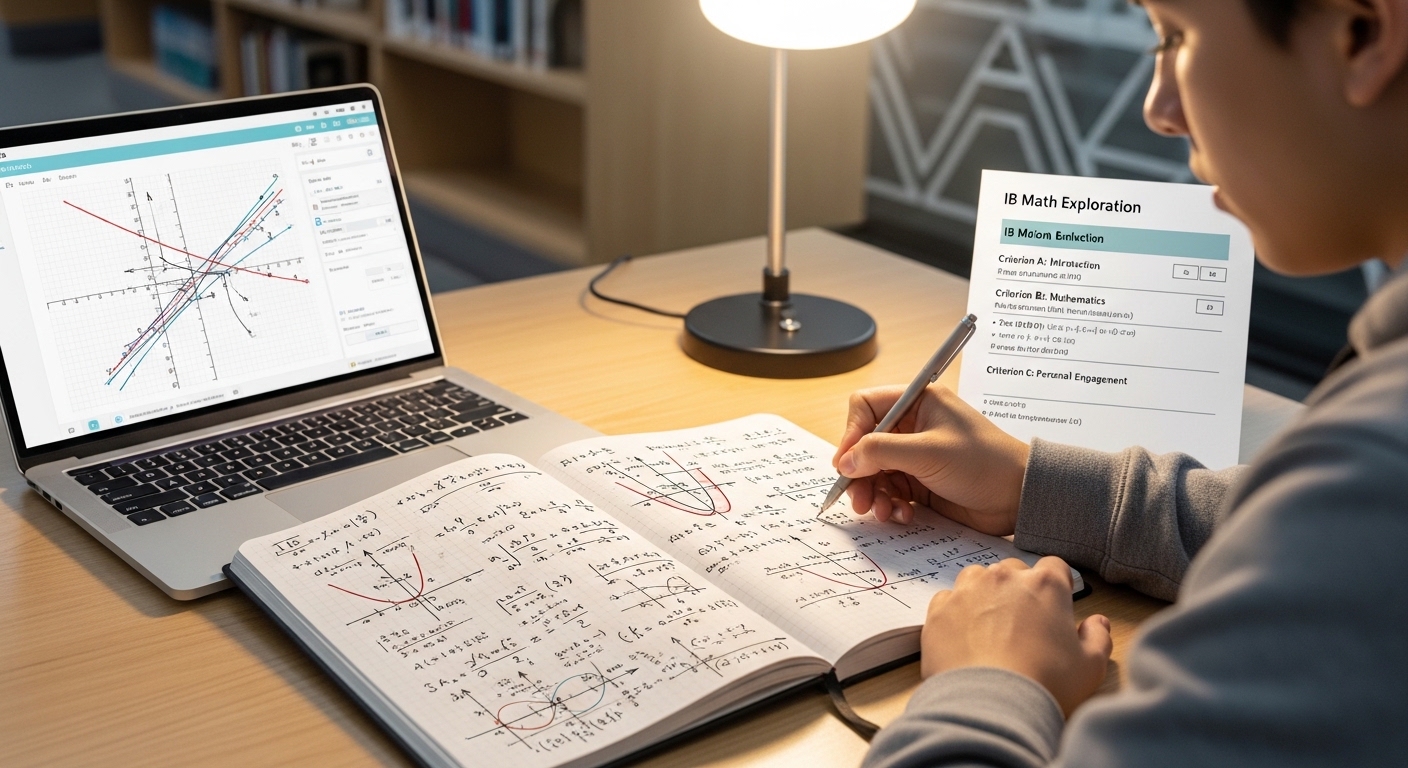
The IA is an individual mathematical exploration.
You choose a topic.
You investigate it using mathematics from your course.
You write a structured report explaining your process and findings.
It is not just a math paper.
It is a communication task.
IB Math IA Rubric Breakdown (What Examiners Look For)
The IA is marked out of 20 using five criteria.
Understanding these criteria is the key to scoring well.
1. Presentation (4 marks)
This is about structure and clarity.
Examiners look for:
- Logical organization
- Clear headings
- Proper labeling of graphs and tables
- Neat mathematical notation
If your work looks messy, you lose easy marks.
Think of your IA as a mini research paper.
2. Mathematical Communication (4 marks)
This is about how clearly you explain your math.
You must:
- Define variables
- Show steps clearly
- Use correct notation
- Explain what each result means
Many students calculate correctly but fail to explain.
Explanation earns marks.
3. Personal Engagement (3 marks)
This shows your involvement.
You can demonstrate this by:
- Choosing a topic connected to your interests
- Collecting your own data
- Making independent decisions
- Trying different approaches
It doesn’t mean writing emotional stories. It means showing ownership.
4. Reflection (3 marks)
This is one of the most misunderstood criteria.
Reflection includes:
- Discussing limitations of your model
- Evaluating accuracy
- Suggesting improvements
- Comparing methods
If your IA ends right after the final calculation, you’re missing marks.
5. Use of Mathematics (6 marks)
This is the most heavily weighted section.
Examiners ask:
- Is the math appropriate for the course level?
- Is it accurate?
- Is it sufficiently deep?
AI students often score well using statistics and modeling.
AA students often score well using calculus or algebraic reasoning.
The key is depth, not complexity.
Example IA Structure (Simple and Effective)
Here’s a practical structure you can follow.
1. Introduction
- State your research question clearly
- Brief background context
- Why this topic matters
Example:
“To what extent can a quadratic model accurately predict the trajectory of a basketball shot?”
2. Mathematical Background
- Define formulas
- Explain theory
- Introduce key concepts
Keep it concise. Don’t copy textbooks.
3. Data Collection or Model Setup
- Show how you collected data
- Explain assumptions
- Present tables clearly
Transparency matters.
4. Mathematical Analysis
- Perform calculations
- Show regression models or derivations
- Use technology where appropriate
- Interpret results after each major step
This is the core of your IA.
5. Reflection and Evaluation
- Discuss accuracy
- Identify limitations
- Suggest improvements
- Compare alternative approaches
This is where high scorers stand out.
Common Mistakes Students Make
- Choosing a topic that is too broad
- Writing too much description and not enough math
- Forgetting reflection
- Using advanced math they don’t understand
- Ignoring formatting and structure
Strong IAs are clear, focused, and analytical.
How Long Should the IB Math IA Be?
There is no strict word count.
Most strong IAs are:
- 12–20 pages
- Focused, not padded
- Dense with mathematics
Quality matters more than length.
How to Score a 6 or 7 in Your IA
Here’s what high-scoring students do differently:
- They understand the rubric before starting.
- They choose manageable topics.
- They explain every step clearly.
- They include strong reflection.
- They refine their work multiple times.
The IA rewards clarity, structure, and depth.
Not genius-level math.
Need Structured IA Support?
If you’re unsure whether your IA is strong enough, or you want guidance aligned directly with the IB rubric, getting support early can prevent major mistakes.
Inside our IB Math membership, you’ll get:
- IA topic validation
- Step-by-step IA structure templates
- Guidance on meeting each rubric criterion
- Modeling and statistics support
- Proven strategies to aim for a 6 or 7
If you want clarity instead of guessing what examiners want, explore the full support system here:
https://mathzem.com/membership-pricing/
Your IA is 20% of your final grade. Treat it strategically.
Frequently Asked Questions About IB Math Internal Assessment
1. How important is the IB Math IA?
It counts for 20% of your final grade. A strong IA can significantly improve your overall score.
2. Can I use advanced mathematics beyond the syllabus?
You can, but only if you fully understand it. Using complex math without clear explanation can reduce marks.
3. Do AI and AA students have different IA expectations?
The rubric is the same. However, AI students often use statistics and modeling, while AA students may use calculus or algebra more deeply.
4. How original does my IA need to be?
It should show personal engagement and independent thinking. It doesn’t need to be groundbreaking, but it must not be copied.
5. Can my teacher help me with my IA?
Teachers can give general guidance and feedback but cannot edit or rewrite your work.