Introduction
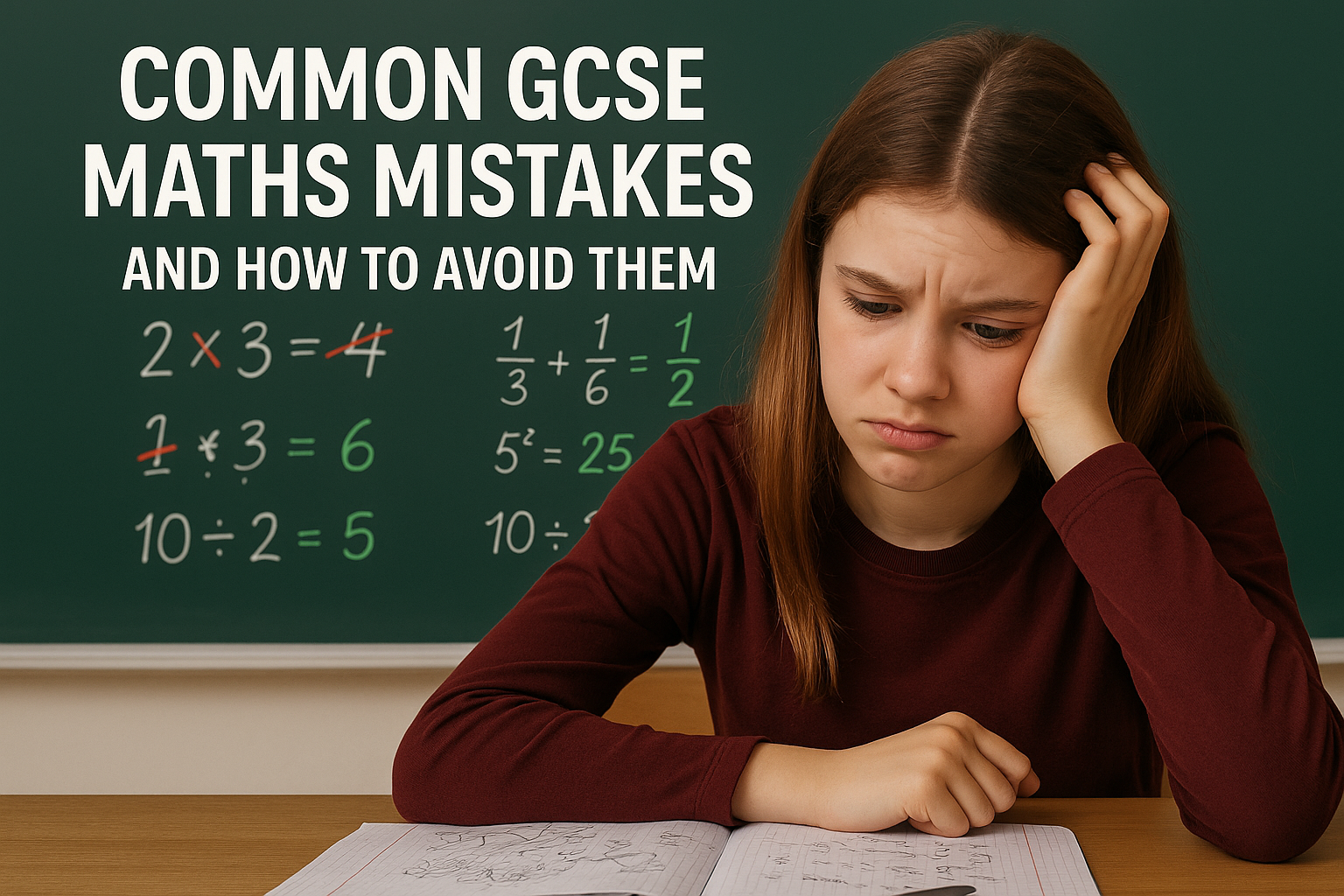
GCSE Maths can feel overwhelming, especially under exam pressure. Even students who know the content well lose marks because of avoidable errors. The good news? By recognising the most frequent GCSE maths mistakes and learning how to avoid them, you can save valuable marks and boost your grade.
This guide highlights the top mistakes students make in GCSE maths exams — and gives you practical strategies to avoid falling into the same traps.
Table of Contents
How to Avoid GCSE Maths Mistakes
Mistake 1: Not Showing Working
Many students go straight to the answer without writing down steps. This is risky because:
- You lose out on method marks if the final answer is wrong.
- Examiners can’t see your reasoning.
How to avoid it:
- Write each step clearly.
- Use proper mathematical notation.
- Even if you’re unsure, attempt the problem and show your approach.
Mistake 2: Misreading the Question
Under exam pressure, it’s easy to miss keywords like “estimate,” “show your working,” or “give your answer to 2 decimal places.”
How to avoid it:
- Highlight or underline key instructions.
- Double-check units (cm vs m, grams vs kg).
- Pause for a second before answering to confirm what’s being asked.
Mistake 3: Relying Too Much on the Calculator
Calculators are helpful, but over-reliance often leads to errors such as:
- Entering numbers incorrectly.
- Using the wrong function.
- Missing opportunities for mental checks.
How to avoid it:
- Estimate before using a calculator — if the answer looks unreasonable, recheck.
- Practise non-calculator questions to strengthen mental maths.
Mistake 4: Weak Algebra Skills
Algebra is one of the biggest stumbling blocks in GCSE maths. Common errors include:
- Forgetting to balance equations.
- Incorrectly expanding brackets.
- Mixing up negative signs.
How to avoid it:
- Practise small steps, e.g., expanding brackets before tackling full equations.
- Always check signs carefully.
- Use past paper questions to test your accuracy.
“GCSE Maths Revision Guide: How to Study Effectively.”
Mistake 5: Forgetting to Label Diagrams in Geometry
Geometry questions often require diagrams, but students lose marks by leaving them blank or unclear.
How to avoid it:
- Draw diagrams neatly.
- Label angles, sides, and points clearly.
- Use geometric notation (e.g., ∠ABC) for clarity.

Mistake 6: Rushing Through Easy Marks
Sometimes students rush through simpler questions, assuming they’re “too easy.” This often leads to careless mistakes.
How to avoid it:
- Slow down and check your arithmetic.
- Don’t skip working, even on simple problems.
- Treat every question as valuable — each mark matters.
Mistake 7: Struggling with Time Management
Many students don’t complete the paper because they spend too long on early questions.
How to avoid it:
- Keep track of time (e.g., one mark = one minute as a rough guide).
- Move on if stuck — return later if time allows.
- Practise timed past papers regularly.
Mistake 8: Ignoring Units and Rounding Instructions
Marks are often lost for giving answers in the wrong units or rounding incorrectly.
How to avoid it:
- Circle rounding instructions in the question.
- Always write units in your final answer.
- Double-check your answer matches what the question asked for.

Mistake 9: Leaving Questions Blank
Even if you don’t know the full solution, examiners may award marks for partial steps. Leaving a question blank guarantees zero marks.
How to avoid it:
- Attempt every question.
- Write down formulas, diagrams, or methods you know — they may earn marks.
Mistake 10: Not Reviewing Answers
Students often stop when they finish, leaving silly mistakes unchecked.
How to avoid it:
- If time allows, recheck calculations and rounding.
- Focus on areas where you know you’re prone to errors.
- Use spare minutes to revisit skipped questions.
Get Mathzem Free Resources to Avoid Mistakes
Don’t let simple mistakes hold you back. Access Mathzem’s free GCSE maths resources today and give yourself the best chance of exam success.
FAQs on GCSE Maths Mistakes
What are the most common GCSE maths mistakes?
The most common include misreading questions, not showing working, calculator errors, and rushing through easy marks.
How can I avoid silly mistakes in GCSE maths?
Slow down, highlight key words, and always double-check units and answers before moving on.
Do examiners give marks for working?
Yes. Method marks are awarded for clear steps, even if the final answer is wrong.
How important is time management in GCSE maths?
Very important. Poor time management can cost marks if you don’t attempt all questions.
Conclusion
Avoiding common GCSE maths mistakes can make the difference between missing out and achieving your target grade. By showing your working, reading carefully, managing time, and checking answers, you’ll save valuable marks and feel more confident in the exam.
Remember: every mark counts. Avoid the traps, practise smartly, and you’ll put yourself in the best position to succeed.