Introduction: How to score 7 in IB Maths AI
IB Maths Applications and Interpretation (AI) is becoming more popular each year, and for good reason. It mirrors the way mathematics is used in the real world: through data analysis, modelling, statistics, and technology.
But scoring a 7 in IB Maths AI SL or HL isn’t easy. It requires organisation, focused practice, and a deep understanding of mathematical interpretation.
At Mathzem, we help IB students reach top grades every exam season. After years of tutoring AI, we’ve learned exactly what makes the difference between a Level 6 and a Level 7 student.
This guide breaks down the strategies that consistently lead to the highest score.
Table of Contents
1. Understand How IB Maths AI Is Different From AA
AI focuses more on understanding and interpreting mathematical ideas rather than performing long symbolic calculations.
AI emphasises:
- Data analysis
- Probability and statistics
- Modelling real-life scenarios
- Using technology effectively
- Understanding trends and behaviours
Because the exam includes real-world contexts, the challenge isn’t always the maths, it’s interpreting the story behind the problem.
A Level 7 student knows why something happens mathematically, not just how to calculate it.
Learn More: How to score in IB Math AA
2. Become a Master of Your GDC (Calculator)
Your calculator is a major part of the course, especially at HL.
Level 7 students:
- Know graphing features perfectly
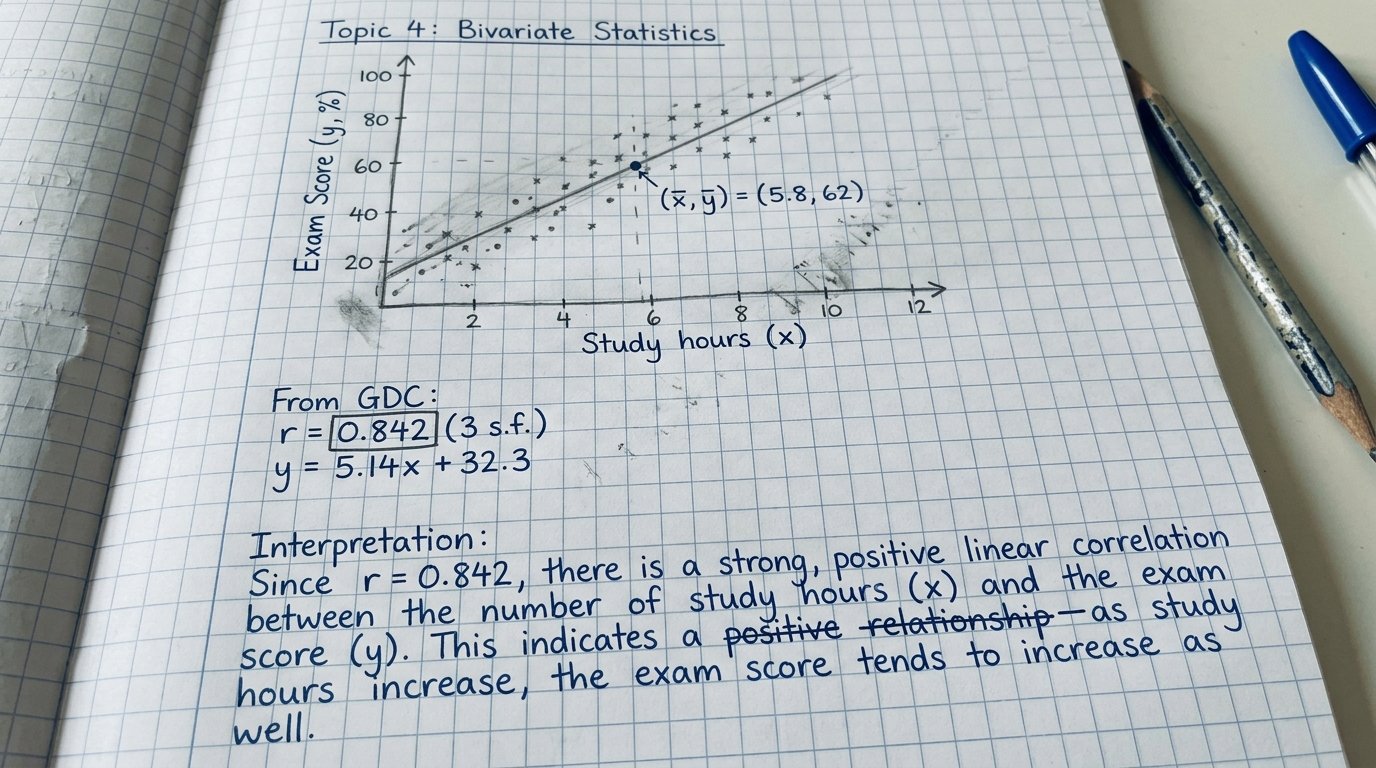
- Understand statistical tools (regression, distributions, residuals)
- Use list operations quickly
- Can model curves in seconds
- Find intersection points without hesitation
If your calculator skills are slow, you lose valuable marks.
If your calculator skills are strong, you gain marks effortlessly.
Practice using the GDC as if it’s part of your hand.

3. Build Strong Data Interpretation Skills
Most AI questions involve interpreting graphs, tables, trends, or mathematical models.
To score a 7, you must be able to:
- Explain why a model is appropriate
- Comment on reliability
- Interpret what a value means in real life
- Describe behaviour (increasing, decreasing, concave up/down)
- Justify your reasoning clearly
AI rewards students who think logically and communicate clearly.
4. Practice Modelling, the Heart of AI
Modelling questions appear in nearly every exam paper.
You must know how to:
- Choose an appropriate model (linear, exponential, polynomial, logistic, etc.)
- Use regression tools
- Explain why your model fits the situation
- Evaluate limitations
- Interpret parameters in context
Modelling alone can be the difference between a 6 and a 7.
5. Create a Structured Past Paper Schedule
AI has very predictable question styles, making practice your biggest asset.
Mathzem’s Recommended 12-Week Plan:
Weeks 1–4: Master individual topic questions
Weeks 5–8: Timed Paper 1 and Paper 2 sections
Weeks 9–12: Full exam simulations under real timing
HL students:
Also complete Paper 3 weekly during the final month.
By exam time, a Level 7 student will have done:
- 6–8 Paper 1s
- 6–8 Paper 2s
- 2–4 Paper 3s (HL)
Consistency wins.
6. Learn to Write Perfect Mathematical Explanations
AI is not just about numbers. The exam tests your ability to justify reasoning.
A Level 7 explanation should include:
- What the result means
- Why the model fits
- What the graph shows
- Why a method is chosen
- Evaluation of accuracy
- Link to real-world meaning
Clear communication is crucial.
7. Take the IA Seriously, It’s Worth 20%
A strong IA can secure your Level 7 even if the exam doesn’t go perfectly.
A strong AI IA includes:
- A real, meaningful context
- An appropriate model or statistical method
- Clear calculations using the GDC
- Interpretation that explains real-world meaning
- Justification for choices made
- A thoughtful conclusion
Mathzem tutors guide students through IA planning and structure to ensure clarity and professionalism.
See Mathzem’s membership options:
https://mathzem.com/membership-pricing/
8. Don’t Underestimate Paper 2 (Long Responses)
Paper 2 tests depth of understanding.
To score high, you must:
- Explain your reasoning step-by-step
- Interpret results correctly
- Justify every decision
- Avoid unnecessary steps
- Manage time effectively
Students who only practice Paper 1 often lose marks on Paper 2.
9. For HL: Train Properly for Paper 3
Paper 3 is one of the hardest assessments in IB maths because it involves:
- Complex modelling
- Multi-step reasoning
- Unfamiliar contexts
- Deep interpretation
To get a 7 in HL, you must train specifically for Paper 3 using past questions or similar style challenges.
Mathzem provides dedicated Paper 3 training sessions for HL students.
10. Get Expert Support When You Feel Stuck
Most students don’t struggle because they’re “bad at maths.”
They struggle because:
- They use the wrong methods
- They misunderstand question wording
- They cannot interpret the maths clearly
- They practise inconsistently
Working with experienced IB maths tutors significantly boosts confidence and results.
Explore Mathzem’s tutoring memberships for IB Maths AI:
https://mathzem.com/membership-pricing/
FAQs About Scoring a 7 in IB Maths AI
Q1: Is AI easier than AA?
Neither is easier, AI is applied, AA is theoretical.
Students who like context-based maths often perform better in AI.
Q2: How many hours per week should I study AI?
SL: 3–5 hours per week
HL: 5–8 hours per week
Q3: Do I need a tutor to score a 7?
Not required, but guidance helps especially with modelling, IA, and Paper 3 (HL).
Q4: Are calculator skills really that important?
Yes. GDC proficiency can save minutes and earn marks in nearly every question.
Q5: How much does the IA matter?
It’s 20% of your grade, a strong IA can lift you to a 7 even if your exam isn’t flawless.
Conclusion: A Level 7 in IB Maths AI Is Realistically Achievable
Scoring a 7 in IB Maths AI (Applications and Interpretation) requires:
- Strong interpretation skills
- Mastery of modelling
- Calculator efficiency
- Regular past paper practice
- Clear mathematical communication
- A strong IA
- A smart study plan
With consistent effort and the right support, any motivated student can reach the top grade.
If you want structured lessons and personalised guidance from experienced IB Maths AI tutors, Mathzem is here to help you reach your full potential.
Explore our membership plans:
https://mathzem.com/membership-pricing/